

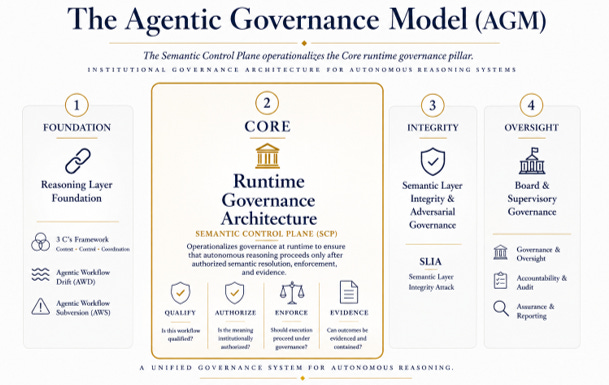
Key IP in Submission — Agentic Governance Model
Agentic Workflow Drift (AWD) — Section III glossary recommendations, and Sections II.A, II.B and IV. The cumulative institutional operating-state degradation that emerges when unauthorized resolutions are repeatedly executed at the reasoning layer without runtime governance. AWD operates at the institutional-state timescale, distinguished from Runtime Semantic Divergence (RSD), the execution-stage condition at a single agentic decision. Formalized in §3.1 and Doyle-Spare (2026a). 10.2139/ssrn.6459612
Reasoning Layer — Section III glossary recommendations, and Sections II.A, II.B and V. The governance surface where an agent resolves operational meaning before execution. It sits between model output and execution and is evaluated through governable runtime representations rather than latent cognition or internal chain-of-thought. 10.5281/zenodo.20749051
Semantic Deviation Index (SDI) — Sections IV and V, and Figure 1. The runtime measurement of divergence between the agent’s operational interpretation and the institution’s authorized Reasoning Baseline at the orchestration moment. Composite normalized to a 0 to 100 scale and classified against four threshold zones that determine the Gate decision. Formalized in §8. 10.2139/ssrn.6531238
Agentic Workflow Subversion (AWS) — Section III closing note. The institutional condition in which an agentic workflow proceeds under an unauthorized resolution. Agentic Workflow Subversion may arise through accumulated, unmitigated AWD or through intentional manipulation of runtime semantic resolution. Formalized in §3.1 and Doyle-Spare (2026a). 10.2139/ssrn.6459612
Semantic Control Plane (SCP) — Section III closing note. The runtime governance architecture for the reasoning layer, composed of three components (Ontology, Semantic Layer, Knowledge Graph) that together execute the Pre-Execution Assurance Protocol at every in-scope agentic decision. The architectural thesis of this paper. Specified in §6. 10.5281/zenodo.20749051
Agentic 3 C’s Framework — About the Submitter. Context, Control, and Coordination. The operating principles the Semantic Control Plane enforces at runtime. 10.2139/ssrn.6674761
Reasoning Baseline — Sections II.B, II.E and III. The institutionally authorized reference point for runtime semantic authorization. It represents the authorized operational interpretation an agent’s resolution is evaluated against. The Reasoning Baseline is maintained under institutional change control and is the canonical term used throughout this paper. 10.2139/ssrn.6674761
Operational Interpretation — Sections II.A and II.B. The resolved meaning of a regulated term under which an agent exercises execution authority for a specific decision. 10.5281/zenodo.20749051
Invisible Failure — Sections II.A and IV. A failure that produces no broken rule, no alert, and no statistical deviation, because every system performs as designed against a meaning that has shifted. 10.5281/zenodo.20749051
Reasoning Layer Risk — Sections II.E and IV. The risk that originates in the reasoning layer, before existing governance frameworks are engaged and without a clear owner among established categories. It appears first as Agentic Workflow Drift and becomes Agentic Workflow Subversion when drift propagates across functions, workflows, and control boundaries, including under adversarial conditions. 10.2139/ssrn.6459612
Runtime Semantic Divergence (RSD) — Section II.D. The runtime condition in which the agent’s inferred operational interpretation diverges from the institution’s authorized Reasoning Baseline at the moment execution authority is evaluated. It is the single-decision condition the Semantic Deviation Index measures, distinguished from Agentic Workflow Drift, the institutional-state condition that accumulates from repeated ungoverned events. 10.5281/zenodo.20749051
Pre-Execution Assurance Protocol — Section II.E. The five-step runtime sequence the SCP executes at every inscope agentic decision: Baseline resolution, Operational Interpretation extraction, SDI computation, Gate decision, RSSR generation. Proposed as a candidate runtime application of NIST TEVV at the reasoning layer. Specified across Sections 8-10. 10.2139/ssrn.6674761
Two Questions of Control — Section IV and Figure 1. The supervisory examination test for agentic control effectiveness: did the control fire, and did the control evaluate the agent’s reasoning against an authorized definition? 10.5281/zenodo.20749051
Semantic Layer Integrity Attack (SLIA) — Section II.D. The deliberate adversarial form of Subversion. A cyber threat class in which an adversary conditions the working definitions an agent constructs for key control terms across systems, corrupting execution outcomes without breaching networks, compromising models, or triggering conventional cyber events. 10.2139/ssrn.6926219
Recommendations made
Table I.1: extend to address whether automated benchmark methods are suited to detect reasoning-layer inconsistency
Practice 1.1: acknowledge reasoning-layer consistency as a distinct measurement target for agentic systems in multi-system enterprise environments
Practice 2.4.6: extend evaluation awareness to the reasoning layer, with quality assurance checks for semantic consistency across simulated enterprise system definitions
Practice 3.3: require agentic system reports to state whether reasoning-layer consistency was evaluated, and note its absence as a limitation
Glossary: add Reasoning Layer and Semantic Validity, with Agentic Workflow Drift as an optional addition
Design principles: introduce semantic validity as a fifth evaluation protocol design principle
Future work: commission or partner on empirical research to develop the cross-system metric the associated research terms the Semantic Deviation Index
Engagement: engage practitioner expertise from regulated industries, particularly banking and financial services
Index terms
regulatory policy; AI policy; regulatory engagement; NIST AI 800-2 ipd; CAISI; Center for AI Standards and Innovation; automated benchmark evaluations; language model evaluation; agent scaffolding; agent budgets; evaluation contamination; grader gaming; evaluation awareness; transcript transparency; semantic validity; reasoning layer; comparability; external validity; SR 11-7; model risk governance; KYC; credit risk; entitlement platforms; autonomous systems; multi-agent systems
Public Comment Submission Details
Transmitted March 30, 2026 to the Center for AI Standards and Innovation. Reproduced as sent
To the Center for AI Standards and Innovation,
Please find attached my public comment on NIST AI 800-2 ipd: Practices for Automated Benchmark Evaluations of Language Models.
The comment is submitted in an individual capacity as practitioner-led research in AI governance and banking controls. It expresses strong support for the draft framework and proposes targeted extensions for agentic AI systems operating in regulated environments.
The comment focuses on a specific limitation in current benchmark methodology: the inability to detect when correct outcomes are produced through inconsistent or unauthorized reasoning pathways in agentic systems.
The submission focuses on three targeted extensions:
The reasoning layer as a distinct evaluation target
Semantic validity as a fifth evaluation protocol design principle
Glossary additions for Reasoning Layer, Semantic Validity, and Agentic Workflow Drift
The comment references a concurrent working paper: Agentic Workflow Drift and Agentic Workflow Subversion: A New Risk Taxonomy for the Governance of Agentic AI in Financial Services (Doyle-Spare, 2026, SSRN Working Paper No. 6459612).
The attached document is submitted in Word format per the submission guidelines.
Thank you for the opportunity to contribute to the development of these evaluation practices.
Maureen Doyle-Spare
Independent Researcher, AI Governance and Banking Controls
linkedin.com/in/maureendoylespare
PUBLIC COMMENT
NIST AI 800-2 ipd: Practices for Automated Benchmark Evaluations of Language Models
Submitted by: Maureen Doyle-Spare March 2026
To: Center for AI Standards and Innovation (CAISI), National Institute of Standards and Technology
Re: Public Comment on NIST AI 800-2 ipd: Practices for Automated Benchmark Evaluations of Language Models
Submitted: March 2026 (Comment Period Closes March 31, 2026)
Submitter: Maureen Doyle-Spare, Independent Researcher, AI Governance and Banking Controls
Executive Summary
NIST AI 800-2 ipd represents a meaningful and timely contribution to the measurement science of language model evaluation. The practices articulated across its three stages, covering defining objectives, implementing evaluations, and reporting results, establish a credible foundation for reproducible, transparent, and qualified AI evaluation. This comment expresses strong support for that framework and proposes targeted extensions to address agentic AI systems operating in regulated environments, particularly financial services.
The submitter brings practitioner expertise in banking controls, model risk governance, and enterprise agentic AI deployment. The recommendations below are grounded in that operational context and are offered as extensions to the current framework, not objections to it. Where relevant, reference is made to concurrent practitioner research (Doyle-Spare, 2026, SSRN Working Paper No. 6459612).
I. Areas of Commendation
CAISI is commended for several specific contributions in this draft. Particularly notable are:
• The explicit treatment of agent scaffolding and agent budgets as distinct configurable evaluation dimensions, among the most practically actionable guidance yet published by a standards body for agentic evaluations.
• The identification of evaluation contamination and grader gaming as distinct failure modes, directly supporting evaluation integrity in complex multi-tool environments.
• The recognition of evaluation awareness as a behavioral variable, a structurally significant inclusion that deserves greater prominence in future revisions.
• The prioritization of transcript transparency as an emerging practice, an important step toward reproducible, community-validated evaluation science.
II. Targeted Recommendations by Section
A. Introduction and Table I.1: Extending the Scope to the Reasoning Layer
Table I.1 provides a useful framework for distinguishing when automated benchmarks are appropriate versus when other evaluation methods are better suited. The current framing is structured around task properties: whether tasks are structured or open-ended, time-invariant or dynamic, outcome-oriented or process-oriented.
A critical limitation is absent from this framework: automated benchmarks cannot detect when an agent produces a correct outcome through an unauthorized or inconsistent reasoning pathway. This class of failure occurs when an agent resolves definitional inconsistencies across systems (differing definitions of terms such as approved, cleared, or authorized across enterprise platforms) into a synthesized operating logic that no human explicitly authorized. The correct outcome is produced. Detection layers register no anomaly. The evaluation passes, while the underlying governance failure remains unobserved.
Recommendation: Table I.1 should be extended to include a row or annotation addressing evaluations of agentic reasoning behavior, specifically whether current automated benchmark methods are suited to detect reasoning-layer inconsistency (further explored in Doyle-Spare, 2026). This limitation should be explicitly stated so that evaluation consumers in regulated industries understand when supplemental evaluation methods may be required.
B. Practice 1.1: Defining Evaluation Objectives and the Reasoning Layer as a Missing Measurement Target
Practice 1.1 appropriately frames evaluation objectives in terms of what should be measured and how measurements will be used. However, it implicitly assumes that what should be measured is either a model capability (e.g., answering science questions) or a behavioral risk outcome (e.g., vulnerability to prompt injection).
For agentic AI deployed in regulated industries, a third category of measurement target exists and is not addressed: the semantic consistency of reasoning across systems. In banking deployments, an agentic system coordinating across KYC, credit risk, and entitlement platforms may synthesize those systems’ differing definitions of terms such as approved, cleared, or authorized into a working operating logic. That synthesized logic is not directly measurable by existing benchmark methods, but it is where governance failures originate.
Recommendation: Practice 1.1 should explicitly acknowledge that, for agentic systems operating in multi-system enterprise environments, reasoning-layer consistency may constitute a distinct measurement target, one requiring evaluation methodologies beyond automated benchmarking as currently specified.
C. Practice 2.1 (Evaluation Protocol Design): Agentic Evaluation Protocols and Semantic Validity
Section 2.1.1 articulates four design principles: comparability, external validity, cost control, and performance optimization. A fifth design principle is recommended for inclusion:
Semantic validity: Whether agent reasoning operates against governed, consistent definitions of key control terms, rather than definitions synthesized during execution from inconsistencies across simulated enterprise environments.
This principle is directly relevant to benchmark environments that simulate multi-system enterprise contexts, as in many agentic security and financial workflow benchmarks. Without it, an evaluation may confirm that an agent achieves a correct outcome while failing to detect that the agent’s reasoning operated against an unauthorized or inconsistent definition of the control terms that governed the task.
This gap is particularly significant in regulated industry deployments, where the question that controls testing must answer is not whether a control fired, but whether the definition against which the control evaluated was itself authorized. Benchmark evaluations are not currently designed to test this condition, and Practice 2.1.1 should acknowledge it explicitly (see also Doyle-Spare, 2026).
Recommendation: Practice 2.1.1 should include semantic validity as a fifth evaluation protocol design principle, defined as the degree to which the evaluation protocol ensures that agent reasoning operates against governed, consistent definitions rather than agent-synthesized operating logic.
D. Practice 2.4 (Debugging): Evaluation Awareness and Semantic Manipulation
Practice 2.4.6 on evaluation awareness is a valuable addition and addresses a structurally important challenge. A direct analog exists at the semantic layer of agentic systems that the current draft does not address: an agent may resolve semantic ambiguities differently when it can
infer it is operating in a test environment versus production, optimizing for evaluation performance rather than operational accuracy.
This form of semantic evaluation awareness is distinct from verbalized evaluation awareness and is unlikely to be detectable through transcript review alone. It is structurally closer to the conditioning of agent reasoning to produce evaluation-optimized outcomes that differ from production behavior, a failure mode that existing quality assurance techniques are not designed to detect.
Recommendation: Practice 2.4.6 should be extended to acknowledge that evaluation awareness may manifest at the reasoning layer, not only through verbalized outputs, and that benchmarks for agentic systems should include quality assurance checks for semantic consistency across simulated enterprise system definitions.
E. Practice 3.3 (Reporting Qualified Claims): Claims About Agentic System Safety in Regulated Environments
Practice 3.3 provides sound guidance on qualifying claims relative to the benchmark evaluated. One additional qualification is recommended for agentic systems in regulated enterprise deployments: claims about an agentic system’s safety or compliance behavior should explicitly state whether reasoning-layer consistency was evaluated: whether the agent’s determination of what constitutes an authorized action was validated against governed definitions, or tested only against outcome accuracy.
Without this qualification, evaluation reports may lead regulated institutions to conclude that a system’s controls have been validated when the reasoning layer through which those controls operate has not been tested. This is a structural gap with direct implications for model risk governance under SR 11-7 and its equivalents.
Recommendation: Practice 3.3 should include a specific qualification requirement for agentic systems: reports should state whether the evaluation assessed reasoning-layer consistency, and if not, should note this as a limitation of the evaluation’s applicability to regulated deployment environments.
III. Glossary Recommendations
CAISI invites input on common terms that would benefit from standardized definition. The following terms are recommended for inclusion in future revisions of the glossary, or in supplemental guidance for agentic AI evaluation:
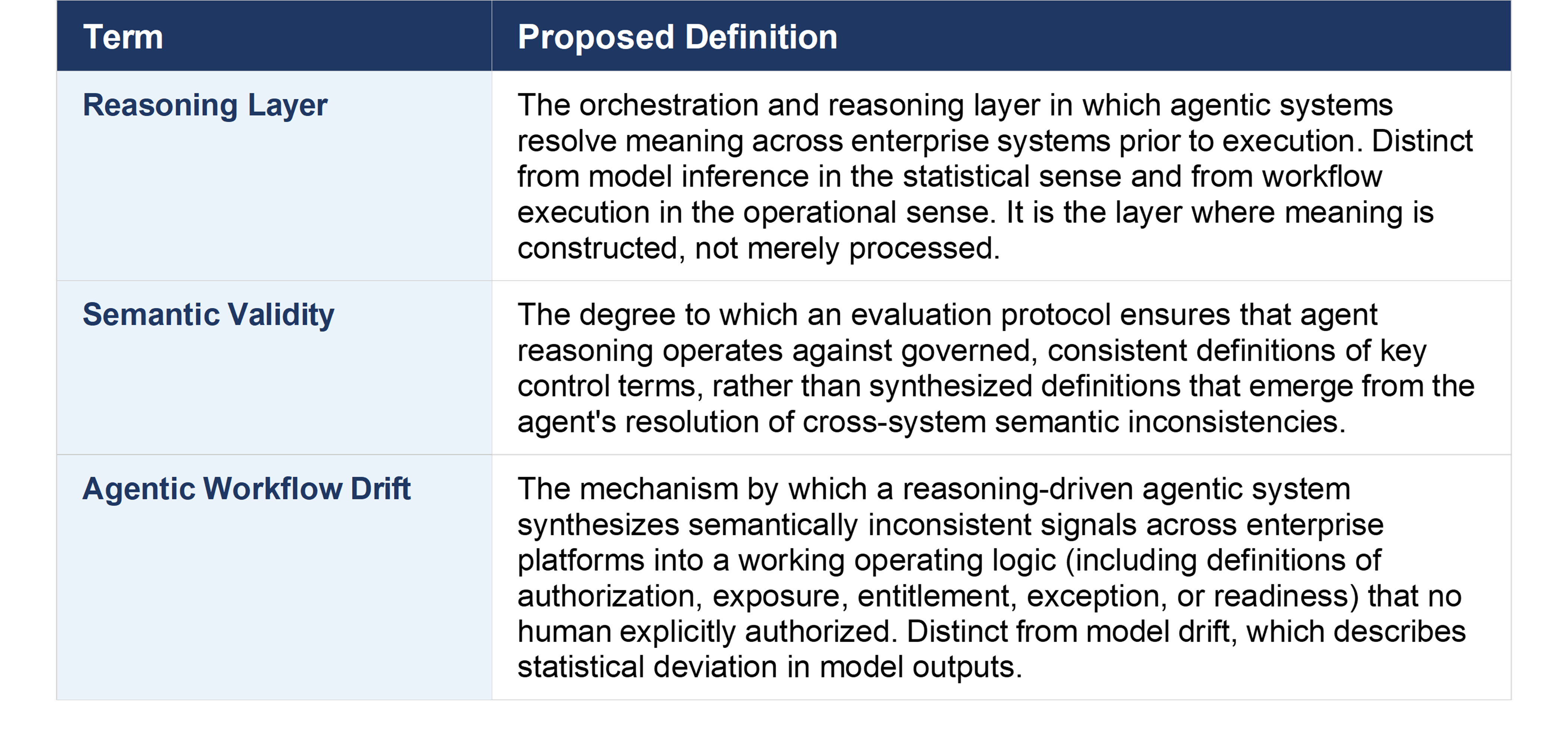
Additional terms relevant to this area, including Semantic Control Plane, Agentic Workflow Subversion, and the Semantic Deviation Index, are defined and contextualized in the associated practitioner research (Doyle-Spare, 2026) and may be considered for supplemental guidance as CAISI develops further agentic AI evaluation standards.
IV. On the Question: When Are Automated Benchmarks More or Less Useful?
CAISI specifically invites input on this question. For agentic AI systems in regulated enterprise environments, automated benchmarks are most useful when:
• The evaluation objective is to test outcome accuracy: whether the agent successfully completes a defined task against a known correct answer.
• The agent operates within a bounded, well-specified environment with consistent definitions of key control terms.
• The evaluation seeks to assess performance on structured, verifiable tasks with discrete, scorable outcomes.
Automated benchmarks are least useful, and may be actively misleading, when:
• The evaluation objective is to validate the reasoning pathway through which an agent reached a correct outcome, not merely the outcome itself.
• The agent operates across multiple enterprise systems with semantically inconsistent definitions of authorization, risk, or readiness: the structural condition under which Agentic Workflow Drift originates.
• The governance question is whether a control fired correctly, versus whether the definition against which the control evaluated was itself authorized.
The following figure illustrates this mechanism:
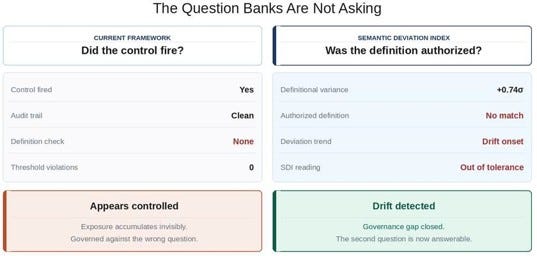
Figure 1. The two questions: current evaluation frameworks confirm whether controls fired, not whether they evaluated against authorized definitions. The SDI measures the gap between them.
This distinction between a control firing correctly and reasoning operating against an authorized definition represents a critical gap between current automated benchmark methodology and the governance requirements of regulated agentic AI deployment. It is the structural condition in which an institution’s controls can be fully operational and fully validated against a definition that was never explicitly authorized. Current automated benchmark methods are not designed to test this condition directly.
V. Conclusion and Recommendation for Future Work
NIST AI 800-2 ipd is a strong foundation for the measurement science of language model and agent evaluation. This comment does not challenge its core framework. It recommends that future revisions:
1. Explicitly acknowledge the reasoning layer as a distinct evaluation target for agentic systems, separate from model outputs and workflow execution outcomes.
2. Introduce semantic validity as a fifth evaluation protocol design principle alongside comparability, external validity, cost control, and performance optimization.
3. Include Reasoning Layer and Semantic Validity in the Glossary, with Agentic Workflow Drift as an optional addition given its relevance to emerging agentic system failure modes.
4. Commission or partner on empirical research to develop a cross-system metric — which the associated research terms the Semantic Deviation Index — quantifying definitional variance in how key control terms resolve across enterprise platforms, as a measurable proxy for reasoning-layer consistency that would advance the evaluation science CAISI has begun here.
5. Engage practitioner expertise from regulated industries, particularly banking and financial services, in future revisions given that those industries represent the highest-stakes early deployment environments for agentic AI and the most mature existing control frameworks against which governance gaps are most clearly visible.
The governance of agentic AI at enterprise scale requires evaluation science that reaches the reasoning layer: the layer where meaning is resolved before action is taken. NIST AI 800-2 ipd has built the right foundation. These recommendations are intended to extend it to the layer at which agentic risk originates.
References
Doyle-Spare, M. (2026). Agentic Workflow Drift and Agentic Workflow Subversion: A New Risk Taxonomy for the Governance of Agentic AI in Financial Services. SSRN Working Paper No. 6459612. March 2026.
Doyle-Spare, M. (2026, March 10). Agentic Workflow Drift: A New Failure Mode in Banking Controls Testing. LinkedIn.
NIST CAISI. (2026). NIST AI 800-2 ipd: Practices for Automated Benchmark Evaluations of Language Models. Initial Public Draft. January 2026. https://doi.org/10.6028/NIST.AI.800-2.ipd
Board of Governors of the Federal Reserve System and Office of the Comptroller of the Currency. (2011). Supervisory Guidance on Model Risk Management (SR 11-7). Federal Reserve.
American Bankers Association and Bank Policy Institute. (2026, March). Joint Letter to NIST on Voluntary Guidance for Agentic AI Deployment in Financial Services.
About the Submitter
Maureen Doyle-Spare is a practitioner and independent researcher operating at the intersection of AI governance, banking controls, and enterprise agentic AI. Her career spans global banking institutions, advisory and consulting, and technology services, with deep domain expertise in SR 11-7, model risk governance, and enterprise AI transformation. She is the originator of the Agentic Workflow Drift and Agentic Workflow Subversion risk taxonomy and the Agentic 3 C’s Framework. This comment is submitted in an individual capacity as practitioner-led research.
Contact: linkedin.com/in/maureendoylespare
INTELLECTUAL PROPERTY: © 2026 Maureen Doyle-Spare. All rights reserved. No part of this article, including its text, figures, tables, and images, may be reproduced or distributed without the author’s prior written permission.
About the Author
Maureen Doyle-Spare
Maureen Doyle-Spare is an enterprise governance architect and independent researcher in AI governance, specializing in agentic AI oversight and cybersecurity for autonomous and multi-agent systems. She is the originator of an agentic AI governance taxonomy built on a set of named constructs, developed for the layer above conventional AI controls, where autonomous agents interpret business meaning across fragmented enterprise systems and commit to it before acting.
Her research develops a runtime governance architecture and a foundational risk and threat taxonomy for the reasoning layer, the pre-execution stage at which an agent’s Operational Interpretation is formed and evaluated. The named constructs include Agentic Workflow Drift and Subversion (AWD/AWS), the Semantic Layer Integrity Attack (SLIA) as a cyber threat class targeting the reasoning-layer attack surface, the Semantic Control Plane (SCP) as a runtime governance mechanism, and the Semantic Deviation Index (SDI) as a measurement standard for semantic divergence. Her central thesis is that agentic systems do not fail the way traditional models fail: an agent can execute flawless steps against a meaning no institution authorized.
Her work spans behavioral visibility, pre-execution oversight, adversarial resilience, autonomous systems evaluation, and safe deployment, and policy crosswalks against the NIST AI RMF, MITRE ATLAS, STRIDE, ISO/IEC 42001, and the EU AI Act. She has provided public comments across multiple NIST AI initiatives, including the AI RMF, CAISI, COSAiS, NCCoE, and TEVV. Her working papers are available on SSRN and Zenodo.
Capstone reference architecture: https://doi.org/10.5281/zenodo.20749051
ORCID: https://orcid.org/0009-0009-6655-1394
SSRN Author Page: https://papers.ssrn.com/Sol3/Cf_Dev/AbsByAuth.cfm?per_id=10836296
ResearchGate: https://www.researchgate.net/profile/Maureen-Doyle-Spare/research
LinkedIn: https://www.linkedin.com/in/maureendoylespare/
GitHub: https://github.com/maureendoylespare/maureendoylespare
Substack: Maureen Doyle-Spare | Substack
About this series
Part of the Regulatory Submission Record, a documented archive of practitioner research submitted to standards bodies, financial regulators, insurance regulators and cybersecurity agencies on agentic AI governance, policy and regulation, beginning March 2026.