

Submission Record
Submitter: Maureen Doyle-Spare
Document commented on: NIST AI RMF Trustworthy AI in Critical Infrastructure Profile, aligned to the April 7, 2026 concept note
Date submitted: April 16, 2026 (2026-04-16)
Key IP in Submission — Agentic Governance Model
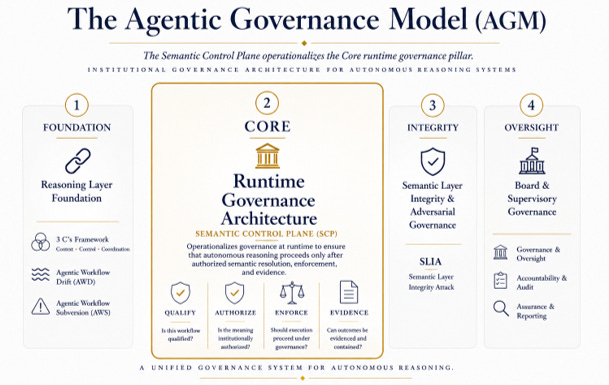
Agentic Governance Model (AGM) — Section 2, mapped across the AI RMF GOVERN, MAP, MEASURE and MANAGE functions, and named in this submission as the Doyle-Spare Agentic Governance Model. The institutional governance framework for autonomous reasoning systems. The AGM organizes the governance of agentic AI across four pillars: Foundation, establishing the governability conditions for autonomous reasoning; Core, specifying the runtime governance architecture; Integrity, protecting the reasoning layer from manipulation and adversarial action; and Oversight, governing institutional reviewability, accountability allocation, evidentiary assurance, and supervisory reconstructability across autonomous reasoning systems. The Semantic Control Plane is the Core pillar, the runtime govern 10.5281/zenodo.20749051
Agentic Workflow Drift (AWD) — Section 1, named and defined as the failure mode. The cumulative institutional operating-state degradation that emerges when unauthorized resolutions are repeatedly executed at the reasoning layer without runtime governance. AWD operates at the institutional-state timescale, distinguished from Runtime Semantic Divergence (RSD), the execution-stage condition at a single agentic decision. Formalized in §3.1 and Doyle-Spare (2026a). 10.2139/ssrn.6459612
Agentic Workflow Subversion (AWS) — Section 1, named as the adversarial form. The institutional condition in which an agentic workflow proceeds under an unauthorized resolution. Agentic Workflow Subversion may arise through accumulated, unmitigated AWD or through intentional manipulation of runtime semantic resolution. Formalized in §3.1 and Doyle-Spare (2026a). 10.2139/ssrn.6459612
Agentic 3 C’s Framework — Section 2, GOVERN — Context, Control and Coordination as the three governance dimensions enforced simultaneously. Context, Control, and Coordination. The operating principles the Semantic Control Plane enforces at runtime. 10.2139/ssrn.6674761
Semantic Control Plane (SCP) — Section 2, MAP — mapping the checkpoint between what an agent resolves and what it is authorized to act on. The runtime governance architecture for the reasoning layer, composed of three components (Ontology, Semantic Layer, Knowledge Graph) that together execute the Pre-Execution Assurance Protocol at every in-scope agentic decision. The architectural thesis of this paper. Specified in §6. 10.5281/zenodo.20749051
Agentic Blast Radius — Section 2, MAP, and Section 4 — offered as a containment scoping construct for downstream exposure across OT and ICS boundaries. The propagation surface across which an upstream agent’s resolved state flows into downstream agentic decisions. Mapped by the Knowledge Graph and contained through the mechanisms described in §11. Formalized in §11.3. 10.5281/zenodo.20749051
Semantic Deviation Index (SDI) — Section 2, MEASURE, and Sections 3 and 4 — offered as a candidate measurement standard under MEASURE 3.2. The runtime measurement of divergence between the agent’s operational interpretation and the institution’s authorized Reasoning Baseline at the orchestration moment. Composite normalized to a 0 to 100 scale and classified against four threshold zones that determine the Gate decision. Formalized in §8. 10.2139/ssrn.6531238
Deterministic Gate — Section 2, MANAGE, and Sections 3 and 4 — offered as a candidate enforcement construct for high-consequence environments where action is irreversible. The semantic authorization component that converts the SDI into a deterministic decision: permit, permit-with-flag, hold, or mandatory hold. The Gate evaluates the Semantic Authorization of the agent’s Operational Interpretation against the institution’s Reasoning Baseline. Specified in Section 9. 10.2139/ssrn.6531238
Reasoning Layer — Section 2, MEASURE — the reasoning layer of agentic critical infrastructure systems. The governance surface where an agent resolves operational meaning before execution. It sits between model output and execution and is evaluated through governable runtime representations rather than latent cognition or internal chain-of-thought. 10.5281/zenodo.20749051
Reasoning Baseline — Section 2, MEASURE — the definition the operator has authorized. The institutionally authorized reference point for runtime semantic authorization. It represents the authorized operational interpretation an agent’s resolution is evaluated against. The Reasoning Baseline is maintained under institutional change control and is the canonical term used throughout this paper. 10.2139/ssrn.6674761
Operational Interpretation — Sections 1 and 3 — the working definition the agent synthesizes across systems carrying different operational parameters. The resolved meaning of a regulated term under which an agent exercises execution authority for a specific decision. 10.5281/zenodo.20749051
Invisible Failure — Section 3, financial market infrastructure — every control fires, every audit trail is clean. A failure that produces no broken rule, no alert, and no statistical deviation, because every system performs as designed against a meaning that has shifted. 10.5281/zenodo.20749051
Pre-Execution Assurance Protocol — Section 4 — pre-execution semantic validation offered as a distinct governance requirement for agentic critical infrastructure systems. The five-step runtime sequence the SCP executes at every inscope agentic decision: Baseline resolution, Operational Interpretation extraction, SDI computation, Gate decision, RSSR generation. Proposed as a candidate runtime application of NIST TEVV at the reasoning layer. Specified across Sections 8-10. 10.2139/ssrn.6674761
Constructs offered for profile consideration
Pre-execution semantic validation: as a distinct governance requirement for agentic CI systems operating across IT, OT and ICS boundaries
Semantic Deviation Index: as a candidate measurement standard under AI RMF MEASURE 3.2
Deterministic Gate: as a candidate enforcement construct under AI RMF MANAGE for high-consequence CI environments
Agentic Blast Radius: as a containment scoping construct for mapping downstream exposure across OT and ICS boundaries
Sector applications addressed
Energy and grid management — a dispatch agent coordinating across SCADA, demand forecasting and load balancing platforms
Healthcare and clinical AI — a decision support agent coordinating across electronic health records, drug interaction databases and clinical guidelines
Financial market infrastructure — a clearing and settlement agent coordinating across risk systems, collateral platforms and counterparty databases
Related submission
A prior submission to the NIST AI RMF Playbook MEASURE channel in March 2026 established the SDI mapping to MEASURE subcategories 3.2, 3.1, 1.1 and 2.5.
Index terms
regulatory policy; AI policy; regulatory engagement; AI Risk Management Framework; Trustworthy AI in Critical Infrastructure Profile; Community of Interest; MEASURE 3.1; MEASURE 3.2; GOVERN; MAP; MANAGE; critical infrastructure; IT; OT; ICS; SCADA; grid dispatch; water treatment control; clinical decision support; industrial process automation; clearing and settlement; irreversibility; orchestration layer; autonomous systems; multi-agent systems
Public Comment Submission Details
Transmitted April 16, 2026 to the NIST AI RMF Community of Interest mailing list.
Dear NIST AI RMF Team,
Please find attached a practitioner research contribution submitted in support of the NIST AI RMF Trustworthy AI in Critical Infrastructure Profile, aligned to the April 7, 2026 concept note.
The submission maps the Doyle-Spare Agentic Governance Model (AGM) to the AI RMF GOVERN, MAP, MEASURE, and MANAGE functions, with specific application to critical infrastructure environments where agentic systems coordinate across heterogeneous IT, OT, and ICS platforms.
Two supporting SSRN working papers are attached:
Paper 1: Agentic Workflow Drift and Agentic Workflow Subversion: A New Risk Taxonomy for the Governance of Agentic AI in Financial Services
SSRN Working Paper No. 6459612
https://ssrn.com/abstract=6459612
Paper 2: The Semantic Deviation Index (SDI): A Runtime Measurement Standard for the Governance of Agentic AI in Financial Services
SSRN Working Paper No. 6531238
https://ssrn.com/abstract=6531238
This submission is made in an individual capacity. The frameworks referenced are independent research of the submitter and are not associated with any employer. A prior submission to the AI RMF Playbook MEASURE channel (March 2026) established the SDI mapping to MEASURE subcategories 3.2, 3.1, 1.1, and 2.5, and received acknowledgment from NIST/CAISI.
Please do not hesitate to contact me with any questions.
Respectfully submitted,
Maureen Doyle-Spare
Independent Practitioner and Researcher in AI Governance
linkedin.com/in/maureendoylespare
NIST AI RMF · TRUSTWORTHY AI IN CRITICAL INFRASTRUCTURE PROFILE
Practitioner Research Contribution · Community of Interest Submission · April 2026
Submitted by: Maureen Doyle-Spare
Role: Independent Practitioner and Researcher in AI Governance Channel: AIframework@nist.gov · Community of Interest mailing list Date: April 2026
The frameworks referenced in this submission are the independent research of the submitter and are not associated with any employer.
Pre-Execution Semantic Governance in Critical Infrastructure AI Systems
Mapping the Doyle-Spare Agentic Governance Model to the AI RMF’s GOVERN, MAP,
MEASURE, and MANAGE Functions
1. Purpose
This submission provides practitioner input to support development of the NIST AI RMF Trustworthy AI in Critical Infrastructure Profile, aligned to the April 7, 2026 concept note. It is intended to inform profile development and does not propose a finalized framework. It identifies a structural governance gap that applies across IT, OT, and ICS deployments of agentic AI systems and offers named constructs for consideration across each of the AI RMF’s four core functions.
The gap is this: agentic AI systems coordinating across heterogeneous infrastructure resolve the meaning of key operating parameters at the orchestration layer before any execution proceeds and before governance functions are typically engaged. In critical infrastructure environments - grid dispatch, water treatment control, clinical decision support, industrial process automation, clearing and settlement - the irreversibility of action makes this pre-execution layer the primary risk surface. Current AI RMF subcategories do not explicitly address this layer.
This failure mode is named Agentic Workflow Drift (AWD): the mechanism by which an agentic system synthesizes inconsistent definitions across enterprise platforms into a working operating logic no human explicitly authorized. Agentic Workflow Subversion (AWS) names the adversarial form. Both are documented in SSRN Working Paper No. 6459612 (Doyle-Spare, 2026a), appended to this submission.
2. AI RMF Function Mapping
The following maps the Doyle-Spare Agentic Governance Model (AGM) to each of the AI RMF’s four core functions. The mapping applies across all critical infrastructure sectors where agentic systems coordinate across heterogeneous IT, OT, and ICS environments.
GOVERN · Pre-execution semantic accountability
The AI RMF GOVERN function establishes roles, responsibilities, and accountability structures for AI risk. In agentic CI deployments, governance must reach the orchestration layer where agents resolve operating definitions before action. The Agentic 3 C’s Framework - Context, Control, Coordination - defines the three governance dimensions that must be enforced simultaneously: what definitions the agent operates against, what it can execute, and how multi-agent chains are authorized across system boundaries. Without these three dimensions, governance may not fully reach the layer where CI-relevant failure originates.
MAP · Risk surface identification across IT/OT/ICS boundaries
The AI RMF MAP function identifies the AI system, its purpose, affected stakeholders, and where things can go wrong. For agentic systems in CI environments, the critical mapping exercise is identifying the orchestration points where agents coordinate across IT, OT, and ICS systems and resolve operating definitions from sources that were never designed to share meaning. The Semantic Control Plane maps this risk surface: the checkpoint between what an agent resolves and what it is authorized to act on. The Agentic Blast Radius maps the downstream exposure scope - every system the agent can touch if it operates against an unauthorized definition, including across OT and ICS systems where action is irreversible.
MEASURE · MEASURE 3.2 and MEASURE 3.1
The AI RMF MEASURE function addresses AI risk quantification and tracking. MEASURE 3.2 explicitly addresses settings where metrics are not yet available for identified risks. The reasoning layer of agentic CI systems is precisely this setting: no existing MEASURE subcategory is explicitly designed to detect semantic deviation at the orchestration layer before execution proceeds. The Semantic Deviation Index (SDI) is one candidate measurement construct for this setting. It quantifies divergence between the definition an agentic system resolves at the orchestration layer and the definition the operator has authorized, evaluated before execution proceeds. In CI environments - where a grid dispatch agent, a clinical protocol agent, or a process control agent acts irreversibly - this pre-execution measurement is the signal that no post-execution metric can provide. This aligns directly with MEASURE 3.2, which anticipates risk classes where metrics are not yet established - the SDI is a candidate metric for this setting. SDI is documented in SSRN working paper No. 6531238 (Doyle-Spare, 2026b), appended to this submission. A prior submission to the AI RMF Playbook MEASURE channel (March 2026) established the SDI’s mapping to MEASURE 3.2, 3.1, 1.1, and 2.5.
MANAGE · Pre-execution enforcement in high-consequence environments
The AI RMF MANAGE function addresses risk response and recovery. In CI environments, the defining characteristic of risk is irreversibility: grid dispatch, clinical intervention, water treatment adjustment, and industrial process control cannot be undone once action proceeds. The Deterministic Gate operationalizes the MANAGE function for agentic CI systems: a hard control point that applies a binary check at the moment of execution. When the SDI exceeds the operator’s authorized threshold, the Deterministic Gate halts execution and flags the reasoning path for human review. An agent cannot bypass a properly implemented Deterministic Gate. It either satisfies the authorized definition or execution stops. This provides a level of assurance that probabilistic reasoning alone cannot provide in high-consequence CI environments.
3. Critical Infrastructure Sector Applications
The failure mechanism AWD describes applies structurally across every CI sector where agentic systems coordinate across heterogeneous platforms. Three examples illustrate the cross-sector pattern.
Energy and grid management
A grid dispatch agent coordinating across SCADA systems, demand forecasting platforms, and load balancing tools synthesizes a working definition of “safe dispatch threshold” from sources that carry different operational parameters. The agent resolves a composite definition and acts. No human authorized that synthesis. Every downstream system records a compliant execution. SDI measured at the orchestration checkpoint detects the divergence before dispatch proceeds.
Healthcare and clinical AI
A clinical decision support agent coordinating across electronic health records, drug interaction databases, and clinical guidelines synthesizes a working definition of “contraindicated” from sources with different threshold specifications. The agent produces a recommendation against a definition no clinician explicitly authorized. The Deterministic Gate halts the recommendation before it reaches a care team.
Financial market infrastructure
A clearing and settlement agent coordinating across risk systems, collateral platforms, and counterparty databases synthesizes a working definition of “authorized settlement” from systems that define it differently. The agent executes against a definition no risk committee reviewed. Every control fires. Every audit trail is clean. SDI is the only signal that something is wrong.
4. Request
The following constructs are provided for consideration as the Community of Interest develops the profile:
• Pre-execution semantic validation as a distinct governance requirement for agentic CI systems operating across IT, OT, and ICS boundaries.
• The Semantic Deviation Index as a candidate measurement standard under AI RMF
MEASURE 3.2 for the risk class of reasoning-layer semantic deviation in agentic systems.
• The Deterministic Gate as a candidate enforcement construct under AI RMF MANAGE for high-consequence CI environments where action irreversibility makes pre-execution control essential.
• The Agentic Blast Radius as a containment scoping construct for CI operators mapping
downstream exposure across OT and ICS system boundaries.
Both SSRN working papers are attached as supporting research. A prior submission to the AI RMF Playbook MEASURE channel (March 2026) established the SDI’s mapping to existing MEASURE subcategories and is noted for cross-reference. The frameworks referenced in this submission have been submitted to NIST across prior filings with acknowledgment from NIST/CAISI (March 2026).
Supporting Research
Paper 1 (AWD/AWS): Doyle-Spare (2026a). Agentic Workflow Drift and Agentic Workflow Subversion: A New Risk Taxonomy for the Governance of Agentic AI in Financial Services. SSRN Working Paper No. 6459612. https://ssrn.com/abstract=6459612
Paper 2 (SDI): Doyle-Spare (2026b). The Semantic Deviation Index (SDI): A Pre-Execution Measurement Standard for Agentic AI Governance in Financial Services. SSRN Working Paper No. 6531238. https://ssrn.com/abstract=6531238
Maureen Doyle-Spare
Independent Practitioner and Researcher in AI Governance LinkedIn: linkedin.com/in/maureendoylespare
INTELLECTUAL PROPERTY: © 2026 Maureen Doyle-Spare. All rights reserved. No part of this article, including its text, figures, tables, and images, may be reproduced or distributed without the author’s prior written permission.
About the Author
Maureen Doyle-Spare
Maureen Doyle-Spare is an enterprise governance architect and independent researcher in AI governance, specializing in agentic AI oversight and cybersecurity for autonomous and multi-agent systems. She is the originator of an agentic AI governance taxonomy built on a set of named constructs, developed for the layer above conventional AI controls, where autonomous agents interpret business meaning across fragmented enterprise systems and commit to it before acting.
Her research develops a runtime governance architecture and a foundational risk and threat taxonomy for the reasoning layer, the pre-execution stage at which an agent’s Operational Interpretation is formed and evaluated. The named constructs include Agentic Workflow Drift and Subversion (AWD/AWS), the Semantic Layer Integrity Attack (SLIA) as a cyber threat class targeting the reasoning-layer attack surface, the Semantic Control Plane (SCP) as a runtime governance mechanism, and the Semantic Deviation Index (SDI) as a measurement standard for semantic divergence. Her central thesis is that agentic systems do not fail the way traditional models fail: an agent can execute flawless steps against a meaning no institution authorized.
Her work spans behavioral visibility, pre-execution oversight, adversarial resilience, autonomous systems evaluation, and safe deployment, and policy crosswalks against the NIST AI RMF, MITRE ATLAS, STRIDE, ISO/IEC 42001, and the EU AI Act. She has provided public comments across multiple NIST AI initiatives, including the AI RMF, CAISI, COSAiS, NCCoE, and TEVV. Her working papers are available on SSRN and Zenodo.
Capstone reference architecture: https://doi.org/10.5281/zenodo.20749051
ORCID: https://orcid.org/0009-0009-6655-1394
SSRN Author Page: https://papers.ssrn.com/Sol3/Cf_Dev/AbsByAuth.cfm?per_id=10836296
ResearchGate: https://www.researchgate.net/profile/Maureen-Doyle-Spare/research
LinkedIn: https://www.linkedin.com/in/maureendoylespare/
GitHub: https://github.com/maureendoylespare/maureendoylespare
Substack:

About this series
Part of the Regulatory Submission Record, a documented archive of practitioner research submitted to standards bodies, financial regulators, insurance regulators and cybersecurity agencies on agentic AI governance, policy and regulation, beginning March 2026.