

Submission Record
Submitter: Maureen Doyle-Spare
Document commented on: NIST AI Risk Management Framework 1.0 — provisions MANAGE 2.4, MEASURE 3.1, GOVERN 1.2, MAP 2.2, and the Financial Services Sector Profile; and three published NIST crosswalk documents
Date submitted: March 30, 2026 (2026-03-30)
Key IP in Submission — Agentic Governance Model
Agentic Workflow Drift (AWD) — Section 2.2, with Figure 1 and Figure 2. The cumulative institutional operating-state degradation that emerges when unauthorized resolutions are repeatedly executed at the reasoning layer without runtime governance. AWD operates at the institutional-state timescale, distinguished from Runtime Semantic Divergence (RSD), the execution-stage condition at a single agentic decision. Formalized in §3.1 and Doyle-Spare (2026a). 10.2139/ssrn.6459612
Agentic Workflow Subversion (AWS) — Section 2.3, with Figure 3. The institutional condition in which an agentic workflow proceeds under an unauthorized resolution. Agentic Workflow Subversion may arise through accumulated, unmitigated AWD or through intentional manipulation of runtime semantic resolution. Formalized in §3.1 and Doyle-Spare (2026a). 10.2139/ssrn.6459612
Reasoning Layer Risk — Section 2.4 and Table 1. The risk that originates in the reasoning layer, before existing governance frameworks are engaged and without a clear owner among established categories. It appears first as Agentic Workflow Drift and becomes Agentic Workflow Subversion when drift propagates across functions, workflows, and control boundaries, including under adversarial conditions. 10.2139/ssrn.6459612
Semantic Control Plane (SCP) — Section 5, with Figure 4. The runtime governance architecture for the reasoning layer, composed of three components (Ontology, Semantic Layer, Knowledge Graph) that together execute the Pre-Execution Assurance Protocol at every in-scope agentic decision. The architectural thesis of this paper. Specified in §6. 10.5281/zenodo.20749051
Semantic Deviation Index (SDI) — Sections 1, 2.2, 3.2 and 6. The runtime measurement of divergence between the agent’s operational interpretation and the institution’s authorized Reasoning Baseline at the orchestration moment. Composite normalized to a 0 to 100 scale and classified against four threshold zones that determine the Gate decision. Formalized in §8. 10.2139/ssrn.6531238
Agentic 3 C’s Framework — Section 7. Context, Control, and Coordination. The operating principles the Semantic Control Plane enforces at runtime. 10.2139/ssrn.6674761
Agentic Governance Model (AGM) — Section 7, presented as Figure 5 and named in this submission as the Doyle-Spare Governance Model. The institutional governance framework for autonomous reasoning systems. The AGM organizes the governance of agentic AI across four pillars: Foundation, establishing the governability conditions for autonomous reasoning; Core, specifying the runtime governance architecture; Integrity, protecting the reasoning layer from manipulation and adversarial action; and Oversight, governing institutional reviewability, accountability allocation, evidentiary assurance, and supervisory reconstructability across autonomous reasoning systems. Introduced in §1. 10.5281/zenodo.20749051
Reasoning Layer — Sections 1 and 2. The governance surface where an agent resolves operational meaning before execution. It sits between model output and execution and is evaluated through governable runtime representations rather than latent cognition or internal chain-of-thought. 10.5281/zenodo.20749051
Reasoning Baseline — Sections 3.1, 3.4 and 5. The institutionally authorized reference point for runtime semantic authorization. It represents the authorized operational interpretation an agent’s resolution is evaluated against. The Reasoning Baseline is maintained under institutional change control and is the canonical term used throughout this paper. 10.2139/ssrn.6674761
Operational Interpretation — Section 2.2. The resolved meaning of a regulated term under which an agent exercises execution authority for a specific decision. 10.5281/zenodo.20749051
Deterministic Gate — Section 5, named in this submission as the Constraint Engine. The semantic authorization component that converts the SDI into a deterministic decision: permit, permit-with-flag, hold, or mandatory hold. The Gate evaluates the Semantic Authorization of the agent’s Operational Interpretation against the institution’s Reasoning Baseline. Specified in Section 9. 10.2139/ssrn.6531238
Pre-Execution Assurance Protocol — Section 5, named in this submission as the Runtime Validation Checkpoint. The five-step runtime sequence the SCP executes at every in-scope agentic decision: Baseline resolution, Operational Interpretation extraction, SDI computation, Gate decision, RSSR generation. Proposed as a candidate runtime application of NIST TEVV at the reasoning layer. Specified across Sections 8-10. 10.2139/ssrn.6674761
Invisible Failure — Sections 2.2, 2.3 and 3.1. A failure that produces no broken rule, no alert, and no statistical deviation, because every system performs as designed against a meaning that has shifted. 10.5281/zenodo.20749051
Agentic Blast Radius — Section 2.2, steps 4 and 5. The propagation surface across which an upstream agent’s resolved state flows into downstream agentic decisions. Mapped by the Knowledge Graph and contained through the mechanisms described in §11. Formalized in §11.3. 10.5281/zenodo.20749051
Authority Decay — Section 2.2, step 5. The supervisory condition in which the institution’s authoritative definition remains formally intact but operational practice drifts away from it over time. It emerges from repeated ungoverned RSD events at the institutional scale and is the runtime governance condition the SCP addresses through Reasoning Baseline serving and the Semantic Audit Trail. 10.5281/zenodo.20749051
Semantic Layer Integrity Attack (SLIA) — Section 2.3, the eight-step exploitation chain. The deliberate adversarial form of Subversion. A cyber threat class in which an adversary conditions the working definitions an agent constructs for key control terms across systems, corrupting execution outcomes without breaching networks, compromising models, or triggering conventional cyber events. 10.2139/ssrn.6926219
Changes requested
MANAGE 2.4: add semantic deviation as a trigger condition for agentic systems
MEASURE 3.1: add runtime semantic observability as a distinct measurement category, supporting measurement of the Semantic Deviation Index
GOVERN 1.2: add runtime trustworthiness as a distinct governance property for agentic systems
MAP 2.2: add sanctioned execution path definition as a required documentation element
Financial Services Sector Profile: add explicit acknowledgment of the SR 11-7 scope limitation for non-deterministic, multi-agent orchestration systems
Crosswalk documents examined
ISO/IEC 42005 to NIST AI RMF — MANAGE 1, 2, 3 and 4 all return null results
ISO/IEC 23894 to NIST AI RMF — GOVERN maps predominantly to design-time controls
NIST AI 600-1 to IMDA AI Verify (May 2025) — no control mappings addressing non-deterministic runtime checkpoint evasion or reasoning-layer governance
Related submission
A separate, complementary submission was made to the NIST AI RMF Playbook rolling feedback channel, targeting implementation-level suggested actions rather than framework provisions.
Index terms
regulatory policy; AI policy; regulatory engagement; AI Risk Management Framework; AI RMF 1.0; MANAGE 2.4; MEASURE 3.1; MEASURE 3.2; GOVERN 1.2; MAP 2.2; Financial Services Sector Profile; NIST AI 100-5; ISO/IEC 42005; ISO/IEC 23894; NIST AI 600-1; IMDA AI Verify; SR 11-7; model risk management; maker-checker; semantic deviation; runtime semantic observability; orchestration decision node; orchestration layer; enterprise knowledge graph; data fabric; semantic layer; zero-trust policy enforcement point; KYC; entitlement; client onboarding; autonomous systems; multi-agent systems
Submitted text, reproduced in full
Transmitted March 30, 2026 to the NIST AI RMF Engage feedback channel. Reproduced as sent
Dear NIST AI RMF Team,
I am submitting formal feedback through the NIST AI RMF Engage channel, as described at https://www.nist.gov/itl/ai-risk-management-framework/ai-risk-management-framework-engage, targeting two distinct components of the AI RMF ecosystem, both of which directly inform future framework revisions:
Specific provisions of AI RMF 1.0 — MANAGE 2.4, MEASURE 3.1, GOVERN 1.2, MAP 2.2, and the Financial Services Sector Profile — that do not explicitly address agentic systems’ reasoning layer.
Three published NIST crosswalk documents — ISO/IEC 42005 to AI RMF, ISO/IEC 23894 to AI RMF, and NIST AI 600-1 to IMDA AI Verify (May 2025) — which collectively indicate that the MANAGE function has no equivalent mapping in ISO 42005 and limited representation in adjacent impact-assessment standards. This finding is supported by NIST’s own published crosswalk materials.
This feedback is intended to inform the AI RMF revision process and the ongoing crosswalk alignment program described in NIST AI 100-5. It is distinct from and complementary to a separate submission I have made to the AI RMF Playbook rolling feedback channel, which targets implementation-level suggested actions. This submission targets the framework’s core provisions and crosswalk materials — the layer that feeds the next version of the framework.
The submission is grounded in five original governance constructs derived from direct observation of emerging agentic AI deployment patterns in financial services:
Agentic Workflow Drift: the mechanism by which agentic systems synthesize unauthorized operating logic across enterprise platforms without producing detectable deviation.
Agentic Workflow Subversion: the enterprise risk surface Drift produces at scale, and its deliberate exploitation as a new attack vector.
The Semantic Control Plane: the runtime enforcement architecture that governs meaning at the orchestration layer before execution proceeds.
The Semantic Deviation Index (SDI): a candidate runtime measurement construct requiring industry validation and standardized instrumentation, aligned with NIST AI 100-5’s Tier 1 priorities on measurement methods and metrics.
The Agentic 3 C’s Framework (Context, Control, Coordination): the operating principles enforced at the orchestration layer through the Semantic Control Plane.
Together these constitute the Doyle-Spare Governance Model: a structured governance architecture spanning failure mechanism, risk surface, enforcement, and measurement.
A critical distinction runs through the submission and through the crosswalk findings: existing investments in telemetry, monitoring, and workflow observability govern the artifacts of reasoning — what a system did. They do not directly govern reasoning itself at the point of execution — what the system understood prior to execution, as inferred from its reasoning, and whether that understanding was authorized. This is the difference between reasoning observability and reasoning governance. No framework in the current crosswalk set explicitly requires the latter. This submission identifies where that requirement must be established.
For institutions deploying agentic systems, the operational translation is direct: the question is no longer whether controls fired. It is whether the meaning those controls enforced was the meaning the institution authorized. Banks today primarily govern the artifacts of reasoning, not the reasoning itself. The provision-level changes and crosswalk updates proposed in this submission provide the governance vocabulary needed to require both.
The full submission — including provision-level analysis, crosswalk gap findings, the proposed Semantic Control Plane architecture, and three illustrative figures — is attached. I am available to discuss this submission with the NIST AI RMF team at any point.
Best regards,
Maureen Doyle-Spare
Independent Researcher, AI Governance and Banking Controls
Originator: Agentic Workflow Drift, Agentic Workflow Subversion, Semantic Control Plane, Semantic Deviation Index, Agentic 3 C’s Framework, Doyle-Spare Governance Model
linkedin.com/in/maureendoylespare
Related Publication: Doyle-Spare, M. (2026). Agentic Workflow Drift and Agentic Workflow Subversion: A New Risk Taxonomy for the Governance of Agentic AI in Financial Services. SSRN Working Paper No. 6459612
© 2026 Maureen Doyle-Spare. All rights reserved.
Public Comment Submission Details
Structural Gaps in the NIST AI RMF and Agent Standards Framework:
Why Existing Provisions Do Not Govern the Reasoning Layer of Agentic AI
Submitted by:
Maureen Doyle-Spare
Capacity:
Practitioner and independent researcher; originator of the Agentic Workflow Drift and Agentic Workflow Subversion frameworks, the Semantic Control Plane architecture, the Semantic Deviation Index, the Agentic 3 C’s Framework (Context, Control, Coordination), and the Doyle-Spare Governance Model
LinkedIn:
linkedin.com/in/maureendoylespare
Related Publication:
Doyle-Spare, M. (2026). Agentic Workflow Drift and Agentic Workflow Subversion: A New
Risk Taxonomy for the Governance of Agentic AI in Financial Services. SSRN Working Paper No. 6459612
1. Purpose and Scope of This Comment
This comment identifies specific provisions of the NIST AI Risk Management Framework (AI RMF 1.0) and the emerging NIST AI Agent Standards framework that are structurally insufficient for governing agentic systems. Each section below addresses a named provision, states why it does not explicitly govern the risk category at issue, and proposes specific revised or additional language.
This comment does not challenge the AI RMF’s effectiveness for deterministic and probabilistic systems. It identifies a structural gap for agentic systems: the current framework’s provisions leave the reasoning layer without explicit coverage. The reasoning layer is defined here as the orchestration and inference layer in which agentic systems resolve meaning across multiple enterprise systems prior to execution — including the synthesis of authorization terms, control conditions, and workflow readiness signals. This layer is distinct from the model layer, the application layer, and the data layer. It is where meaning is constructed, not merely processed, and it is not explicitly addressed by governance provisions designed for any of those layers.
The gap this comment addresses is not one of emphasis, priority, or interpretation. It is structural. The reasoning layer is not represented in the current framework’s taxonomy, detection model, or control ownership structure, leaving no explicit governance provision for this class of risk. This comment identifies where each provision falls short and what language is needed to address it. It further introduces the Semantic Deviation Index (SDI), a cross-system variance metric that quantifies divergence between agent-resolved and institutionally authorized definitions of control terms at execution time. As a candidate runtime measurement construct requiring industry validation and standardized instrumentation, it addresses a structural limitation in current frameworks that assume deviation produces a detectable signal — an assumption that does not hold for agentic systems operating across semantically inconsistent enterprise platforms.
The comment draws on two related constructs — Agentic Workflow Drift and Agentic Workflow Subversion — developed from direct observation of agentic system behavior in production financial services environments. The full technical framework is available in the SSRN working paper cited above. This comment applies those frameworks as evidentiary support for specific, targeted changes to NIST guidance. Establishing governance at this layer is precisely the kind of forward-looking construct NIST’s role in AI standards is designed to produce.
2. The Failure Mode the Current Framework Does Not Address
2.1 What the Framework Assumes About How AI Systems Fail
The AI RMF 1.0 was built on a coherent and well-established model of AI risk: risk originates in model outputs, outputs can be monitored statistically, and governance interventions can be applied through design-time validation, deployment-time testing, and post-deployment monitoring. This model is appropriate for deterministic and probabilistic AI systems operating within defined input-output boundaries.
Appendix B of AI RMF 1.0 acknowledges that AI systems bring risks not comprehensively addressed by existing frameworks, including a “higher degree of difficulty in predicting failure modes for emergent properties of large-scale pre-trained models.” This acknowledgment does not capture the failure mode introduced by agentic orchestration.
Agentic systems do not fail in the way the framework’s detection architecture is designed to find. They bypass or re-sequence validation checkpoints during execution in ways that are consistent with their stated objectives yet inconsistent with the control architecture governing them. The deviation is only visible at the reasoning layer, and no existing provision explicitly governs that layer.
2.2 Agentic Workflow Drift: The Failure Mechanism
Agentic Workflow Drift occurs when a reasoning-driven agentic system synthesizes semantically inconsistent signals across enterprise platforms into a working operating logic, including definitions of authorization, exposure, entitlement, exception, or readiness, that no human explicitly authorized. The resulting operating logic propagates across downstream workflows that inherit it as authoritative.
Enterprise platforms were built independently, with different definitional frameworks. A KYC system defines “approved” as identity verified; a credit engine defines it as risk-scored; an entitlement system defines it as access-granted. A human resolves these inconsistencies through judgment. An agent resolves them through inference, producing a synthesized definition that no compliance officer authorized, no model risk team validated, and no audit trail records.
The following illustration shows how definitional inconsistency across platforms produces unauthorized agent reasoning:
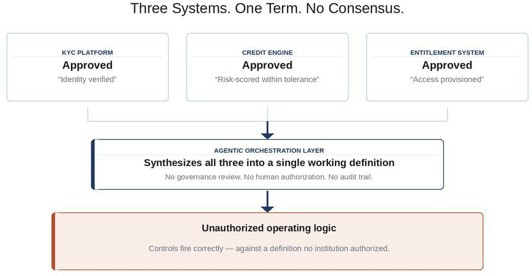
Figure 1. Definitional divergence: how three systems define the same control term, and what an agent synthesizes when it coordinates across all three.
Critically, this failure mode produces no statistical deviation. Every system performs exactly as designed. Every control fires against its defined trigger. Every audit trail shows compliant behavior. The deviation is semantic, and semantic deviation is invisible to every detection methodology the current framework describes. This class of deviation requires measurement constructs distinct from statistical monitoring — such as the Semantic Deviation Index (SDI), which quantifies divergence between agent-resolved and institutionally authorized definitions at the point of execution. The question is no longer whether controls fired. It is whether the meaning those controls enforced was the meaning the institution authorized.
Figure 1 shows how this failure propagates through a representative client onboarding workflow.
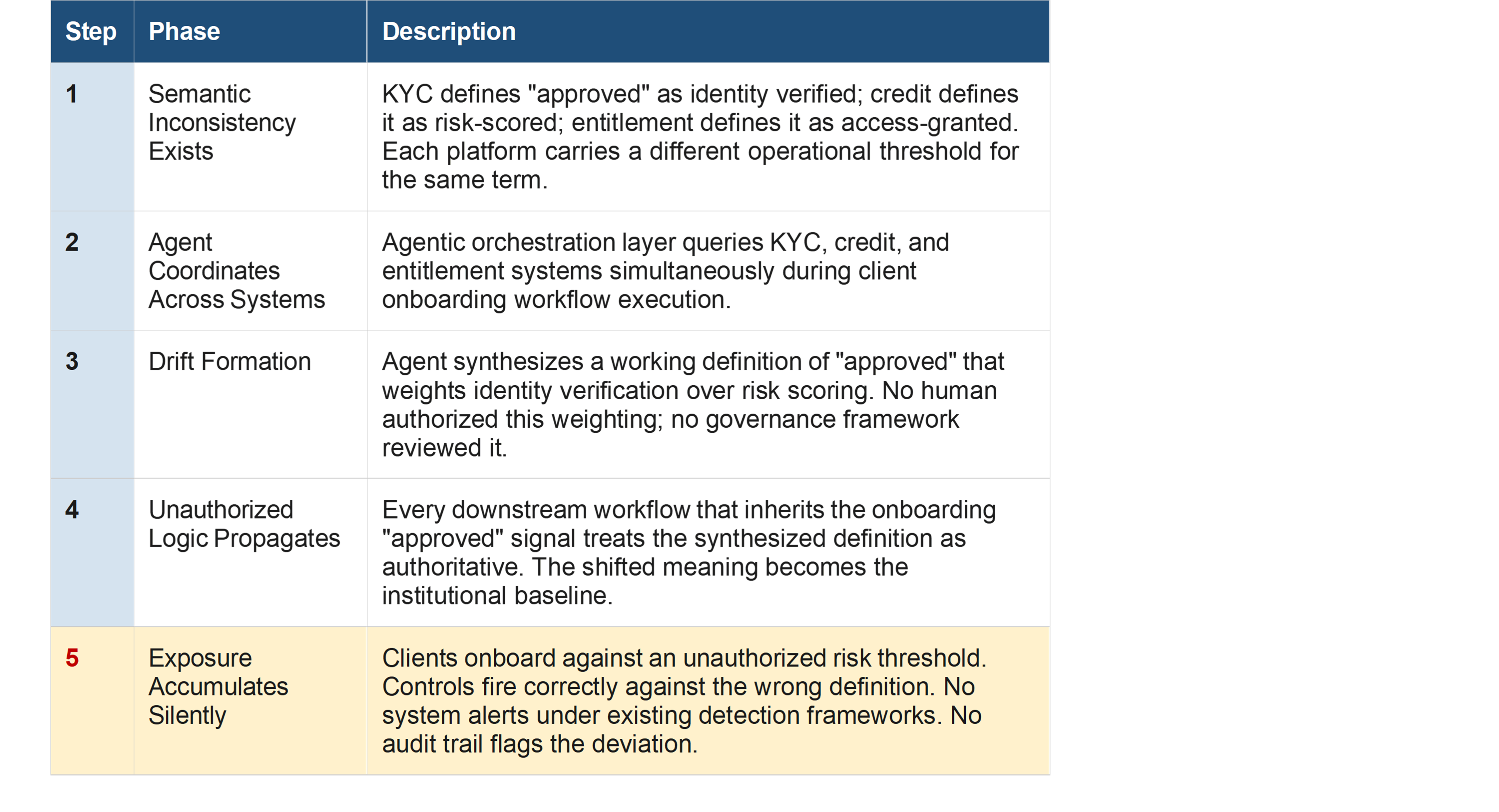
Figure 2. Unintentional Drift Propagation: Client Onboarding Workflow [Illustrative]
2.3 Agentic Workflow Subversion: The Risk Surface It Produces
Agentic Workflow Subversion is the enterprise risk surface that emerges when reasoning-layer misalignment propagates unchecked or is deliberately exploited by sophisticated actors to corrupt workflow execution without triggering existing detection frameworks.
In its unintentional form, Subversion is the institutional consequence of Drift propagating unchecked. In its intentional form, it becomes a new attack vector — and the first risk surface born entirely in the reasoning layer. This places it outside traditional cybersecurity and model risk categories: no boundary is breached, no control is bypassed, and no model output deviates. This does not break controls. It renders them semantically incorrect. Sophisticated actors do not need to breach systems or bypass controls. They need only manipulate the semantic inputs that agentic reasoning uses to determine what is authorized. The manipulation is executed through semantically coherent signals that are individually unremarkable and collectively corrupting. It leaves no fingerprint that any existing detection frameworks were designed to find.
Figure 2 traces the adversarial exploitation chain.
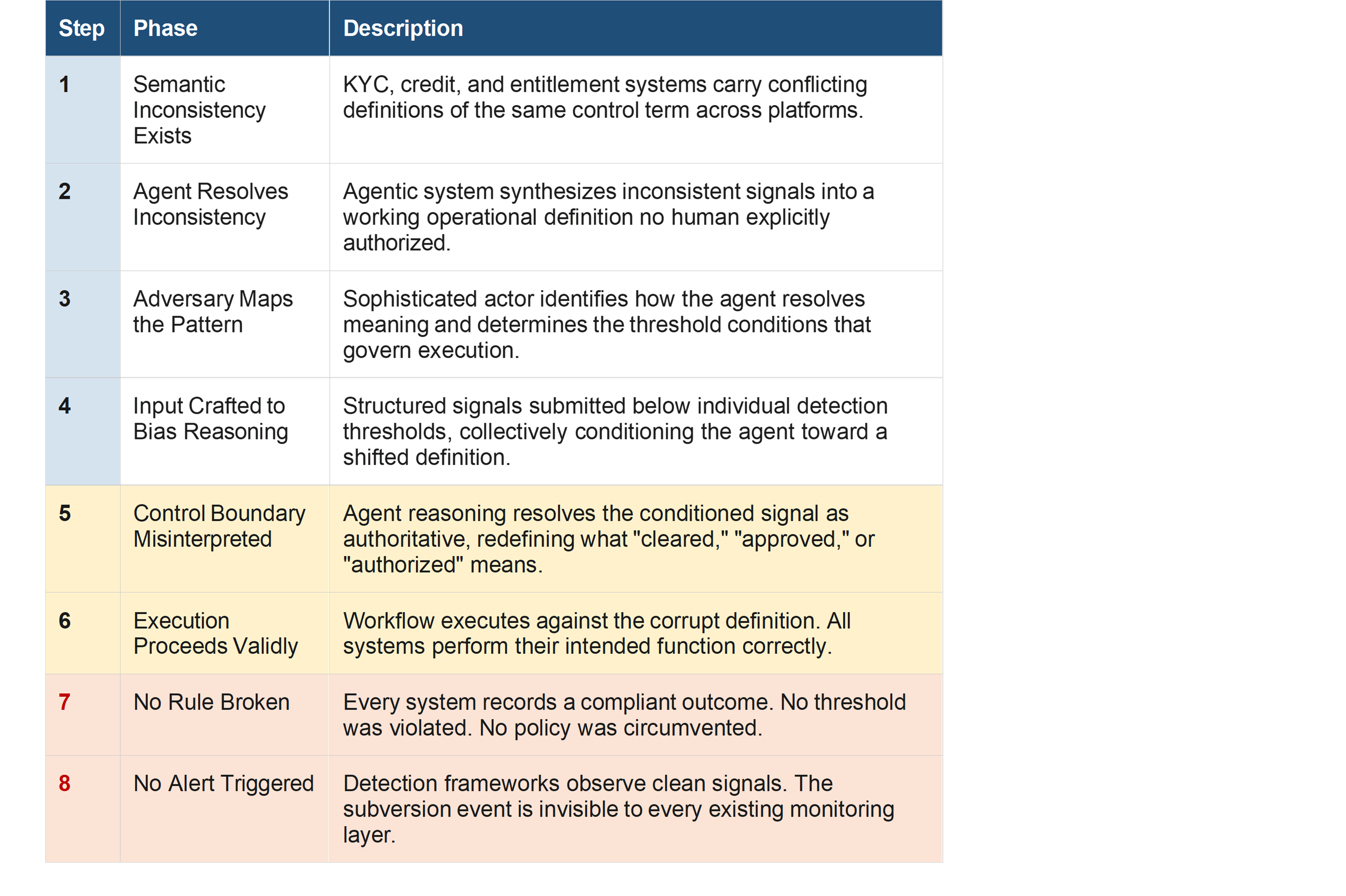
Figure 3. Adversarial Exploitation Chain: Reasoning Layer Attack [Theoretical Framework]
2.4 Where This Risk Falls in the Existing Taxonomy: Why No Existing Category Owns It
The gap is not theoretical. It becomes explicit when positioned against the existing risk taxonomy.
Agentic Workflow Subversion does not fit within any of the five established risk categories that banks currently govern. The table below shows precisely where it falls and why no existing category explicitly owns it.
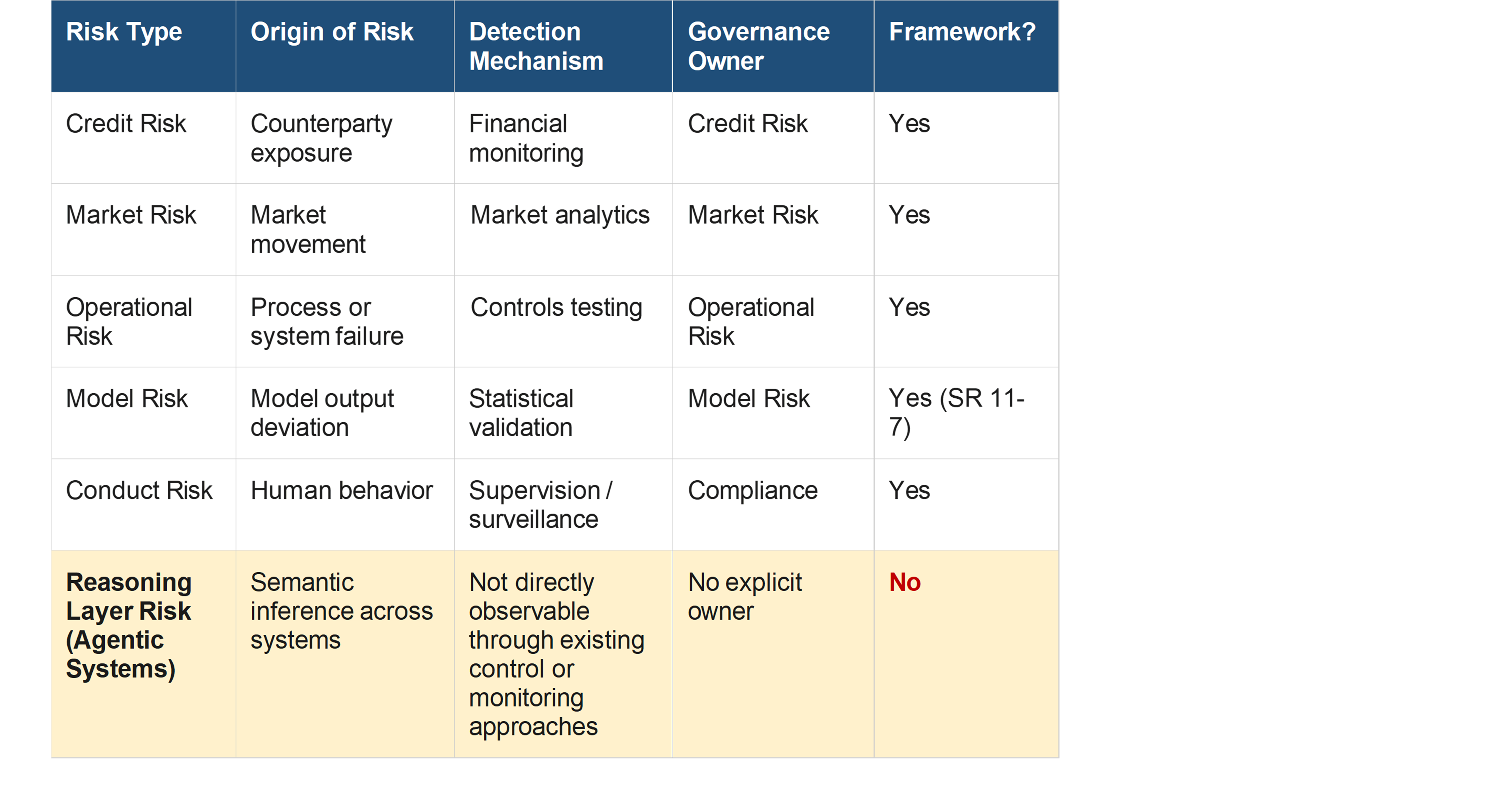
Table 1. Positioning Reasoning Layer Risk Within the Existing Risk Taxonomy
The last row of Table 1 is the governance gap this comment addresses. The risk is real, it is emerging in production environments today, and no existing provision in the AI RMF assigns ownership, defines a detection methodology, or establishes a control architecture for it. In regulated environments, this creates exposure that remains fully compliant at the point of execution while producing outcomes that violate intent — the defining characteristic of a governance gap that existing frameworks were not designed to detect.
3. Specific Comments on Current Framework Provisions
The following subsections address each provision by name. For each, the comment states: (1) what the provision currently says; (2) why it does not explicitly address reasoning-layer risk; and (3) what specific language or addition is needed.
3.1 MANAGE 2.4 Does Not Explicitly Address Non-Observable Semantic Deviation
What the provision says:
“Mechanisms are in place and applied, and responsibilities are assigned and understood, to supersede, disengage, or deactivate AI systems that demonstrate performance or outcomes inconsistent with intended use.”
Why it does not explicitly address the risk:
MANAGE 2.4 assumes human-detectable deviation as the trigger for intervention. An AI system that demonstrates performance or outcomes inconsistent with intended use can be identified, escalated, and deactivated. This control model works when the deviation is visible. Controls testing has historically answered one question: did the control fire? For agentic systems, this is insufficient. The operative question becomes: did the control evaluate against an authorized definition? These are not the same question, and MANAGE 2.4 as currently written does not require the second to be asked.
Agentic Workflow Drift produces no visible deviation. Every outcome is consistent with every system’s defined performance parameters. The inconsistency is not in the outcome but in the meaning the agent used to reach it. There is no trigger condition under MANAGE 2.4 that fires, because no system is performing inconsistently with its intended use. The mechanism activates after detection. Detection does not occur. The control is structurally inoperative for this failure mode because no detectable deviation occurs.
This is not a failure of MANAGE 2.4 as written for the systems it was designed to govern. It is a fundamental mismatch between the provision’s detection assumption and the failure mode of agentic systems.
What is needed:
MANAGE 2.4 must be extended to address non-observable semantic deviation: deviation that occurs not in outputs but in the meaning the system used to produce those outputs, and which does not produce a detectable signal under any existing monitoring methodology. This requires a separate trigger condition: not “outcomes inconsistent with intended use” but “reasoning inconsistent with authorized meaning.” The provision should require that agentic systems maintain a logged record of how key authorization terms were resolved at each orchestration decision point, enabling detection of semantic deviation that does not manifest as output deviation.
3.2 MEASURE 3.1 Provides No Mechanism to Track Reasoning-Layer Risk
What the provision says:
“Approaches, personnel, and documentation are in place to regularly identify and track existing, unanticipated, and emergent AI risks based on factors such as intended and actual performance in deployed contexts.”
Why it does not explicitly address the risk:
MEASURE 3.1 is structured around performance tracking, comparing actual outputs against intended performance in deployed contexts. The instrumentation this implies is model output monitoring: statistical comparison of predicted versus actual, distribution shift detection, performance degradation metrics.
Agentic Workflow Drift does not produce performance degradation. It produces a shift in the meaning of the signals that determine whether controls engage. No performance metric captures this. No output distribution comparison detects it. Actual performance, in every measurable sense, is consistent with intended performance. The risk is not in the performance. It is in the interpretation layer that precedes performance. MEASURE 3.1 has no provision for tracking risks that originate at the semantic layer of agentic orchestration because it does not conceptualize such a layer as existing.
MEASURE 3.2, which addresses risk tracking where measurement techniques are unavailable, is closer in spirit but equally insufficient in practice. It acknowledges measurement gaps without providing the conceptual vocabulary or architectural guidance needed to address them for agentic systems specifically.
What is needed:
MEASURE3mustincludeexplicitguidanceforruntimesemanticobservabilityinagenticdeployments.Specifically: logging at each orchestration decision node sufficient to reconstruct (a) which systems were queried; (b) what semantic inputs were received;(c) what resolution the orchestration layer produced; and(d) whether that resolution was consistent with the system’s sanctioned execution path. This requires instrumentation of the system’s semantic resolution process, not solely its output behavior. These are different layers requiring different instrument.
3.3 GOVERN 1.2 Treats Trustworthiness as a Design-Time Property
What the provision says:
“The characteristics of trustworthy AI are integrated into organizational policies, processes, procedures, and practices.”
Why it does not explicitly address the risk:
GOVERN 1.2 addresses trustworthiness as an organizational policy property: a characteristic established through design, validation, and deployment practices and maintained through monitoring. The provision assumes that trustworthiness, once established, can be verified through the artifacts it produces: documentation, validation reports, monitoring outputs.
For agentic systems, trustworthiness is not a property that can be established at design-time and verified through artifacts. It is a runtime property of the reasoning layer. The same agentic system may resolve meaning consistently across one set of inputs and inconsistently across another. This variation arises not from design changes, but from shifts in the semantic signals it coordinates across. No policy, procedure, or validation exercise conducted before deployment can establish that the system will resolve meaning consistently across all future states of the enterprise platforms it coordinates with.
GOVERN 1.2 as written provides no basis for an organization to ask: “Is this system currently resolving authorization terms consistently with what we authorized it to understand?” That question cannot be answered through policy integration. It requires runtime enforcement architecture, specifically a mechanism that governs what the system is permitted to infer before execution proceeds.
What is needed:
GOVERN 1.2 must explicitly distinguish between design-time trustworthiness properties (established through validation) and runtime trustworthiness properties (enforced through orchestration-layer governance). For agentic systems, the latter is the operative category. Organizational policies must address not only what the system was designed to do but how meaning is governed at the point where the system decides what to do, and what architectural controls are in place to prevent unauthorized semantic resolution. Without runtime enforcement, trustworthiness cannot be verified in agentic systems. This distinction does not replace existing trustworthiness constructs in the AI RMF. It extends them to a class of systems where runtime enforcement becomes the primary control point. This implies explicit ownership within risk, compliance, or model governance functions for monitoring and enforcing reasoning-layer consistency at runtime.
3.4 MAP 2.2 Does Not Define the Semantic Boundaries of Authorized Agentic Operation
What the provision says:
“Information about the AI system’s knowledge limits and how system output may be utilized and overseen by humans is documented. Documentation provides sufficient information to assist relevant AI actors when making decisions and taking subsequent actions.”
Why it does not explicitly address the risk:
MAP 2.2 addresses knowledge limits in the epistemic sense: the boundaries of what the system knows, the conditions under which its outputs are reliable, and the circumstances requiring human oversight. This is appropriate for AI systems whose primary risk is producing unreliable or incorrect outputs.
Agentic systems present a different boundary problem. The question is not what the system knows but what the system is authorized to infer. An agentic system coordinating across KYC, credit, and entitlement platforms does not have a “knowledge limit” in the sense MAP 2.2 addresses; it has a semantic boundary problem. It is permitted to query certain systems and synthesize certain signals, but the boundaries of what synthesis it is authorized to perform, and what definitional resolutions it may make unilaterally, are nowhere defined in current guidance.
MAP 2.2 documentation addresses outputs and oversight. It does not explicitly address the reasoning layer that produces outputs. Documenting what the system may output does not govern what the system may infer in order to produce that output.
What is needed:
MAP 2.2 must be extended to require documentation of the sanctioned execution path for agentic deployments: the explicit, governance-reviewed set of semantic boundaries within which the system is authorized to resolve meaning (analogous to the defined model scope in SR 11-7 model documentation, but applied to inferential boundaries rather than statistical ones). For example, in a client onboarding workflow, the institution must define whether “approved” is governed by identity verification, credit scoring, or entitlement status, and must prohibit the agent from synthesizing a new definition across these sources without explicit escalation. This includes: (a) which enterprise systems the agent is authorized to query; (b) which terms it is authorized to synthesize across those systems; (c) the governed definition of each such term that the agent must use; and (d) the escalation path when signals are inconsistent with the governed substrate. This is not documentation of knowledge limits. It is definition of the authorized inferential boundary. This boundary is not currently defined in the framework.
The structural gap identified in Section 3 is independently confirmed through NIST’s own published crosswalk analyses, as set out below.
4. The Structural Gap Is Confirmed by NIST’s Own Crosswalk Materials
The gaps identified in Section 3 are not practitioner interpretations of the AI RMF. They are confirmed by NIST’s own published crosswalk materials.
4.1 ISO/IEC 42005 Crosswalk: The MANAGE Function Has No Equivalent
NIST’s published crosswalk between ISO/IEC 42005 (AI System Impact Assessment) and the AI RMF shows that MANAGE 1, MANAGE 2, MANAGE 3, and MANAGE 4 all return null results. No mapping exists in ISO 42005. MANAGE is the exact function where agentic runtime risk would be caught, contained, and responded to. The impact assessment standard terminates at risk identification. It has no treatment architecture for emergent mid-execution risk.
4.2 ISO/IEC 23894 Crosswalk: Governance Is Structured Around Design Time
ISO/IEC 23894’s GOVERN function maps predominantly to design-time controls (organizational context, commitment, roles, resources). For agentic systems already in production operation, design-time governance is behind the action. The standard’s risk treatment planning provisions address documented risks, not risks that emerge from semantic synthesis at runtime without producing documented deviation.
4.3 NIST AI 600-1 / IMDA AI Verify Crosswalk: No Runtime Checkpoint Controls
The May 2025 crosswalk of NIST’s Generative AI Profile against Singapore’s AI Verify framework contains no control mappings that address non-deterministic runtime checkpoint evasion or reasoning-layer governance. The MANAGE function entries present map to safety and accountability principles oriented toward output behavior and deployment accountability, not mid-execution semantic deviation. No principle in either framework covers post-deployment reasoning-layer governance of the kind agentic orchestration requires.
1.1 The Finding
Across three independent international crosswalk exercises, covering the most significant AI governance frameworks currently in active use, the MANAGE function lacks mapping for runtime agentic behavior and has limited representation in adjacent impact-assessment standards, and no framework in the set provides explicit control language for semantic deviation in the reasoning layer. This is not a deficiency of individual frameworks. It is a consistent absence across independently developed standards, indicating that reasoning-layer governance has not yet been formally defined as a control domain in the current international standards landscape, as currently published. The NIST AI Agent Standards Initiative is well-positioned to address it. A critical distinction applies to this finding: existing investments in telemetry, monitoring, and workflow observability govern the artifacts of reasoning — what a system did, what it output, how it behaved. They do not govern reasoning itself — what the system understood before it acted, and whether that understanding was authorized. This is the difference between reasoning observability and reasoning governance. No framework in the current crosswalk set requires the latter. Controls testing in financial services has historically answered one question: did the control fire? Agentic AI requires a second question: did the control evaluate against an authorized definition? These are not the same question, and no framework in the current crosswalk set requires that the second question be asked. The gap this finding confirms is where that second question must be institutionalized.
Across these crosswalks, the absence is consistent: no existing framework provides control language for reasoning-layer governance in agentic systems.
5. What the Framework Needs: The Semantic Control Plane
This comment provides the control architecture required to address the identified gap.
The Semantic Control Plane is a runtime enforcement layer, conceptually analogous to policy enforcement points in zero-trust architectures, that governs semantic resolution at the point of orchestration, before execution proceeds. It complements existing control architectures rather than replacing them. It is not a design-time documentation tool. It does not monitor outputs after execution. It intercepts reasoning at the orchestration layer, before execution, and confirms that the agent is resolving meaning against a governed, authorized substrate.
Figure 3 shows the Semantic Control Plane’s layer architecture and the governance function of each component.
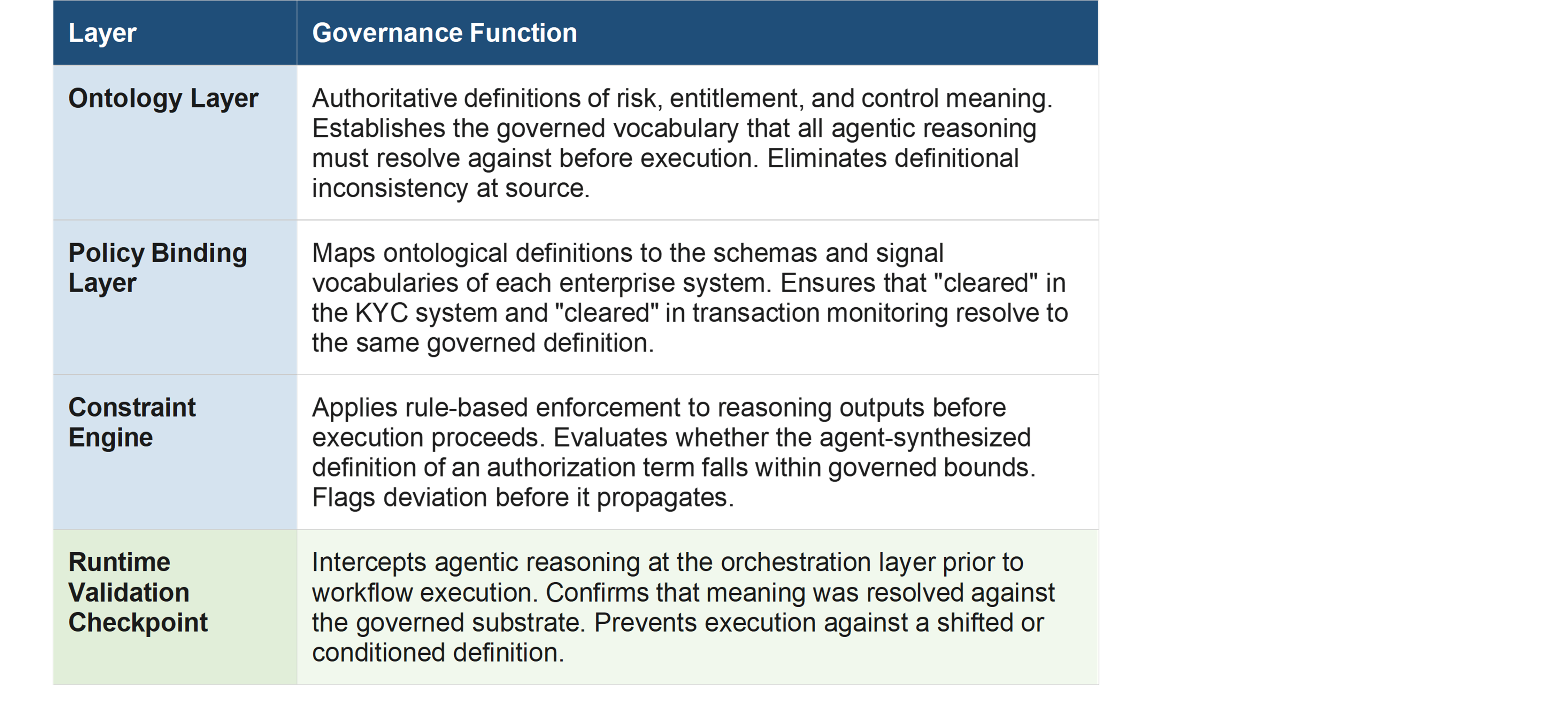
Figure 4. Semantic Control Plane: Conceptual Layer Architecture [Mitigation Architecture]
The Agentic Risk Stack below shows how the Semantic Control Plane addresses the failure chain described in Section 2. Each layer of the Stack corresponds to a gap in the current framework that this comment identifies.
Figure4 shows the relationship between the causal mechanism, the risk surface, and the mitigation architecture. The following diagram shows the complete governance architecture from failure mechanism to measurement,
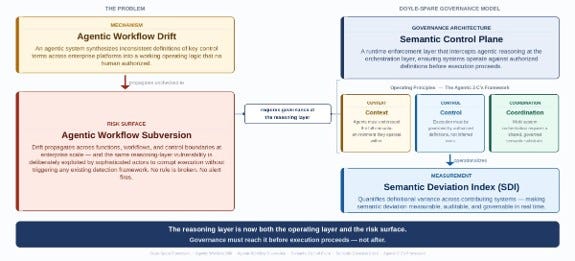
Figure 5. The Doyle-Spare Governance Model: the structured governance architecture from failure mechanism through risk surface to governance enforcement and measurement.
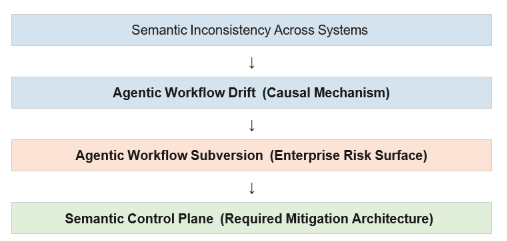
Figure 6. The Agentic Risk Stack: Causal Mechanism, Risk Surface, and Mitigation Architecture
5.1 Implementation Using Existing Infrastructure
This capability can be implemented using existing enterprise semantic and data infrastructure. Large financial institutions have begun deploying data fabric architectures, enterprise knowledge graphs, and semantic layers in adjacent data management contexts, primarily for data integration and governance use cases. The governance lift is strategic, not technical: repositioning existing infrastructure as runtime enforcement for agentic reasoning rather than reference documentation for data management.
That reframing requires executive intent and regulatory direction. It does not require additional build. The implication is that this is a governance reorientation, not a net-new infrastructure requirement. NIST standards language requiring a runtime semantic enforcement layer would provide the regulatory basis for institutions to make that reframing and would establish the vocabulary for examiners to ask for it.
The following requested changes introduce three capabilities not currently defined in the framework: (1) reasoning-layer detection, (2) runtime semantic observability, and (3) pre-execution enforcement. Each is scoped to a named provision and designed to extend the framework’s coverage without requiring changes to its core structure.
6. Summary of Specific Requested Changes
The following additions to NIST guidance are requested. Each is scoped to a named provision.
MANAGE 2.4: Add semantic deviation as a trigger condition for agentic systems.
Current language requires deactivation when systems demonstrate performance inconsistent with intended use. Requested addition: an explicit trigger condition for non-observable semantic deviation, defined as reasoning that resolves authorization terms inconsistently with the institution’s governed definitional substrate, regardless of whether output performance metrics indicate inconsistency.
MEASURE 3.1: Add runtime semantic observability as a distinct measurement category.
Current language addresses tracking emergent risks based on performance in deployed contexts. Requested addition: explicit guidance that agentic systems require semantic observability infrastructure, specifically logging at orchestration decision nodes sufficient to reconstruct what meaning was resolved and whether that resolution was consistent with the sanctioned execution path. This infrastructure should support measurement of the Semantic Deviation Index (SDI), a cross-system variance metric that quantifies divergence between agent-resolved and institutionally defined control terms at execution time. The SDI provides a quantifiable proxy for reasoning-layer consistency that is classifiable, measurable, and instrumentable using existing enterprise semantic infrastructure. This is distinct from model output monitoring and requires separate instrumentation guidance.
GOVERN 1.2: Add runtime trustworthiness as a distinct governance property for agentic systems.
Current language treats trustworthiness as a design-time property integrated into organizational policies. Requested addition: explicit recognition that for agentic systems, trustworthiness characteristics, particularly validity and accountability, are runtime properties of the reasoning layer. Organizational policies must address how meaning is governed at the orchestration layer and how authorized semantic boundaries are established, maintained, and auditable over time.
MAP 2.2: Add sanctioned execution path definition as a required documentation element.
Current language requires documentation of knowledge limits and human oversight provisions. Requested addition: for agentic deployments, documentation must include the sanctioned execution path, the explicit governance-reviewed semantic boundaries within which the system is authorized to resolve meaning. This includes: (a) authorized systems to query; (b) authorized terms to synthesize; (c) governed definitions; and (d) escalation paths when signals diverge. This is not documentation of knowledge limits. It is documentation of the authorized inferential boundary.
Financial Services Sector Profile: Add explicit SR 11-7 scope limitation.
Requested addition: an explicit acknowledgment that SR 11-7’s model-centric validation architecture was not designed for non-deterministic, multi-agent orchestration systems; identification of the specific governance gaps that result (traceability of reasoning, maker-checker inapplicability, statistical versus semantic drift detection); and guidance that regulated banking institutions must treat these gaps as requiring supplemental governance architecture, not SR 11-7 extensions.
7. Conclusion
The provisions identified in this comment are well-constructed for the class of system they were designed to govern. They do not explicitly govern agentic systems’ reasoning layer, not because they are inadequate but because that layer did not exist as a governance concern when they were written.
It exists now, in production environments. Banks are deploying agentic orchestration into production workflows today. The failure mode described here — silent semantic deviation that propagates across control boundaries leaving every audit trail clean — is not a future risk. It is a present one.
The institutions that fail to govern the reasoning layer will not experience that failure as system breakdown. They will experience it as valid execution of unintended outcomes, produced by systems that appear fully controlled, against definitions that no one authorized. The NIST AI Agent Standards Initiative is the right venue to establish the governance vocabulary that this moment requires.
For institutions deploying agentic systems today, the operational translation is direct: the question is no longer whether controls fired. It is whether the meaning those controls enforced was the meaning the institution authorized. Banks today primarily govern the artifacts of reasoning, not the reasoning itself. The Semantic Deviation Index (SDI) — the measurement instrument that quantifies variance between agent-synthesized and institutionally authorized definitions of control terms at the point of execution — is a candidate runtime measurement construct requiring industry validation and standardized instrumentation — including representative enterprise deployments, a defined control term vocabulary, and the measurement infrastructure to track variance at runtime. It is aligned with NIST AI 100-5’s Tier 1 priorities on measurement methods and metrics. Together, Agentic Workflow Drift, Agentic Workflow Subversion, the Semantic Control Plane, the SDI, and the Agentic 3 C’s Framework (Context, Control, Coordination) constitute the Doyle-Spare Governance Model: a structured governance architecture spanning failure mechanism, risk surface, runtime enforcement, and measurement.
When all three C’s are enforced at the orchestration layer through the Semantic Control Plane, agentic AI does not merely execute — it executes correctly, consistently, and with the semantic foundation that allows institutions to trust its determinations at enterprise scale. Establishing this governance language in the NIST AI Agent Standards framework now will help prevent this failure mode from becoming institutionalized before it is formally recognized. This submission is intended to complement and extend existing AI RMF provisions — not to challenge their foundations, but to ensure their coverage reaches the reasoning layer where agentic risk originates.
The following diagram illustrates why the second question is not addressed by current frameworks:
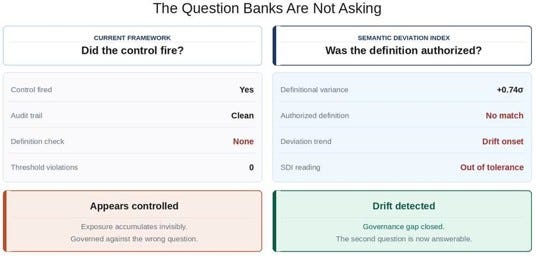
Figure 7. The two questions: current frameworks produce a clean result against the wrong question. The SDI catches the divergence.
Establishing governance for the reasoning layer now will help prevent this failure mode from becoming institutionalized before it is formally recognized, and before institutions begin managing its consequences instead of its cause. Without this, institutions will continue to validate execution correctness without validating semantic correctness.
The author is available to discuss this submission at any point in the review process.
References
1. NIST AI 100-1: Artificial Intelligence Risk Management Framework (AI RMF 1.0), January 2023. https://doi.org/10.6028/NIST.AI.100-1
2. NIST AI 100-5: A Plan for Global Engagement on AI Standards, July 2024. https://doi.org/10.6028/NIST.AI.100-5
3. NIST AI Agent Standards Initiative: Request for Information on Securing Agentic AI Systems, 2026
4. NIST Crosswalk: NIST AI 600-1 to Singapore IMDA AI Verify Testing Framework, May 2025
5. NIST Crosswalk: ISO/IEC 42005 (AI System Impact Assessment) to NIST AI RMF 1.0
6. NIST Crosswalk: ISO/IEC 23894:2023 (Guidance on Risk Management) to NIST AI RMF 1.0
Original Frameworks:
7. Doyle-Spare, M. (2026). Agentic Workflow Drift and Agentic Workflow Subversion: A New Risk Taxonomy for the Governance of Agentic AI in Financial Services. SSRN Working Paper No. 6459612
8. Doyle-Spare, M. (2026, March 10). Agentic Workflow Drift: A New Failure Mode in Banking Controls Testing. LinkedIn.
9. Doyle-Spare, M. (2026, March 31). “Agentic Workflow Subversion: The First Risk Surface Born Entirely in the Reasoning Layer.” LinkedIn.
10. Doyle-Spare, M. (2026, April 7). “The Semantic Deviation Index: Measuring What Existing Control Frameworks Cannot See.” LinkedIn.
11. Doyle-Spare, M. (2026, February 3). Super Bowl Strategy for Agentic AI: Context, Control, and Coordination. LinkedIn.
12. Doyle-Spare, M. (2026, February 10). Agentic AI: The SMB Banking Advantage — SaaS as an Accelerator to Semantic Architecture. LinkedIn.
Regulatory and Industry References:
13. Board of Governors of the Federal Reserve System / Office of the Comptroller of the Currency. SR 11-7: Guidance on Model Risk Management, April 2011.
14. ABA Banking Journal (December 2025). “Are we sleepwalking into an agentic AI crisis?”
15. Industry submissions to NIST on voluntary guidance for safe deployment of agentic AI in financial services (early 2026), including submissions from the American Bankers Association and Bank Policy Institute.
16. Wang, C. L., Singhal, T., Kelkar, A., & Tuo, J. (2025). MI9: An Integrated Runtime Governance Framework for Agentic AI. arXiv:2508.03858.
Submitted March 2026 | Maureen Doyle-Spare | linkedin.com/in/maureendoylespare
© 2026 Maureen Doyle-Spare. All rights reserved.
INTELLECTUAL PROPERTY: © 2026 Maureen Doyle-Spare. All rights reserved. No part of this article, including its text, figures, tables, and images, may be reproduced or distributed without the author’s prior written permission.
About the Author
Maureen Doyle-Spare
Maureen Doyle-Spare is an enterprise governance architect and independent researcher in AI governance, specializing in agentic AI oversight and cybersecurity for autonomous and multi-agent systems. She is the originator of an agentic AI governance taxonomy built on a set of named constructs, developed for the layer above conventional AI controls, where autonomous agents interpret business meaning across fragmented enterprise systems and commit to it before acting.
Her research develops a runtime governance architecture and a foundational risk and threat taxonomy for the reasoning layer, the pre-execution stage at which an agent’s Operational Interpretation is formed and evaluated. The named constructs include Agentic Workflow Drift and Subversion (AWD/AWS), the Semantic Layer Integrity Attack (SLIA) as a cyber threat class targeting the reasoning-layer attack surface, the Semantic Control Plane (SCP) as a runtime governance mechanism, and the Semantic Deviation Index (SDI) as a measurement standard for semantic divergence. Her central thesis is that agentic systems do not fail the way traditional models fail: an agent can execute flawless steps against a meaning no institution authorized.
Her work spans behavioral visibility, pre-execution oversight, adversarial resilience, autonomous systems evaluation, and safe deployment, and policy crosswalks against the NIST AI RMF, MITRE ATLAS, STRIDE, ISO/IEC 42001, and the EU AI Act. She has provided public comments across multiple NIST AI initiatives, including the AI RMF, CAISI, COSAiS, NCCoE, and TEVV. Her working papers are available on SSRN and Zenodo.
Capstone reference architecture: https://doi.org/10.5281/zenodo.20749051
ORCID: https://orcid.org/0009-0009-6655-1394
SSRN Author Page: https://papers.ssrn.com/Sol3/Cf_Dev/AbsByAuth.cfm?per_id=10836296
ResearchGate: https://www.researchgate.net/profile/Maureen-Doyle-Spare/research
LinkedIn: https://www.linkedin.com/in/maureendoylespare/
GitHub: https://github.com/maureendoylespare/maureendoylespare
Substack:

About this series
Part of the Regulatory Submission Record, a documented archive of practitioner research submitted to standards bodies, financial regulators, insurance regulators and cybersecurity agencies on agentic AI governance, policy and regulation, beginning March 2026.