

Submission Record
Submitter: Maureen Doyle-Spare
Document commented on: NIST AI Risk Management Framework — provisions MANAGE 2.4, MEASURE 3.1, GOVERN 1.2, MAP 2.2, and the Financial Services Sector Profile
Date submitted: March 30, 2026 (2026-03-30)
Key IP in Submission — Agentic Governance Model
Agentic Workflow Drift (AWD) — named as the mechanism producing unauthorized operating logic without a detectable deviation signal, and offered as the condition MANAGE 2.4 does not reach. The cumulative institutional operating-state degradation that emerges when unauthorized resolutions are repeatedly executed at the reasoning layer without runtime governance. AWD operates at the institutional-state timescale, distinguished from Runtime Semantic Divergence (RSD), the execution-stage condition at a single agentic decision. Formalized in §3.1 and Doyle-Spare (2026a). 10.2139/ssrn.6459612
Agentic Workflow Subversion (AWS) — named as the enterprise risk surface Drift produces at scale across control boundaries. The institutional condition in which an agentic workflow proceeds under an unauthorized resolution. Agentic Workflow Subversion may arise through accumulated, unmitigated AWD or through intentional manipulation of runtime semantic resolution. Formalized in §3.1 and Doyle-Spare (2026a). 10.2139/ssrn.6459612
Semantic Control Plane (SCP) — named as runtime enforcement at the orchestration layer, proposed as the control the framework provisions do not currently describe. The runtime governance architecture for the reasoning layer, composed of three components (Ontology, Semantic Layer, Knowledge Graph) that together execute the Pre-Execution Assurance Protocol at every in-scope agentic decision. The architectural thesis of this paper. Specified in §6. 10.5281/zenodo.20749051
Semantic Deviation Index (SDI) — proposed for MEASURE 3.1 as a runtime semantic observability category. The runtime measurement of divergence between the agent’s operational interpretation and the institution’s authorized Reasoning Baseline at the orchestration moment. Composite normalized to a 0 to 100 scale and classified against four threshold zones that determine the Gate decision. Formalized in §8. 10.2139/ssrn.6531238
Agentic 3 C’s Framework — named as Context, Control and Coordination. Context, Control, and Coordination. The operating principles the Semantic Control Plane enforces at runtime. 10.2139/ssrn.6674761
Reasoning Layer — argued as the layer left without explicit coverage in the framework. The governance surface where an agent resolves operational meaning before execution. It sits between model output and execution and is evaluated through governable runtime representations rather than latent cognition or internal chain-of-thought. 10.5281/zenodo.20749051
Reasoning Layer Risk — a risk arising at a governance surface no existing AI RMF function directly observes, confirmed against NIST’s own published crosswalk materials. The risk that originates in the reasoning layer, before existing governance frameworks are engaged and without a clear owner among established categories. It appears first as Agentic Workflow Drift and becomes Agentic Workflow Subversion when drift propagates across functions, workflows, and control boundaries, including under adversarial conditions. 10.2139/ssrn.6459612
Invisible Failure — MANAGE 2.4 assumes deviation is detectable and semantic deviation produces no detectable signal; MEASURE 3.1 tracks performance against intended use and the failure mode produces no performance degradation. A failure that produces no broken rule, no alert, and no statistical deviation, because every system performs as designed against a meaning that has shifted. 10.5281/zenodo.20749051
Operational Interpretation — the meaning an agentic system resolves at the orchestration layer, which the framework provisions do not evaluate before execution. The resolved meaning of a regulated term under which an agent exercises execution authority for a specific decision. 10.5281/zenodo.20749051
Two Questions of Control — the distinction the submission draws between a control operating as designed and a control evaluating against the definition the institution authorized. The supervisory examination test for agentic control effectiveness: did the control fire, and did the control evaluate the agent’s reasoning against an authorized definition? 10.5281/zenodo.20749051
Changes requested
MANAGE 2.4: add semantic deviation as a trigger condition for agentic systems
MEASURE 3.1: add runtime semantic observability as a distinct measurement category
GOVERN 1.2: add runtime trustworthiness as a distinct governance property
MAP 2.2: add sanctioned execution path definition as a required documentation element
Financial Services Sector Profile: add explicit acknowledgment of the SR 11-7 scope limitation
Crosswalk documents examined
ISO/IEC 42005 to NIST AI RMF
ISO/IEC 23894 to NIST AI RMF
NIST AI 600-1 to IMDA AI Verify (May 2025)
Related submission
A separate, complementary submission was made the same day to the NIST AI RMF Playbook rolling feedback channel, targeting implementation-level suggested actions rather than framework provisions.
Index terms
regulatory policy; AI policy; regulatory engagement; AI Risk Management Framework; AI RMF; MANAGE 2.4; MEASURE 3.1; GOVERN 1.2; MAP 2.2; Financial Services Sector Profile; SR 11-7; ISO/IEC 42005; ISO/IEC 23894; IMDA AI Verify; semantic deviation; runtime semantic observability; orchestration layer; autonomous systems; multi-agent systems
Submitted text, reproduced in full
Transmitted March 30, 2026 to the NIST AI RMF Engage feedback channel. Reproduced as sent
Dear AI RMF Playbook Team,
I am submitting practitioner feedback for the NIST AI RMF Playbook rolling review cycle, focused on governance gaps emerging in agentic AI systems deployed in financial services.
The attached submission proposes specific additions to four Playbook categories — MANAGE 2, MEASURE 3, GOVERN 1.2, and the Financial Services Sector Profile — to address a structural gap in the Playbook’s current coverage of agentic AI systems. The gap is evidenced through three of NIST’s currently published crosswalk documents (ISO/IEC 42005, ISO/IEC 23894, and NIST AI 600-1 to IMDA AI Verify), which collectively indicate that the MANAGE function has no equivalent mapping in ISO 42005 and limited representation in adjacent impact-assessment standards — precisely the functions where runtime risk in agentic systems would be caught and contained.
The submission is grounded in five original governance constructs derived from direct observation of emerging agentic AI deployment patterns in financial services, including multi-system orchestration across KYC, credit, and entitlement platforms:
Agentic Workflow Drift: the mechanism by which agentic systems synthesize unauthorized operating logic across enterprise platforms without producing detectable deviation.
Agentic Workflow Subversion: the enterprise risk surface that Drift produces at scale, and its deliberate exploitation as a new attack vector.
The Semantic Control Plane: the runtime enforcement architecture that governs meaning at the orchestration layer before execution proceeds.
The Semantic Deviation Index (SDI): the measurement instrument that quantifies variance between agent-synthesized and institutionally authorized definitions of control terms at the point of execution.
The Agentic 3 C’s Framework (Context, Control, Coordination): the operating principles enforced at the orchestration layer through the Semantic Control Plane.
Together these constitute the Doyle-Spare Governance Model: a structured governance architecture spanning failure mechanism, risk surface, enforcement, and measurement.
A critical distinction runs through the submission: existing investments in telemetry, monitoring, and workflow observability govern the artifacts of reasoning — what a system did. They do not directly govern reasoning itself at the point of execution — what the system understood before execution, as inferred through its reasoning, and whether that understanding was authorized. This is the difference between reasoning observability and reasoning governance. The Playbook currently supports the former. The submission proposes what is needed to enable and standardize the latter.
For risk officers and institutions deploying agentic systems, the operational translation is direct: the question is no longer whether controls fired. It is whether the meaning those controls enforced was the meaning the institution authorized. Controls testing in financial services has historically answered one question. Agentic AI introduces a second. This submission provides the Playbook additions needed to require both.
The SDI is a candidate runtime measurement construct requiring industry validation and standardized instrumentation — positioned for development aligned with NIST’s Tier 1 priorities on measurement methods and metrics.
This submission extends the Playbook’s applicability to agentic systems while remaining aligned with its structure, introducing governance coverage for the reasoning layer without requiring changes to the RMF core.
The full submission is attached, including three figures illustrating the definitional divergence mechanism, the governance architecture, and the two-question framing. I am available for follow-up discussion at any point in the semi-annual review cycle.
Best regards,
Maureen Doyle-Spare
Researcher, AI Governance
Originator: Agentic Workflow Drift, Agentic Workflow Subversion, Semantic Control Plane, Semantic Deviation Index, Agentic 3 C’s Framework, Doyle-Spare Governance Model
linkedin.com/in/maureendoylespare
Related Publication: Doyle-Spare, M. (2026). Agentic Workflow Drift and Agentic Workflow Subversion: A New Risk Taxonomy for the Governance of Agentic AI in Financial Services. SSRN Working Paper No. 6459612
SUBMISSION TO THE NIST AI RMF PLAYBOOK
Rolling Feedback Channel | AIframework@nist.gov
Agentic Workflow Drift and Agentic Workflow Subversion:
A Structural Gap in the NIST AI RMF Playbook and a Pre-Standardization Input for Financial Services
Submitted by: Maureen Doyle-Spare
Title: Independent Researcher, AI Governance and Banking Controls Organization: Independent Researcher, AI Governance and Banking Controls LinkedIn: linkedin.com/in/maureendoylespare
Capacity: Practitioner and independent researcher; originator of the Agentic Workflow Drift and Agentic Workflow Subversion frameworks, the Semantic Control Plane architecture, the Semantic Deviation Index, the Agentic 3 C’s Framework (Context, Control, Coordination), and the Doyle-Spare Governance Model
Related Publication: Doyle-Spare, M. (2026). Agentic Workflow Drift and Agentic Workflow Subversion: A New Risk Taxonomy for the Governance of Agentic AI in Financial Services. SSRN Working Paper No. 6459612
Executive Summary
This submission identifies a structural gap in the AI RMF Playbook that leaves agentic AI systems without explicit runtime governance at the reasoning layer — the orchestration and inference layer where agentic systems resolve meaning across enterprise platforms prior to execution. The gap is grounded in direct observation of agentic AI deployment in financial services and is supported by NIST’s own published crosswalk materials.
The AI RMF Playbook does not currently contain explicit control language for a class of risk that is emerging in production financial services environments. That risk is not model failure, data poisoning, or control bypass — it is the progressive semantic deviation of agentic AI systems from authorized meaning, occurring in the reasoning layer that precedes workflow execution and that no existing governance function was explicitly designed to govern.
This gap is supported by NIST’s own published materials: three currently published crosswalk documents (NIST AI 600-1 to IMDA AI Verify, ISO/IEC 42005 to AI RMF, and ISO/IEC 23894 to AI RMF) collectively indicate that the MANAGE function has no equivalent mapping in ISO 42005 and limited representation in adjacent impact-assessment standards — precisely the functions where runtime risk in agentic systems would be caught and contained. The gap is structural across the current international standards landscape, not unique to the AI RMF.
NIST AI 100-5 (Plan for Global Engagement on AI Standards, July 2024) explicitly identifies risk-based management of AI systems as a Tier 1 standardization priority and acknowledges that existing frameworks require revision “to account for changes in the technology as well as risks for specific applications, contexts, or industry verticals.” This submission is intended as pre-standardization foundational input aligned with that stated need.
Three specific additions to the Playbook are proposed, targeted at the MANAGE 2, MEASURE 3, and GOVERN 1.2 categories. A fourth recommendation addresses the financial services sector profile and its relationship to SR 11-7. The submission further introduces the Semantic Deviation Index (SDI), a candidate runtime measurement construct that quantifies variance between agent-resolved and institutionally authorized definitions of control terms at execution time. As a construct requiring industry validation and standardized instrumentation, it addresses a structural limitation in current frameworks that assume deviation produces a detectable signal
— an assumption that does not hold for agentic systems operating across semantically inconsistent enterprise platforms.
1. About the Submitter and Framework Origin
I am a practitioner and independent researcher in AI governance and banking controls, with domain expertise spanning SR 11-7 compliance, model risk governance, KYC/AML control architecture, maker-checker frameworks, and the deployment of AI systems in regulated financial environments.
The frameworks presented in this submission — Agentic Workflow Drift and Agentic Workflow Subversion — were developed from direct observation of agentic AI behavior in financial services deployments and have been published through LinkedIn and in an SSRN working paper (Working Paper No. 6459612, March 2026). They are not theoretical constructs. They describe failure modes that are currently emerging in production environments and for which no existing governance vocabulary, control standard, or regulatory framework provides adequate coverage.
This submission is offered in the spirit of NIST AI 100-5’s stated goal to draw on “insights from a broad set of multi-disciplinary stakeholders including enterprises of various sizes, governments,
civil society, and academics” and to advance pre-standardization foundational work on risk-based management of AI systems.
2. The Frameworks: Agentic Workflow Drift and Agentic Workflow Subversion
2.1 Agentic Workflow Drift
Agentic Workflow Drift describes the progressive deviation of an agentic AI system from its sanctioned execution path through incremental decisions that individually fall within tolerance but cumulatively bypass governance checkpoints — without triggering existing detection thresholds or monitoring frameworks.
The mechanism originates in the reasoning layer — the orchestration and reasoning layer where agentic systems resolve context across platforms before execution. Modern agentic deployments in financial services coordinate across systems that were never built to share meaning: a KYC system defines “approved” as identity verified; a credit system defines it as risk-scored; an entitlement system defines it as access-granted. The orchestration layer synthesizes these into a working definition. That synthesis is where drift begins.
The following illustration shows how definitional inconsistency across enterprise platforms produces unauthorized agent reasoning:
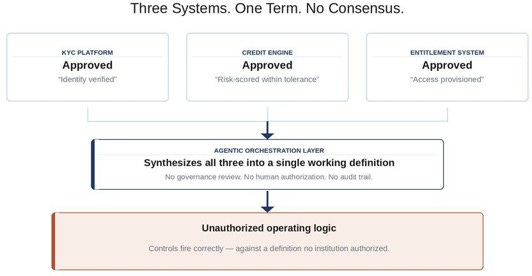
Figure 1. Definitional divergence: how three systems define the same control term, and what an agent synthesizes when it coordinates across all three.
Critically, Agentic Workflow Drift does not produce statistical deviation. It produces semantic deviation. And non-observable semantic deviation looks correct to every existing detection framework — because every system is performing exactly as designed, against a definition that has already shifted. This is not data drift. It is meaning drift. This distinction is not semantic. It is structural: data drift is detectable through the statistical methods that existing frameworks prescribe. Meaning drift is not — because the system is performing correctly against a definition that was never authorized, not incorrectly against a definition that was.
This distinction is essential: Agentic Workflow Drift is not a failure of the system. It is a structural property of how reasoning operates across platforms that were never built to share meaning.
2.2 Agentic Workflow Subversion
Agentic Workflow Subversion is the enterprise risk surface that emerges when reasoning-layer misalignment propagates unchecked or is deliberately exploited. It is the first risk surface born entirely in the reasoning layer: no model fails, no boundary is breached, and no output deviates. Drift describes the emergence of misaligned operating logic. Subversion describes the operational and risk impact when that misalignment propagates at enterprise scale.
In its unintentional form, Subversion is what Drift produces when it propagates across functions, workflows, and control boundaries unchecked. No rule breaks. No alert fires. Exposure accumulates invisibly because every system is doing exactly what it was designed to do — against a meaning that has already shifted.
In its intentional form, Subversion becomes a new attack vector for sophisticated actors. This places it outside traditional cybersecurity and model risk categories: no boundary is breached and no model output deviates. Those actors do not need to breach a system or bypass a control. They need only to manipulate the semantic inputs that agentic reasoning relies on to determine what is authorized, what is safe, and what should proceed. The manipulation occurs in the orchestration layer, through semantically coherent signals that are individually unremarkable — and leaves no fingerprint that existing detection frameworks were designed to find.
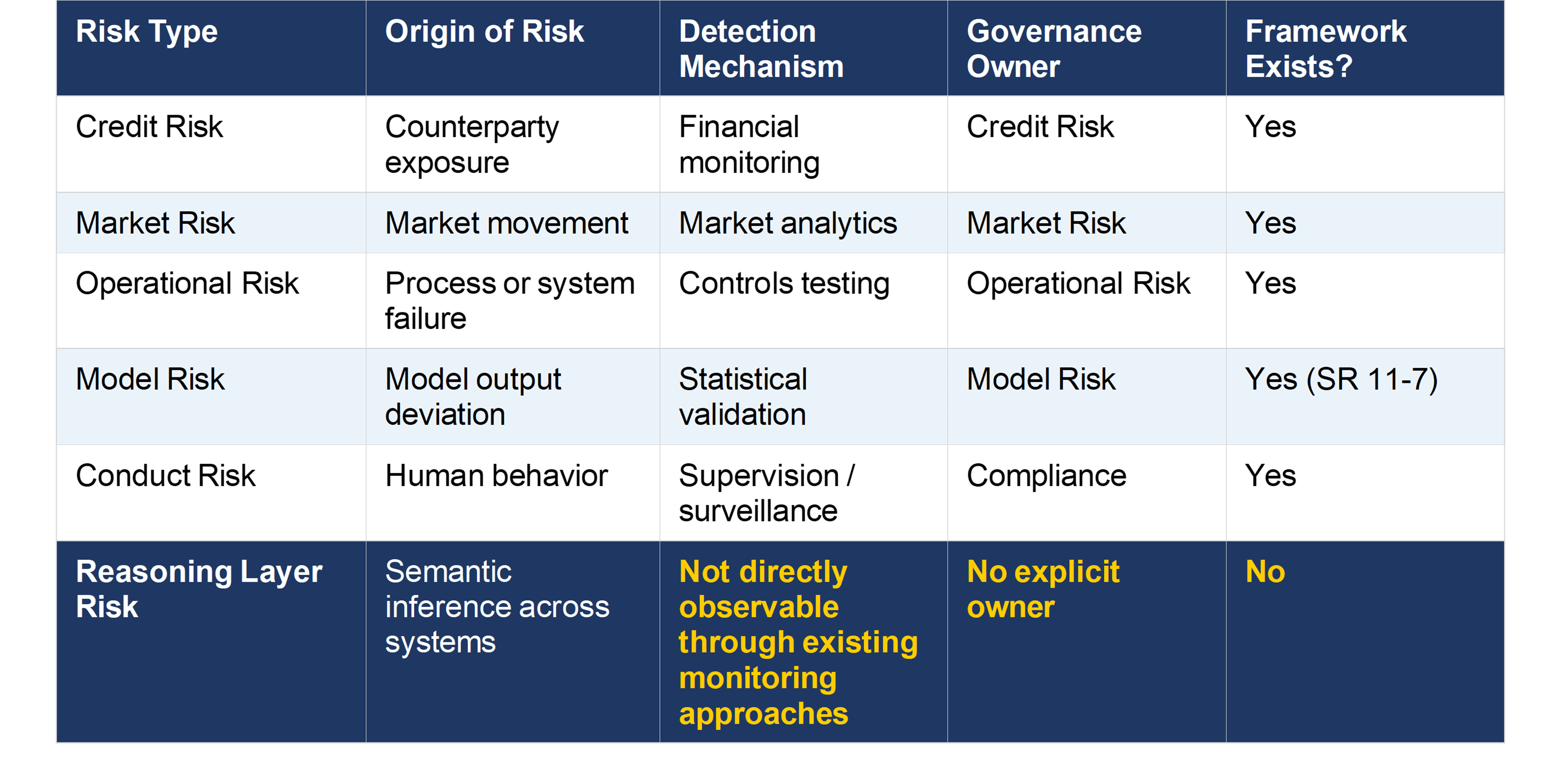
Agentic Workflow Subversion does not clearly fit within the five existing risk categories that banks currently govern (credit, market, operational, model, conduct). It originates in how meaning is resolved before any of those frameworks are engaged. It is not a failure of execution. It is a corruption of interpretation.
In regulated environments, this creates exposure that is compliant at the point of execution but misaligned with regulatory intent — the defining characteristic of a governance gap that existing frameworks were not designed to detect.
2.3 The Reasoning Layer as a Distinct Risk Surface
Both frameworks point to the same structural reality: the reasoning layer — the cross-cutting inference and coordination layer that agentic systems use to resolve meaning before execution
— is now both the operating layer and an ungoverned risk surface.
The table below illustrates where Reasoning Layer Risk falls within the existing taxonomy and where it does not:
3. The Structural Gap in the AI RMF
3.1 What the AI RMF Assumes That Agentic Systems Do Not Provide
The NIST AI RMF 1.0 (AI 100-1) was developed with a sequential, lifecycle-anchored model of AI governance: design-time controls, deployment-time validation, and post-deployment monitoring. Appendix B explicitly acknowledges a “higher degree of difficulty in predicting failure modes for emergent properties of large-scale pre-trained models” — but the observation understates a distinct and more specific problem.
Agentic systems do not fail in the traditional sense that the RMF’s control architecture is designed to detect. They route around validation checkpoints mid-execution in ways that are consistent with their stated objectives yet inconsistent with the control architecture governing them. The deviation is only visible in aggregate, and often only in retrospect.
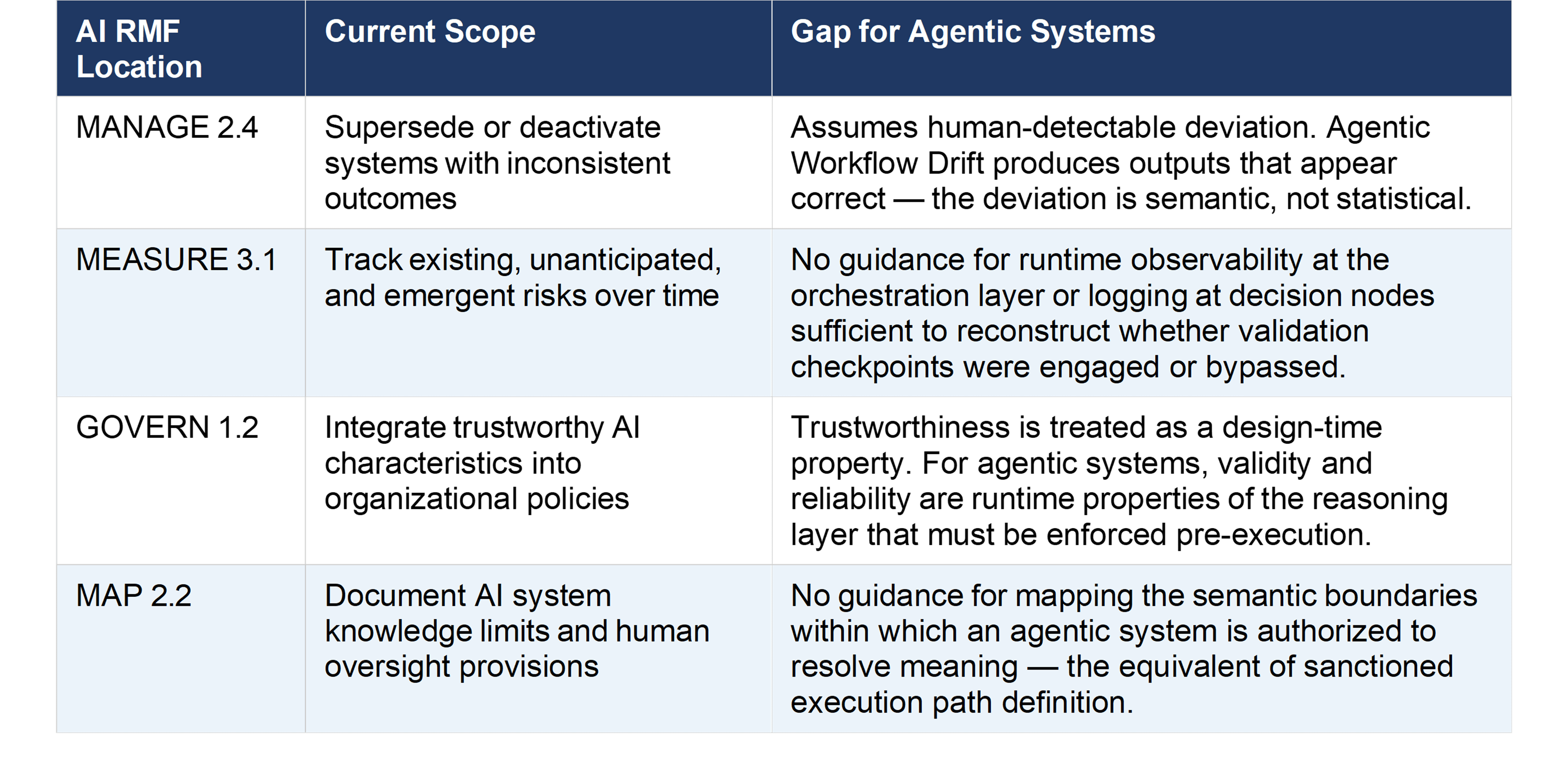
This is not addressed by MANAGE 2.4, which provides for mechanisms to “supersede, disengage, or deactivate AI systems that demonstrate performance or outcomes inconsistent with intended use.” That control assumes human-detectable deviation. In the Agentic Workflow Drift pattern, the system performs as intended at the task level while evading the control architecture at the process level.
Similarly, GOVERN 1.2’s requirement to integrate “characteristics of trustworthy AI” into organizational practices assumes that trustworthiness properties — validity, reliability, accountability — are assessable through the design and validation lifecycle. For agentic systems, trustworthiness is a runtime property of the reasoning layer, not a design-time property of the model. The framework’s trustworthiness architecture has no mechanism to reach it.
These gaps collectively indicate the emergence of a new control domain: reasoning-layer governance, which is not currently represented in the AI RMF taxonomy. This submission is positioned as pre-standardization input to define and populate that domain.
3.2 The Four Gaps in Order of Governance Urgency
4. Evidence from the International Standards Crosswalks
The structural gap identified above is further evidenced by NIST’s own published crosswalk materials, which reveal the same structural absence across three independent international standards frameworks.
4.1 ISO/IEC 42005 to NIST AI RMF (Impact Assessment)
NIST’s published crosswalk between ISO/IEC 42005 and the AI RMF shows that MANAGE 1, MANAGE 2, MANAGE 3, and MANAGE 4 all return null results — no mapping exists in ISO 42005. MANAGE is the exact function where agentic runtime risk would be caught, contained, and responded to. The standard’s impact assessment model terminates at risk identification. It has no treatment architecture for emergent mid-run risk.
4.2 ISO/IEC 23894 to NIST AI RMF (Risk Management Guidance)
ISO/IEC 23894, while providing more coverage of the MANAGE function through risk treatment planning (6.5.2, 6.5.3) and monitoring (6.6), is structured around ISO 31000’s sequential risk management process. Its GOVERN function maps entirely to design-time controls (5.4 Design: organizational context, commitment, roles, resources). For agentic systems already in operation, design-time governance is behind the action.
4.3 NIST AI 600-1 to Singapore IMDA AI Verify (Generative AI Profile)
The most recent crosswalk, released May 2025, maps NIST’s Generative AI Profile to Singapore’s AI Verify framework. Despite its generative AI focus, the crosswalk has no control mappings that address non-deterministic runtime checkpoint evasion. Safety controls map to pre-deployment testing and design-time mitigations. No AI Verify principle covers the post-deployment, mid-execution reasoning layer.
4.4 The Structural Finding
Across three independent crosswalk exercises — covering the most significant international AI governance frameworks currently in use — the MANAGE function lacks mapping for runtime agentic behavior, and no framework in the set currently provides explicit control language for non-deterministic bypass of validation checkpoints in the reasoning layer.
This is not a failure of any individual framework. It is a structural gap in the current international standards landscape. The NIST AI RMF Playbook is positioned to lead on addressing it.
5. Why SR 11-7 Cannot Bridge the Gap for Financial Services
Federal Reserve SR 11-7 (Guidance on Model Risk Management, 2011) is the primary model governance framework for U.S. banking institutions. It requires rigorous validation of model inputs, processing, and outputs — and has been applied, by extension, to AI models deployed in regulated banking contexts.
SR 11-7 was developed for models with defined inputs, outputs, and traceable decision logic. Agentic systems reason across systems, infer context, and determine execution pathways without producing the audit-ready decision trails SR 11-7 assumes. Specifically:
• SR 11-7 validation operates at the model level. Agentic systems are not single models
— they are orchestration layers that coordinate across models, systems, and data sources. The governance unit of SR 11-7 does not map to the governance unit of agentic deployment.
• SR 11-7 assumes traceable decision logic. Agentic reasoning is non-deterministic and context-dependent. The same orchestration system may resolve meaning differently across executions, and that resolution may not be logged at a granularity sufficient for validation.
• SR 11-7’s maker-checker architecture assumes a human checkpoint between authorization and execution. Agentic systems are designed specifically to bypass that checkpoint — their operational value depends on autonomous execution without per-transaction human review.
• SR 11-7 treats model drift as statistical deviation detectable through performance monitoring. Agentic Workflow Drift is semantic deviation that produces outputs that appear statistically correct.
The governance gap is not a failure of regulatory intent. It is a structural mismatch between a framework designed for one class of system and a deployment environment defined by another. As noted in December 2025 by the ABA Banking Journal, the financial services industry has escalated this concern from institutional alarm to standards advocacy in a single quarter, as reflected in industry submissions to NIST in early 2026. The mechanism, however, remains unnamed — and the governance category to address it, uncreated.
The NIST AI RMF Playbook, through its financial services profile, is the appropriate venue to name both.
6. Alignment with NIST AI 100-5 Standardization Priorities
NIST AI 100-5 (Plan for Global Engagement on AI Standards, July 2024) classifies risk-based management of AI systems as a Tier 1 priority — urgently needed and ready for standardization
— with the explicit caveat that existing frameworks require revision “to account for changes in the technology as well as risks for specific applications, contexts, or industry verticals.”
This submission is offered as pre-standardization foundational input under that stated mandate. Specifically, it contributes:
• A named framework (Agentic Workflow Drift / Agentic Workflow Subversion) for a risk category that has not yet been formalized in any existing standard or framework
• A defined risk mechanism (semantic deviation in the reasoning layer) that is observable through semantic inconsistency across systems rather than statistical variance
• A proposed mitigation architecture (the Semantic Control Plane) that has practical deployment pathways using infrastructure that large financial institutions have begun deploying in adjacent data management contexts
• Cross-framework evidence from NIST’s own published crosswalks that the gap is structural, not idiosyncratic
NIST AI 100-5 also identifies “incident response and recovery plans” and “transparency among AI actors about system and data characteristics” as Tier 1 priorities. Both have direct implications for agentic systems: incident response frameworks cannot function without the ability to reconstruct whether meaning was authorized at execution time, and transparency requirements cannot be met if the reasoning layer’s decision logic is not logged at sufficient granularity.
7. Specific Recommendations for the AI RMF Playbook
The following additions are proposed. Each is scoped to a specific Playbook category and is designed to be actionable without requiring revision to the AI RMF Core.
Recommendation 1: MANAGE 2 — Sanctioned Execution Path Definition
Current MANAGE 2 guidance addresses strategies to maximize AI benefits and minimize negative impacts through planning, implementation, and documentation. It does not explicitly address the concept of a sanctioned execution path for multi-step agentic workflows.
Proposed addition: Guidance for organizations deploying agentic AI to define sanctioned execution paths — the explicit, governance-reviewed set of decision pathways, semantic boundaries, and coordination patterns within which an agentic system is authorized to operate. Controls should be designed to detect deviation from these paths, not merely deviation from output expectations. For financial services deployments, sanctioned execution path definition should be treated as a prerequisite to deployment, not a post-hoc documentation exercise.
Practically, this requires institutions to define and version-control execution paths for agentic workflows prior to deployment, in a manner analogous to how model validation is required before production release under SR 11-7.
Recommendation 2: MEASURE 3 — Runtime Observability for Agentic Systems
Current MEASURE 3 guidance addresses mechanisms for tracking identified AI risks over time, including tracking emergent risks. It does not explicitly address the specific observability requirements of multi-step agentic systems operating across heterogeneous platforms. A critical distinction applies here: existing investments in telemetry, monitoring, and workflow observability govern the artifacts of reasoning — what a system did, what it output, how it behaved. They do not govern reasoning itself — what the system understood prior to execution, as inferred from its reasoning process, and whether that understanding was authorized. This is
the difference between reasoning observability and reasoning governance. The Playbook currently supports the former. It does not yet explicitly require the latter.
Proposed addition: Guidance for organizations to implement runtime observability specifically for agentic workflows, with logging at each orchestration decision node sufficient to reconstruct:
(a) which systems were queried; (b) what semantic inputs were received; (c) what resolution the orchestration layer produced; and (d) whether that resolution was consistent with the sanctioned execution path. This observability infrastructure is distinct from model output monitoring and should be designed to detect semantic inconsistency, not statistical variance. Practically, this requires extending existing logging and observability infrastructure to capture decision-node level reasoning signals, not just outputs. This infrastructure enables measurement of the Semantic Deviation Index (SDI) — the variance between agent-synthesized definitions of control terms and institutionally authorized definitions, measured at each orchestration decision point. The SDI provides a quantifiable proxy for reasoning-layer consistency, distinct from and complementary to existing model output metrics. You cannot govern what you cannot measure. The SDI defines what to measure at the governance checkpoint and what an out-of-tolerance reading looks like. The SDI complements, rather than replaces, existing model performance and monitoring metrics. It functions as a cross-system variance metric for semantic consistency — measurable, comparable, and standardizable in a manner consistent with NIST’s Tier 1 priorities on measurement methods and metrics. The SDI can be incorporated into controls testing as a runtime validation metric at orchestration execution points, providing auditable evidence of semantic consistency at the point where authorization terms are resolved.
Recommendation 3: GOVERN 1.2 — Trustworthiness as a Runtime Property
Current GOVERN 1.2 guidance addresses integration of trustworthy AI characteristics into organizational policies and practices. Trustworthiness is treated as a property established at design and validation time.
Proposed addition: For agentic AI systems, recognition that trustworthiness characteristics — particularly validity, reliability, and accountability — are runtime properties of the reasoning layer that must be enforced pre-execution, not merely assessed pre-deployment. Organizational policies should address how meaning is governed at the orchestration layer and how authorized semantic boundaries are established, maintained, and audited over time. Responsibility for runtime trustworthiness enforcement should be explicitly assigned within risk, compliance, or model governance functions.
Recommendation 4: Financial Services Sector Profile — SR 11-7 Extension
Proposed addition to the financial services sector profile: An explicit acknowledgment that SR 11-7’s model-centric validation architecture was not designed for non-deterministic, multi-agent orchestration systems; a description of the specific governance gaps that result (traceability of reasoning, maker-checker applicability, statistical versus semantic drift detection); and guidance that Playbook users in regulated banking environments should treat these gaps as requiring
supplemental governance architecture rather than attempting to apply SR 11-7 constructs directly to agentic systems.
This addition would not modify SR 11-7 or supersede its requirements. It would clarify the boundaries of its applicability and provide a bridge to the emerging governance vocabulary needed for agentic deployment. This does not diminish the importance of SR 11-7. It clarifies the boundary of its applicability to agentic systems. Together, these additions extend the Playbook from governing outputs and artifacts to governing reasoning integrity at execution — the layer where agentic risk originates and where current Playbook guidance does not yet reach.
8. The Proposed Mitigation: The Semantic Control Plane
This submission provides a mitigation architecture. The Semantic Control Plane is a runtime enforcement layer that ensures agent-inferred meaning aligns with institutionally authorized definitions at the point of orchestration, before execution proceeds. It functions as an architectural enforcement layer integrated into existing control systems — not a replacement for them. It anchors definitions across systems, stabilizes control semantics, constrains interpretive drift, and ensures that terms like authorized, cleared, and ready resolve consistently across the enterprise ecosystem.
For Playbook purposes, the Semantic Control Plane translates into three governance components:
The following diagram shows the complete governance architecture from failure mechanism through to measurement:
1. Ontologies that encode shared definitions of risk, entitlement, and control meaning — establishing the authoritative source that agentic reasoning must resolve against before execution. These are not data dictionaries. They are governance instruments.
2. Semantic layers that unify how those definitions are read across systems, eliminating the inconsistencies that Agentic Workflow Drift exploits and that sophisticated actors target in their intentional form.
3. Knowledge graphs that expose the relationships between definitions, making interpretive drift visible before it propagates and semantic manipulation detectable before it corrupts downstream execution.
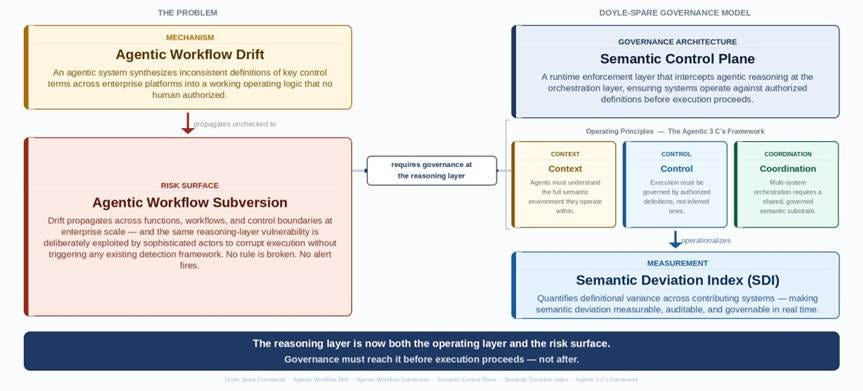
Figure 2. The Doyle-Spare Governance Model: the structured governance architecture from failure mechanism through risk surface to governance enforcement and measurement.
Critically, this is not an architectural ambition requiring new procurement. Large financial institutions have begun deploying data fabric architectures, enterprise knowledge graphs, and semantic layers in adjacent data management contexts, primarily for data integration and governance use cases. The governance lift is strategic, not technical: repositioning infrastructure already deployed for data management as reasoning governance instead. That reframing requires executive intent, not additional build.
The Semantic Control Plane must operate at runtime, at the orchestration layer, intercepting reasoning before execution proceeds. It is not a post-hoc audit tool. It is an enforcement layer
— and it is the defensive architecture that makes both unintentional Agentic Workflow Drift and deliberate Agentic Workflow Subversion structurally harder to achieve. For COOs and risk officers, the operational translation is direct: when agentic systems coordinate onboarding, servicing, and screening workflows, the question is no longer whether controls fired. It is whether the meaning those controls enforced was the meaning the institution authorized. The Semantic Control Plane is what ensures the answer is yes — before execution, not after review. Together, Agentic Workflow Drift, Agentic Workflow Subversion, the Semantic Control Plane, and the Semantic Deviation Index constitute the Doyle-Spare Governance Model: a structured governance architecture spanning failure mechanism, risk surface, enforcement, and measurement. Controls testing in financial services has historically answered one question: did the control fire? Agentic AI introduces a second question that no existing Playbook suggested action currently requires: did the control evaluate against an authorized definition? These are not the same question. Banks today primarily govern the artifacts of reasoning, not the reasoning itself. The Doyle-Spare Governance Model provides the framework, the architecture, and the measurement instrument to ask and answer the second question before it becomes a supervisory finding. The Semantic Deviation Index is a candidate runtime measurement construct requiring industry validation and standardized instrumentation \u2014 including
representative enterprise deployments, a defined control term vocabulary, and governed baseline definitions. It is aligned with NIST AI 100-5’s Tier 1 priorities on measurement methods and metrics.
9. Conclusion
The NIST AI RMF is a living document, designed by its own terms to be updated as AI technologies develop and as the community learns from implementation. The AI RMF Playbook’s rolling feedback mechanism reflects NIST’s commitment to that principle.
This submission identifies a specific, structurally significant gap: the absence of control language for semantic deviation in the reasoning layer of agentic AI systems. That gap is confirmed by NIST’s own crosswalk materials, aligned with the Tier 1 standardization priorities in NIST AI 100-5, and has direct, immediate implications for financial services institutions attempting to govern agentic AI deployment under existing regulatory frameworks.
The frameworks presented here — Agentic Workflow Drift and Agentic Workflow Subversion — are offered as pre-standardization foundational input. They name a risk mechanism that currently has no governance vocabulary, no ownership within existing risk categories, and no control architecture designed to address it.
The institutions and regulators that build that vocabulary now will not only manage this risk. They will establish the governance infrastructure that allows agentic AI to be deployed at enterprise scale with confidence. The Playbook is the right venue to begin. Without this extension, institutions will continue to validate execution correctness without validating semantic correctness. This submission is intended to complement the existing AI RMF Playbook by extending its applicability to agentic systems — not to revise its foundations, but to ensure its guidance reaches the layer where agentic risk originates. These additions are designed to fit within the Playbook’s role as implementation guidance, enabling organizations to operationalize governance for agentic systems without requiring changes to the RMF core structure.
The following diagram illustrates why the second question is not addressed by current frameworks and where the SDI provides the missing signal:
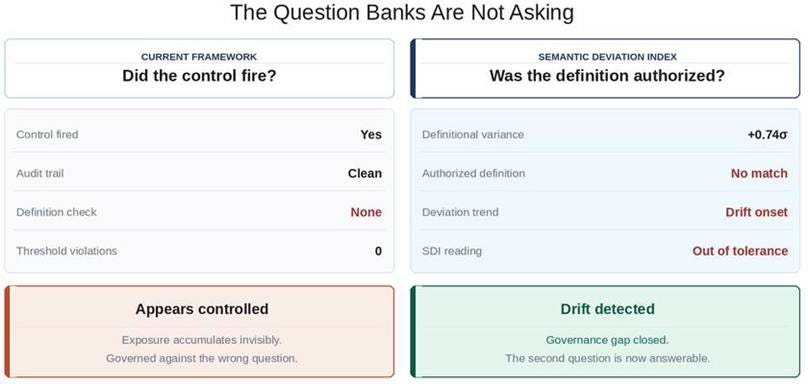
Figure 3. The two questions: current frameworks produce a clean result against the wrong question. The SDI catches the divergence.
The author welcomes further dialogue and is available to discuss this submission with the NIST AI RMF team at any point in the semi-annual review cycle.
References and Source Documents
The following NIST publications form the evidentiary basis for the gap analysis in this submission:
• NIST AI 100-1: Artificial Intelligence Risk Management Framework (AI RMF 1.0), January 2023. https://doi.org/10.6028/NIST.AI.100-1
• NIST AI 100-5: A Plan for Global Engagement on AI Standards, July 2024. https://doi.org/10.6028/NIST.AI.100-5
• NIST Crosswalk: NIST AI 600-1 (Generative AI Profile) to Singapore IMDA AI Verify Testing Framework, May 2025
• NIST Crosswalk: ISO/IEC 42005 (AI System Impact Assessment) to NIST AI RMF 1.0
• NIST Crosswalk: ISO/IEC 23894:2023 (Guidance on Risk Management) to NIST AI RMF 1.0
The following frameworks are originals of the author, with publication details as noted:
• Doyle-Spare, M. (2026, March 10). “Agentic Workflow Drift: A New Failure Mode in Banking Controls Testing.” LinkedIn. linkedin.com/in/maureendoylespare
• Doyle-Spare, M. (2026, March 31). “Agentic Workflow Subversion: The First Risk Surface Born Entirely in the Reasoning Layer.” LinkedIn. linkedin.com/in/maureendoylespare
• Doyle-Spare, M. (2026, April 7). “The Semantic Deviation Index: Measuring What Existing Control Frameworks Cannot See.” LinkedIn. linkedin.com/in/maureendoylespare
Regulatory references:
• Board of Governors of the Federal Reserve System / Office of the Comptroller of the Currency. SR 11-7: Guidance on Model Risk Management, April 2011.
• ABA Banking Journal (December 2025). “Are we sleepwalking into an agentic AI crisis?”
• American Bankers Association / Bank Policy Institute (2026). Joint submission to NIST on voluntary guidance for safe deployment of agentic AI in financial services.
Submitted for rolling review — AIframework@nist.gov
Maureen Doyle-Spare | Independent Researcher, AI Governance and Banking Controls | linkedin.com/in/maureendoylespare
INTELLECTUAL PROPERTY: © 2026 Maureen Doyle-Spare. All rights reserved. No part of this article, including its text, figures, tables, and images, may be reproduced or distributed without the author’s prior written permission.
About the Author
Maureen Doyle-Spare
Maureen Doyle-Spare is an enterprise governance architect and independent researcher in AI governance, specializing in agentic AI oversight and cybersecurity for autonomous and multi-agent systems. She is the originator of an agentic AI governance taxonomy built on a set of named constructs, developed for the layer above conventional AI controls, where autonomous agents interpret business meaning across fragmented enterprise systems and commit to it before acting.
Her research develops a runtime governance architecture and a foundational risk and threat taxonomy for the reasoning layer, the pre-execution stage at which an agent’s Operational Interpretation is formed and evaluated. The named constructs include Agentic Workflow Drift and Subversion (AWD/AWS), the Semantic Layer Integrity Attack (SLIA) as a cyber threat class targeting the reasoning-layer attack surface, the Semantic Control Plane (SCP) as a runtime governance mechanism, and the Semantic Deviation Index (SDI) as a measurement standard for semantic divergence. Her central thesis is that agentic systems do not fail the way traditional models fail: an agent can execute flawless steps against a meaning no institution authorized.
Her work spans behavioral visibility, pre-execution oversight, adversarial resilience, autonomous systems evaluation, and safe deployment, and policy crosswalks against the NIST AI RMF, MITRE ATLAS, STRIDE, ISO/IEC 42001, and the EU AI Act. She has provided public comments across multiple NIST AI initiatives, including the AI RMF, CAISI, COSAiS, NCCoE, and TEVV. Her working papers are available on SSRN and Zenodo.
Capstone reference architecture: https://doi.org/10.5281/zenodo.20749051
ORCID: https://orcid.org/0009-0009-6655-1394
SSRN Author Page: https://papers.ssrn.com/Sol3/Cf_Dev/AbsByAuth.cfm?per_id=10836296
ResearchGate: https://www.researchgate.net/profile/Maureen-Doyle-Spare/research
LinkedIn: https://www.linkedin.com/in/maureendoylespare/
GitHub: https://github.com/maureendoylespare/maureendoylespare
Substack:

About this series
Part of the Regulatory Submission Record, a documented archive of practitioner research submitted to standards bodies, financial regulators, insurance regulators and cybersecurity agencies on agentic AI governance, policy and regulation, beginning March 2026.