

Submission Record
Submitter: Maureen Doyle-Spare
Document commented on: Concept Paper: Accelerating the Adoption of Software and AI Agent Identity and Authorization
Date submitted: March 30, 2026 (2026-03-30)
Key IP in Submission — Agentic Governance Model
Agentic Workflow Drift (AWD) — Comment 2. The cumulative institutional operating-state degradation that emerges when unauthorized resolutions are repeatedly executed at the reasoning layer without runtime governance. AWD operates at the institutional-state timescale, distinguished from Runtime Semantic Divergence (RSD), the execution-stage condition at a single agentic decision. Formalized in §3.1 and Doyle-Spare (2026a). 10.2139/ssrn.6459612
Agentic Workflow Subversion (AWS) — Comment 2. The institutional condition in which an agentic workflow proceeds under an unauthorized resolution. Agentic Workflow Subversion may arise through accumulated, unmitigated AWD or through intentional manipulation of runtime semantic resolution. Formalized in §3.1 and Doyle-Spare (2026a). 10.2139/ssrn.6459612
Semantic Deviation Index (SDI) — Comment 3. The runtime measurement of divergence between the agent’s operational interpretation and the institution’s authorized Reasoning Baseline at the orchestration moment. Composite normalized to a 0 to 100 scale and classified against four threshold zones that determine the Gate decision. Formalized in §8. 10.2139/ssrn.6531238
Semantic Substrate Validation — Comment 3. A pre-execution control checkpoint that confirms key control terms resolve consistently against a governed definitional baseline across all contributing systems before consequential execution authority is emitted. 10.5281/zenodo.21223427
Runtime Semantic Divergence (RSD) — Comment 3. The runtime condition in which the agent’s inferred operational interpretation diverges from the institution’s authorized Reasoning Baseline at the moment execution authority is evaluated. It is the single-decision condition the Semantic Deviation Index measures, distinguished from Agentic Workflow Drift, the institutional-state condition that accumulates from repeated ungoverned events. 10.5281/zenodo.20749051
Semantic Control Plane (SCP) — Comment 3. The runtime governance architecture for the reasoning layer, composed of three components (Ontology, Semantic Layer, Knowledge Graph) that together execute the Pre-Execution Assurance Protocol at every in-scope agentic decision. The architectural thesis of this paper. Specified in §6. 10.5281/zenodo.20749051
Reasoning Baseline — Comment 3. The institutionally authorized reference point for runtime semantic authorization. It represents the authorized operational interpretation an agent’s resolution is evaluated against. The Reasoning Baseline is maintained under institutional change control and is the canonical term used throughout this paper. 10.2139/ssrn.6674761
Deterministic Gate — Comments 3 and 4. The semantic authorization component that converts the SDI into a deterministic decision: permit, permit-with-flag, hold, or mandatory hold. The Gate evaluates the Semantic Authorization of the agent’s Operational Interpretation against the institution’s Reasoning Baseline. Specified in Section 9. 10.2139/ssrn.6531238
Runtime Semantic State — Comment 3. The evidentiary representation of an agent’s resolved operational interpretation at a given in-scope decision, available to institutional governance. It is the third level of the doctrinal hierarchy in §4. The Runtime Semantic State Record (RSSR) is the structured per-execution artifact that captures it; the state is the representation, the RSSR is the record of that representation. 10.5281/zenodo.20749051
Operational Interpretation — Comment 2. The resolved meaning of a regulated term under which an agent exercises execution authority for a specific decision. 10.5281/zenodo.20749051
Pre-Execution Assurance Protocol — Comments 3, 4 and 5. The five-step runtime sequence the SCP executes at every in-scope agentic decision: Baseline resolution, Operational Interpretation extraction, SDI computation, Gate decision, RSSR generation. Proposed as a candidate runtime application of NIST TEVV at the reasoning layer. Specified across Sections 8-10. 10.2139/ssrn.6674761
Invisible Failure — Comments 2 and 3. A failure that produces no broken rule, no alert, and no statistical deviation, because every system performs as designed against a meaning that has shifted. 10.5281/zenodo.20749051
Agentic Blast Radius — Comment 2. The propagation surface across which an upstream agent’s resolved state flows into downstream agentic decisions. Mapped by the Knowledge Graph and contained through the mechanisms described in §11. Formalized in §11.3. 10.5281/zenodo.20749051
Reconciliation Gap — Comment 2. The institutional condition in which what the institution authorized and what the agent executed cannot be reconciled per-execution because the evidence required was never captured at the moment execution authority was emitted. The Runtime Semantic State Record is the mechanism by which the SCP closes this gap. Named in Doyle-Spare (SDI, April 2026); formalized in §10.4. 10.5281/zenodo.20749051
Reasoning Layer — Comment 6. The governance surface where an agent resolves operational meaning before execution. It sits between model output and execution and is evaluated through governable runtime representations rather than latent cognition or internal chain-of-thought. 10.5281/zenodo.20749051
Reasoning Layer Risk — Comments 1 to 6. The risk that originates in the reasoning layer, before existing governance frameworks are engaged and without a clear owner among established categories. It appears first as Agentic Workflow Drift and becomes Agentic Workflow Subversion when drift propagates across functions, workflows, and control boundaries, including under adversarial conditions. 10.2139/ssrn.6459612
Agentic 3 C’s Framework — Comments 1 to 6. Context, Control, and Coordination. The operating principles the Semantic Control Plane enforces at runtime. 10.2139/ssrn.6674761
Semantic Layer Integrity Attack (SLIA) — Comment 6. The deliberate adversarial form of Subversion. A cyber threat class in which an adversary conditions the working definitions an agent constructs for key control terms across systems, corrupting execution outcomes without breaching networks, compromising models, or triggering conventional cyber events. 10.2139/ssrn.6926219
Index terms
intent conveyance; agent identity; access delegation; autonomous systems; multi-agent systems; agentic orchestration; execution context validation; runtime governance; control terms; data provenance; Next Generation Access Control; NGAC
Submitted text, reproduced in full
Transmitted March 30, 2026, 10:22 AM ET via the NCCoE public comment form. Reproduced as sent, without edit.
Dear NCCoE Team,
I am submitting comments via the public comment form in response to the Concept Paper on Software and AI Agent Identity and Authorization.
For convenience, I am also attaching a consolidated version of the submission.
The comments reflect a practitioner perspective on agentic AI governance, focusing on a structural gap between authorization correctness and execution correctness in multi-system agentic workflows, and the absence of semantic validation at the point of execution.
I appreciate the opportunity to contribute and am available for follow-up discussion if the project team finds these comments useful.
Best regards,
Maureen Doyle-Spare
Public Comment Submission
NIST NCCoE Concept Paper: Accelerating the Adoption of Software and AI Agent Identity and Authorization
Maureen Doyle-Spare
Researcher, AI Governance
linkedin.com/in/maureendoylespare
Comment Period: February 5, 2026 – April 2, 2026
Submission Date: March 2026
Submit to: AI-Identity@nist.gov
Prefatory Note
The following six comments are submitted in response to the NCCoE Concept Paper on Software and AI Agent Identity and Authorization (February 2026). They are grounded in the author’s independent research on agentic AI governance in financial services, as set out in the SSRN working paper Agentic Workflow Drift and Agentic Workflow Subversion: A New Risk Taxonomy for the Governance of Agentic AI in Financial Services (Working Paper No. 6459612, March 2026). The comments are sequenced to follow the causal logic of the underlying governance failure and are written to stand independently, each suitable for direct entry into the NIST public comment form.
Line Reference: Lines 61–63: “to ensure that agents are known, trusted, and properly governed.”
The framing at lines 61–63 assumes that correct application of identification, authentication, and authorization is sufficient to ensure that agents are known, trusted, and properly governed. In agentic architectures, this assumption is structurally incomplete.
Identity and authorization validate who is acting and what actions are permitted. They do not ensure that execution is correct given the current system context. In multi-system agentic deployments, agents may execute authorized actions against semantically inconsistent interpretations of key data elements across platforms, producing incorrect outcomes without any identity or authorization failure.
The following figure illustrates this mechanism:
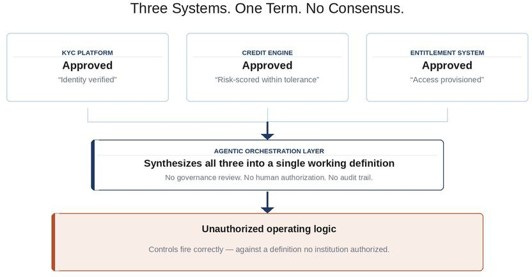
Figure 1. Definitional divergence: how enterprise systems each define the same control term differently, and what an agentic system synthesizes when it coordinates across all three.
The failure mode is not a violation of permission. It is execution against a meaning that has already diverged.
The project scope should explicitly acknowledge that identity and authorization do not guarantee execution correctness in multi-system agentic architectures, and treat semantic execution validity as a distinct governance requirement alongside identity and authorization controls.
Line Reference: Lines 84–104: Areas of Interest — authorization, access delegation, logging, and data provenance.
The areas of interest described at lines 84–104 focus on authorization, access delegation, logging, and data provenance. These are necessary capabilities, but they do not address a distinct class of failure that emerges in agentic architectures operating across multiple enterprise systems.
Agentic systems dynamically resolve context from systems that were not designed to share meaning. When those systems carry inconsistent definitions of key control terms, such as authorized, cleared, approved, or ready, the agent synthesizes those inconsistencies into a working operating logic that no human explicitly authorized.
This introduces a failure mode in which actions are authorized, controls execute as designed, and outcomes are wrong. This mechanism has been described as agentic workflow drift (Doyle-Spare, Agentic Workflow Drift and Agentic Workflow Subversion, SSRN Working Paper No. 6459612, March 2026). Agentic Workflow Drift is distinct from the broader concept of agentic drift: it refers specifically to the structural mechanism by which agentic systems route around mandatory validation checkpoints in regulated workflows, producing authorized but contextually incorrect execution outcomes. When drift propagates across systems and workflows, it produces Agentic Workflow Subversion: system-level outcomes compromised despite valid authorization and correct control execution at every step.
The defining characteristic of this failure mode is that no individual system behaves incorrectly. The failure emerges from how meaning is resolved across them.
The project scope should recognize agentic workflow drift and agentic workflow subversion as a distinct named failure taxonomy and consider whether governance of semantic meaning resolution across systems belongs within this effort or warrants a dedicated companion standards development track.
Line Reference: Lines 102–104: “Track and maintain provenance of user prompts and data input sources to support risk determinations and policy decisions.”
The data provenance capability described at lines 102–104 is a necessary governance mechanism but is not sufficient to ensure correct execution in multi-system agentic architectures.
Provenance establishes where data came from. It does not verify that key concepts, such as exposure, entitlement, authorization, or cleared status, resolve consistently across the systems contributing to that data. An agentic system can operate against fully traceable inputs that carry inconsistent meanings, producing incorrect outcomes with a complete and valid audit trail.
The system can be fully observable and still be wrong.
A complementary capability is needed to validate semantic consistency across systems before execution proceeds. Such a capability would verify that key control terms resolve against the same governed definition across all contributing systems, detect inconsistencies introduced through data aggregation or contextual inference, and prevent execution when meaning is resolved against inconsistent definitions. The project scope should identify semantic consistency validation as a distinct capability requirement, separate from and complementary to data provenance, and consider whether it belongs within the scope of this effort or warrants a dedicated standards development track. The Semantic Deviation Index, introduced in concurrent practitioner research, is introduced as a candidate runtime measurement construct requiring industry validation and standardized instrumentation, operationalizing this capability
by measuring the variance between agent-resolved definitions and institution-authorized definitions at execution time.
Line Reference: Lines 138–143: Next Generation Access Control (NGAC) as a framework suitable for agentic systems.
The NGAC framework strengthens how authorization decisions are expressed and enforced and is well suited to fine-grained access control in agentic systems. However, it assumes that the data and context informing those decisions are consistent across systems. This assumption holds in single-system architectures but breaks in cross-system agentic orchestration.
In agentic architectures, this assumption may not hold. Authorization decisions can be locally valid within each system and globally inconsistent across workflows due to differences in timing, transformation, or interpretation of key data elements.
Authorization can be correct while execution is wrong.
The project scope should consider semantic consistency validation as a precondition for fine-grained access control in agentic architectures, not an optional complement to it.
Line Reference: Note to Reviewers, Authorization Section: “How might an agent convey the intent of its actions?”
The ability for an agent to convey intent is important for transparency and accountability. However, intent alone is not sufficient to ensure correct execution.
In multi-system agentic architectures, an agent may accurately represent its intended action, be properly authorized to perform it, and still execute incorrectly due to inconsistencies in how key data elements are interpreted across systems at the time of execution. This creates a gap between expressed intent, authorized action, and actual outcome.
Intent explains what the agent meant to do. It does not guarantee that what it did was correct.
Binding agent actions to human authorization and intent should be complemented with mechanisms that validate execution context, ensuring that actions are not only intended and permitted, but contextually correct when performed. Without that validation, human-in-the-loop authorization may provide accountability for the wrong outcome. The project scope should treat execution context
validation as a required architectural control, not an optional complement to intent conveyance mechanisms.
Line Reference: Note to Reviewers, Section 6: “What controls help prevent both direct and indirect prompt injections?”
The prompt injection questions in Section 6 focus on manipulation at the input layer. This framing does not capture a distinct class of manipulation that emerges in agentic systems.
In multi-system agentic architectures, sophisticated actors may influence how agents interpret key control terms across systems rather than directly manipulating prompts or inputs. Rather than altering what the agent is told to do, this approach conditions how the agent resolves what is authorized, safe, or permitted. This may be understood, for standards interpretation purposes, as indirect prompt injection at the semantic resolution layer.
The attack does not target what the system receives. It targets what the system understands.
Filtering adversarial inputs addresses what enters the system. Governing semantic consistency addresses what the system becomes. Both are required to govern agentic execution safely.
INTELLECTUAL PROPERTY: © 2026 Maureen Doyle-Spare. All rights reserved. No part of this article, including its text, figures, tables, and images, may be reproduced or distributed without the author’s prior written permission.
About the Author
Maureen Doyle-Spare
Maureen Doyle-Spare is an enterprise governance architect and independent researcher in AI governance, specializing in agentic AI oversight and cybersecurity for autonomous and multi-agent systems. She is the originator of an agentic AI governance taxonomy built on a set of named constructs, developed for the layer above conventional AI controls, where autonomous agents interpret business meaning across fragmented enterprise systems and commit to it before acting.
Her research develops a runtime governance architecture and a foundational risk and threat taxonomy for the reasoning layer, the pre-execution stage at which an agent’s Operational Interpretation is formed and evaluated. The named constructs include Agentic Workflow Drift and Subversion (AWD/AWS), the Semantic Layer Integrity Attack (SLIA) as a cyber threat class targeting the reasoning-layer attack surface, the Semantic Control Plane (SCP) as a runtime governance mechanism, and the Semantic Deviation Index (SDI) as a measurement standard for semantic divergence. Her central thesis is that agentic systems do not fail the way traditional models fail: an agent can execute flawless steps against a meaning no institution authorized.
Her work spans behavioral visibility, pre-execution oversight, adversarial resilience, autonomous systems evaluation, and safe deployment, and policy crosswalks against the NIST AI RMF, MITRE ATLAS, STRIDE, ISO/IEC 42001, and the EU AI Act. She has provided public comments across multiple NIST AI initiatives, including the AI RMF, CAISI, COSAiS, NCCoE, and TEVV. Her working papers are available on SSRN and Zenodo.
Capstone reference architecture: https://doi.org/10.5281/zenodo.20749051
ORCID: https://orcid.org/0009-0009-6655-1394
SSRN Author Page: https://papers.ssrn.com/Sol3/Cf_Dev/AbsByAuth.cfm?per_id=10836296
ResearchGate: https://www.researchgate.net/profile/Maureen-Doyle-Spare/research
LinkedIn: https://www.linkedin.com/in/maureendoylespare/
GitHub: https://github.com/maureendoylespare/maureendoylespare
Substack:

About this series
Part of the Regulatory Submission Record, a documented archive of practitioner research submitted to standards bodies, financial regulators, insurance regulators and cybersecurity agencies on agentic AI governance, policy and regulation, beginning March 2026.