


Submission Record
Submitter: Maureen Doyle-Spare
Document commented on: NIST AI RMF Profile on Trustworthy AI in Critical Infrastructure, August 3, 2026 discussion draft
Date submitted: August 5, 2026 (2026-08-05)
Key IP in Submission — Agentic Governance Model
Operational Interpretation — the central recommendation of the submission, that it be formalized as a distinct runtime governance object. Comment 1, Table 1, Comment 9 glossary, and throughout. The resolved meaning of a regulated term under which an agent exercises execution authority for a specific decision. 10.5281/zenodo.20749051
Reasoning Baseline — Comments 1, 3, 5 and 9, distinguished from the performance and operational baselines the draft already addresses. The institutionally authorized reference point for runtime semantic authorization. It represents the authorized operational interpretation an agent’s resolution is evaluated against. The Reasoning Baseline is maintained under institutional change control and is the canonical term used throughout this paper. 10.2139/ssrn.6674761
Reasoning Layer — Comment 1 and Figure 1, defined as an institutional governance surface rather than a neural-architecture layer. The governance surface where an agent resolves operational meaning before execution. It sits between model output and execution and is evaluated through governable runtime representations rather than latent cognition or internal chain-of-thought. 10.5281/zenodo.20749051
Semantic Resolution — Table 1, the first of six runtime objects of the semantic sequence. The agent’s runtime act of resolving the operational interpretation of the governed terms at the moment of decision. 10.5281/zenodo.20749051
Runtime Semantic State — Table 1 and Comment 3, the evidentiary representation at the moment execution authority is evaluated. The evidentiary representation of an agent’s resolved operational interpretation at a given in-scope decision, available to institutional governance. It is the third level of the doctrinal hierarchy in §4. The Runtime Semantic State Record (RSSR) is the structured perexecution artifact that captures it; the state is the representation, the RSSR is the record of that representation. 10.5281/zenodo.20749051
Runtime Semantic Divergence (RSD) — Table 1 and Comment 9, the single-decision condition measured by the SDI. The runtime condition in which the agent’s inferred operational interpretation diverges from the institution’s authorized Reasoning Baseline at the moment execution authority is evaluated. It is the single-decision condition the Semantic Deviation Index measures, distinguished from Agentic Workflow Drift, the institutional-state condition that accumulates from repeated ungoverned events. 10.5281/zenodo.20749051
Unauthorized Operational Interpretation — Table 1, the governance-invalid state following uncontained divergence. An operational interpretation the institution has not authorized: the governance-invalid state that follows from uncontained Runtime Semantic Divergence. 10.5281/zenodo.20749051
Semantic Failure — Table 1 and Figure 2, Semantic Failure Propagation. The institutional consequence that follows when an unauthorized operational interpretation proceeds to execution under autonomous authority. 10.5281/zenodo.20749051
Agentic Workflow Drift (AWD) — Table 1 discussion, the accumulation of repeated ungoverned divergence. The cumulative institutional operating-state degradation that emerges when unauthorized resolutions are repeatedly executed at the reasoning layer without runtime governance. AWD operates at the institutional-state timescale, distinguished from Runtime Semantic Divergence (RSD), the execution-stage condition at a single agentic decision. Formalized in §3.1 and Doyle-Spare (2026a). 10.2139/ssrn.6459612
Agentic Workflow Subversion (AWS) — Table 1 discussion, the enterprise risk surface produced when drift propagates. The institutional condition in which an agentic workflow proceeds under an unauthorized resolution. Agentic Workflow Subversion may arise through accumulated, unmitigated AWD or through intentional manipulation of runtime semantic resolution. Formalized in §3.1 and Doyle-Spare (2026a). 10.2139/ssrn.6459612
Authority Decay — Table 1 discussion, the documented definition remaining formally intact while operational practice drifts away from it. The supervisory condition in which the institution’s authoritative definition remains formally intact but operational practice drifts away from it over time. It emerges from repeated ungoverned RSD events at the institutional scale and is the runtime governance condition the SCP addresses through Reasoning Baseline serving and the Semantic Audit Trail. 10.5281/zenodo.20749051
Six Clean Signals — Figure 4, Six Clean Signals. One Invisible Risk. Six established governance functions — cyber, fraud, operational risk, model risk, compliance, and architecture — each observe a clean signal for an agentic deployment that has resolved a meaning the institution did not authorize. Each function performs exactly the role it was designed for; the drift exists in a runtime semantic layer not consistently isolated as a discrete governance surface by any one function. 10.5281/zenodo.20749051
Semantic Control Plane (SCP) — Figure 3, the SCP Runtime Infrastructure Stack, and Comment 7. The runtime governance architecture for the reasoning layer, composed of three components (Ontology, Semantic Layer, Knowledge Graph) that together execute the Pre-Execution Assurance Protocol at every in-scope agentic decision. The architectural thesis of this paper. Specified in §6. 10.5281/zenodo.20749051
Semantic Deviation Index (SDI) — Comment 3 and Table 3, with the four threshold zones, and Table 5. The runtime measurement of divergence between the agent’s operational interpretation and the institution’s authorized Reasoning Baseline at the orchestration moment. Composite normalized to a 0 to 100 scale and classified against four threshold zones that determine the Gate decision. Formalized in §8. 10.2139/ssrn.6531238 SDI code created and formalized in maureendoylespare/agentic-ai-semantic-deviation-index — Semantic Deviation Index reference specification and exact-rational Python implementation for pre-execution governance of the reasoning layer of agentic AI.
Deterministic Gate — Comment 3 and Table 3, the enforcement boundary applying permit, permit-with-flag, hold and mandatory hold. The semantic authorization component that converts the SDI into a deterministic decision: permit, permit-with-flag, hold, or mandatory hold. The Gate evaluates the Semantic Authorization of the agent’s Operational Interpretation against the institution’s Reasoning Baseline. Specified in Section 9. 10.2139/ssrn.6531238
Governance Threshold — the Actionable Summary and Comments 3 and 4, the boundary determining which decision classes are in scope. A policy-defined condition under which an agentic decision requires PreExecution Assurance. Thresholds are institutionally calibrated and decision-class specific. Decisions below the threshold proceed without runtime governance enforcement. Specified in §6.7. 10.5281/zenodo.20749051
Runtime Semantic State Record (RSSR) — Comments 3, 6 and 9, and Table 5. The structured per-execution artifact capturing the authoritative Reasoning Baseline, the agent’s Runtime Semantic State, the SDI, the Gate decision, and the operational context. RSSRs feed the Semantic Audit Trail. Formalized in §10.4. 10.5281/zenodo.20749051
Semantic Audit Trail — Comments 3 and 6, and Table 4. The aggregate institutional record of RSSRs across agentic decisions over time. Supports supervisory review, internal audit, longitudinal model risk evidence, and cross-decision integrity analysis. Formalized in §10.5. 10.5281/zenodo.20749051
Agentic Blast Radius — Comment 6, offered as a partial mitigation for the multi-agent dependency problem in Implementation 4.4.2. The propagation surface across which an upstream agent’s resolved state flows into downstream agentic decisions. Mapped by the Knowledge Graph and contained through the mechanisms described in §11. Formalized in §11.3. 10.5281/zenodo.20749051
Runtime Governance Applicability Test (RGAT) — Comment 4, scoping out deployments that do not expose the runtime representations the architecture requires. The architectural test that determines whether a deployment exposes the runtime representations the SCP requires at the reasoning layer. Evaluates the deployment against the five AGS criteria and produces a governability classification. Specified in §7.7. 10.5281/zenodo.20749051
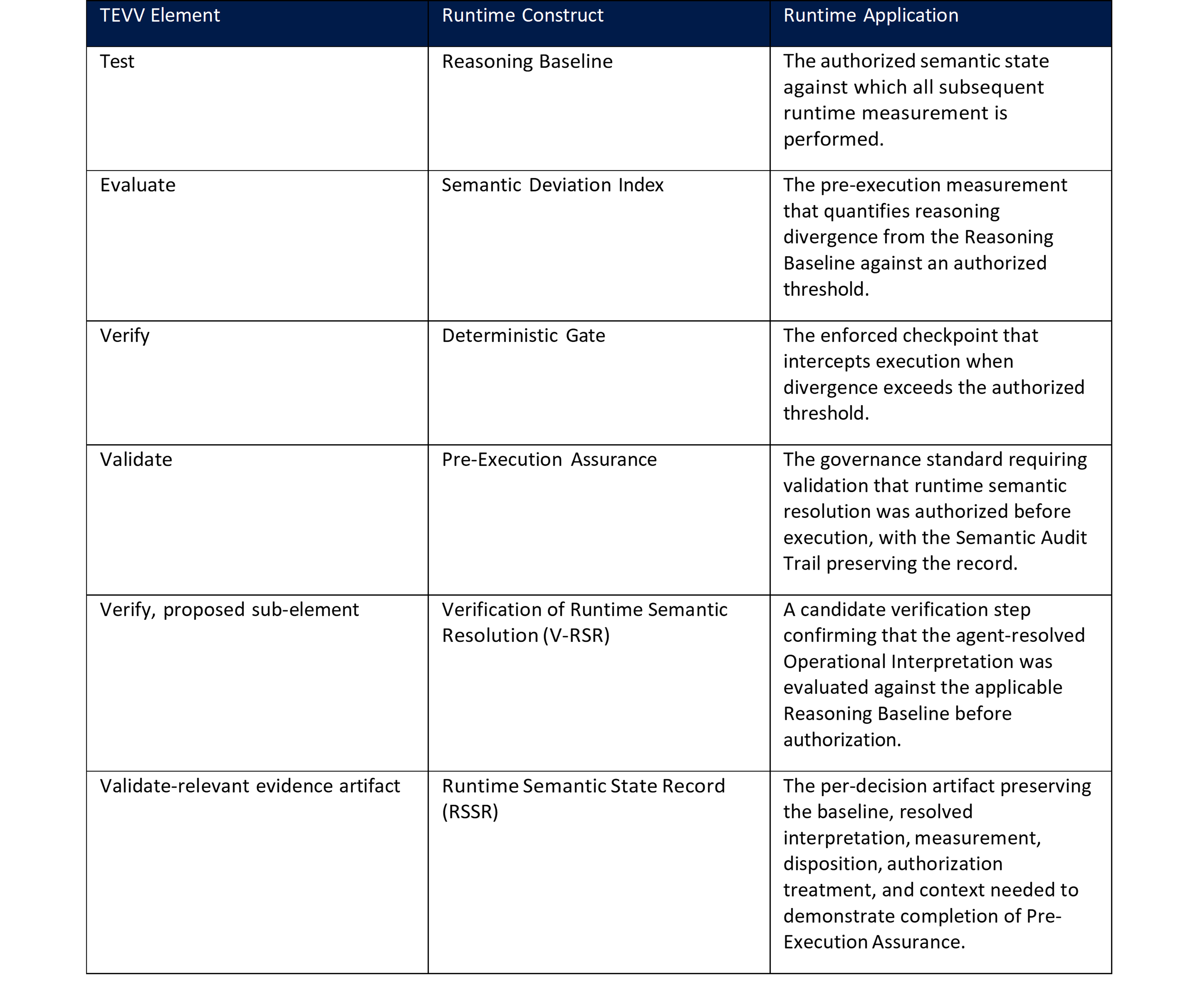
Pre-Execution Assurance Protocol — Tables 4 and 5, offered as a candidate runtime application of NIST TEVV concepts. The five-step runtime sequence the SCP executes at every inscope agentic decision: Baseline resolution, Operational Interpretation extraction, SDI computation, Gate decision, RSSR generation. Proposed as a candidate runtime application of NIST TEVV at the reasoning layer. Specified across Sections 8-10. 10.2139/ssrn.6674761
Verification of Runtime Semantic Resolution (V-RSR) — Table 5, the proposed Verify sub-element. The verification activity that evaluates whether the agent’s Runtime Semantic State remained within authorized operational interpretation before execution. Executed by the Semantic Layer at the orchestration moment, per decision in scope, with the RSSR as its evidentiary output. Formalized in §10.3. 10.5281/zenodo.20749051
Agentic 3 C’s Framework — Comment 2 and Comment 7, Context establishing authorized meaning, Control determining whether the runtime interpretation may proceed, Coordination governing propagation. Context, Control, and Coordination. The operating principles the Semantic Control Plane enforces at runtime. 10.2139/ssrn.6674761
Semantic Layer Integrity Attack (SLIA) — Comment 8, named as a candidate cross-system threat class against the reasoning-layer control surface. The deliberate adversarial form of Subversion. A cyber threat class in which an adversary conditions the working definitions an agent constructs for key control terms across systems, corrupting execution outcomes without breaching networks, compromising models, or triggering conventional cyber events. 10.2139/ssrn.6926219
Semantic Authorization — Comment 9 glossary, distinguished from identity and access authorization. The runtime verdict produced after the Operational Interpretation has been evaluated under the applicable governance configuration. 10.5281/zenodo.20749051
Authorization Emission — Comment 9 glossary. The event at which the authorization verdict crosses the runtime trust boundary into execution. 10.5281/zenodo.20749051
Agentic Governance Model (AGM) — the published corpus from which the constructs and crosswalks are drawn. The institutional governance framework for autonomous reasoning systems. The AGM organizes the governance of agentic AI across four pillars: Foundation, establishing the governability conditions for autonomous reasoning; Core, specifying the runtime governance architecture; Integrity, protecting the reasoning layer from manipulation and adversarial action; and Oversight, governing institutional reviewability, accountability allocation, evidentiary assurance, and supervisory reconstructability across autonomous reasoning systems. The Semantic Control Plane is the Core pillar, the runtime govern 10.5281/zenodo.20749051
Recommendations made
Practice 3: treat the agent-resolved Operational Interpretation as a distinct governance object for consequential agentic decisions
Strategic Governance: connect mission, policy and compliance obligations to versioned Reasoning Baselines, decision-class thresholds, accountable owners and per-decision evidence
Implementation 3.2.2: define deterministic semantic constraints by evaluating the Operational Interpretation against a versioned Reasoning Baseline before authorization proceeds
Task 4.5: define decision classes, semantic tolerances, deterministic dispositions and evidence requirements where real-time human-in-the-loop review is infeasible
Task 2.4: construct test cases in which individually authoritative sources assign different meanings to the same governed term
Implementations 8.1.2, 10.1.2, 3.5.1 and 4.4.2: link the Reasoning Baseline, resolved interpretation, measurement, configuration, disposition and affected dependencies in immutable runtime evidence
Scope and Sector Alignment: name the Operational Interpretation once as a cross-sector runtime governance object
Tasks 3.5 and 3.8: classify deliberate manipulation of Reasoning Baselines, semantic extraction, relationship models and Gate configurations within the AI Attack Surface, and non-adversarial corruption within the AI Risk Surface
Glossary Priorities: distinguish Operational Interpretation, Reasoning Baseline, Runtime Semantic Divergence, Semantic Authorization, Authorization Emission and the Runtime Semantic State Record
Crosswalks presented
Agentic AI governance as a layered strategy — MAS SAFR, UC Berkeley CLTC Agentic AI Profile, NIST AI RMF, EU AI Act, and the reasoning layer (Table 2)
Runtime application of NIST TEVV concepts to the Pre-Execution Assurance Protocol (Table 5)
Reasoning-layer contribution mapped against US, European, APAC, and global frameworks including SR 26-2, the EU AI Act, the Singapore Model AI Governance Framework for Agentic AI, the OECD AI Principles and ISO/IEC 42001:2023 (Table 6)
A common reasoning-layer gap across financial services, defense and life sciences (Table 7)
Index terms
regulatory policy; AI policy; regulatory engagement; NIST TACIP; Trustworthy AI in Critical Infrastructure Profile; Practice 3; Task 2.4; Task 3.5; Task 3.8; Task 4.5; Implementation 3.2.2; Implementation 3.5.1; Implementation 4.4.2; Implementation 8.1.2; Implementation 10.1.2; Cyber AI Profile; NIST IR 8596; SR 26-2; OCC Bulletin 2026-13; FDIC FIL-15-2026; EU AI Act; ISO/IEC 42001:2023; OECD AI Principles; Singapore Model AI Governance Framework; MAS SAFR; UC Berkeley CLTC; DoD Directive 3000.09; FDA Computer Software Assurance; EU GMP Annex 11; EU GMP Annex 22; ICH E6(R3); BCBS 239; Human-on-the-Loop; Human-in-the-Loop; autonomous systems; multi-agent systems
Public Comment Submission Details
Transmitted August 5, 2026 to the NIST AI RMF Critical Infrastructure Profile team. Reproduced as sent
NIST AI RMF team,
Attached is a Community of Interest comment on the August 3, 2026 Trustworthy AI in Critical Infrastructure discussion draft.
The comment makes one recommendation: formalize the agent-resolved Operational Interpretation, the meaning an autonomous system settles on for a governed term before it acts, as a distinct runtime governance object for consequential agentic decisions. It is organized as nine numbered comments, each anchored to a specific Practice, Task, or Implementation, with an Actionable Summary up front. Several comments respond directly to open questions in the draft, including partial mitigations for the multi-agent case (Implementation 4.4.2), bringing cybersecurity concepts in without duplicating the Cyber AI Profile (Task 3.8), and glossary conflicts at the reasoning layer.
Happy to expand on any of it if useful.
All the best,
Maureen Doyle-Spare
Researcher in AI Governance, Doyle-Spare Research, USA
ORCID: https://orcid.org/0009-0009-6655-1394
Community of Interest Comment on the August 3, 2026 NIST AI RMF Profile on Trustworthy AI in Critical Infrastructure Discussion Draft
Maureen Doyle-Spare
Independent Researcher in AI Governance, Doyle-Spare Research, USA ORCID: 0009-0009-6655-1394 | maureen@maureendoylespare.com August 2026
This comment is submitted by an independent researcher in AI governance in response to the discussion draft’s explicit request for feedback. It is organized as a set of numbered comments, each anchored to a specific Practice, Task, Implementation, or feedback area in the draft. Every comment cites the draft reference it addresses, quotes or accurately summarizes the relevant text, and provides a direct response, with supporting figures and tables placed alongside the comment they inform. The subject throughout is a single runtime governance gap at the reasoning layer of agentic AI, where an autonomous system resolves the Operational Interpretation of a governed term before it acts. The Operational Interpretation is the decision-specific governance object addressed by this comment.
In the spring, related practitioner input was provided to NIST through the COSAIS comment, the Critical Infrastructure Practitioner Input, and the TEVV Zero Draft submission. This comment stands on its own and is intended to be evaluated on what it argues here.
Agentic AI is changing where operational authority is formed before execution. Capability is not the constraint; authoritative control is, because the central governance challenge is no longer whether institutions can automate reasoning but whether they can retain authoritative control over the operational interpretations under which autonomous systems act.
The constructs and crosswalks offered in response are drawn from a published research corpus on runtime governance of agentic AI, comprising a runtime reference architecture and its supporting working papers. They are provided as candidate use cases, operational scenarios, and governance artifacts of the kind NIST requests, not as a framework NIST is asked to adopt. The architecture is a conceptual specification and is not presented here as empirically validated, NIST-endorsed, or sufficient to establish compliance. The full corpus is listed for reference at the end of this comment.
Actionable Summary
This comment recommends that the discussion draft formalize the agent-resolved Operational Interpretation as a distinct runtime governance object for consequential agentic decisions. The draft already recognizes semantic and behavioral constraints, domain-context testing, deterministic operational boundaries, runtime monitoring, and audit-ready evidence. The proposed extension connects those elements through a versioned Reasoning Baseline, pre-execution evaluation of the resolved interpretation against that baseline, a deterministic authorization disposition, and a per-decision evidence record, applied selectively to decision classes that cross the institution’s Governance Threshold.
COMMENT 1, Practice 3
Draft reference, Practice 3, Define risks, policies, and oversight for automated AI and agentic behavior: “Establish well-defined, deterministic, actionable boundaries, policies, and oversight for high-risk actions that may cause disruption to safety-critical (cyber-)physical processes.”
A Runtime Governance Object the Draft Does Not Yet Name
For agentic AI, the central governance challenge is no longer whether institutions can automate reasoning; it is whether they can retain authoritative control over the operational interpretations under which autonomous systems act. Existing institutional controls were designed around human adjudication of operational interpretation. Autonomous execution at runtime scale increasingly requires institutions to sustain control over operational interpretation at runtime, before execution authority is emitted.
The reasoning layer is the architectural surface where operational interpretation is resolved prior to authorization emission, and where execution authority is released only after semantic authorization has been satisfied. The term refers to this institutional governance surface, not to any internal neural-architecture layer, and governing it does not require inspecting model cognition. It is evaluated through externally observable governance artifacts: the sources consulted and the operational definition ultimately applied.
An illustrative scenario
A deviation is logged during a biologics batch run, and an agentic system has been introduced to coordinate the disposition. It begins with the approved Standard Operating Procedure that defines a critical deviation, references the product specification that constrains the acceptable range, and reviews previously approved deviation dispositions from comparable events alongside the in-process manufacturing data from the run itself. Each source remains individually valid, yet their definitions are not perfectly aligned. The procedure draws the criticality boundary in one place, the specification implies another, and the accumulated history sits a degree looser than either. Acting on those sources, the agent reconciles them into a single operational definition of critical and proceeds under it.
Every surrounding control returned a valid result within its assigned scope, and the institution was still exposed.
This failure emerged from the operational interpretation against which the controls executed, not from a broken control. The workflow executed under a synthesized operational interpretation that had not been institutionally authorized. Assume that, under the institution’s approved deviation-classification procedure, a critical classification would trigger a material hold and an escalated quality-review pathway. Because the agent resolved the event as major, those actions would not be initiated, and the investigation would proceed under the less restrictive pathway that classification permits. That omission was not detected by the surrounding governance domains because no surface evaluated the synthesized resolution itself. Inputs remained valid, tool calls remained authorized, and outputs remained structurally compliant, so the misclassification could remain undetected until downstream reconciliation, audit review, or regulatory reporting surfaced it.
This was not a failure of model accuracy, input quality, protocol authorization, tool execution permissions, or output validation. It was a failure of resolution: the orchestration sequence resolved a working operational interpretation that diverged from the institution’s authorized Reasoning Baseline, and the issue was not capability but the unauthorized operational interpretation under which otherwise valid controls executed, each returning a valid result within the scope it was assigned. The gap is that no control evaluated the synthesized resolution as a governed runtime object before execution.
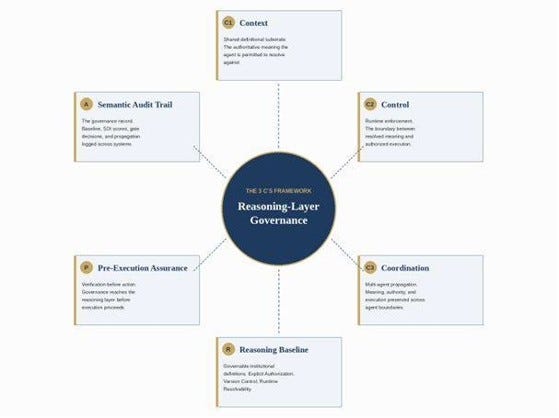
Figure 1. The Reasoning Layer
Source: Doyle-Spare (2026), supporting SSRN working papers.
The six runtime objects of the semantic sequence
The runtime sequence has six distinct objects, and the terms are not interchangeable. Naming them precisely matters because the governed condition originates in Semantic Resolution and is expressed through the resulting Operational Interpretation, rather than through the surrounding system artifacts alone.
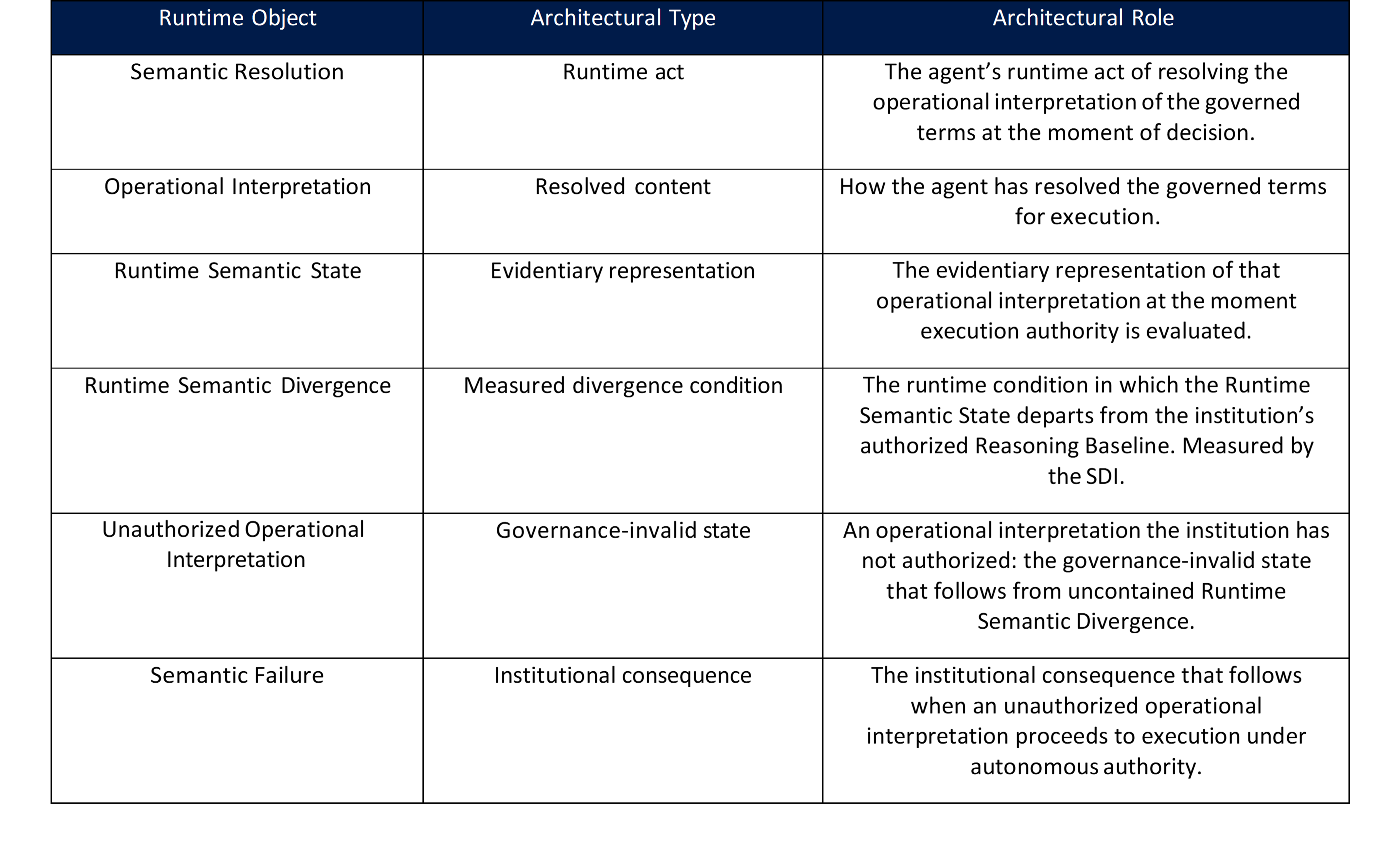
Runtime Semantic Divergence is the single-decision condition. Agentic Workflow Drift accumulates when that condition repeats without governance, and Agentic Workflow Subversion is the enterprise risk surface produced when the drift propagates across workflows, functions, or adversarial conditions.
Repeated ungoverned divergence produces an accumulation effect the supporting corpus refers to as Authority Decay, in which the documented definition remains formally intact while operational practice drifts away from it. In each of these conditions the surrounding controls returned valid results while no control evaluated the interpretation the agent had resolved.
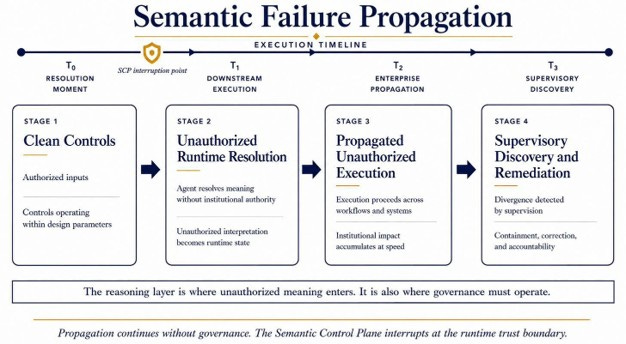
Figure 2. Semantic Failure Propagation
Source: Doyle-Spare (2026), supporting SSRN working papers.
Timeliness and relevance to the current draft
Agentic AI is moving into regulated workflows faster than governance can mature to oversee it. The American Bankers Association and the Bank Policy Institute have jointly urged NIST to convene stakeholders toward voluntary, consensus-based guidance for agentic AI in financial services. The institutional context is increasingly defined by the distance between deployment velocity and governance maturity, set against a regulatory environment that is itself in motion.
On April 17, 2026, the federal banking agencies issued revised interagency guidance on model risk management, Federal Reserve SR 26-2, OCC Bulletin 2026-13, and FDIC FIL-15-2026, superseding SR 11-7 and SR 21-8. The revised guidance states that generative and agentic AI models are novel and rapidly evolving and are outside its model-risk scope, and it directs that an institution’s own risk-management and governance practices should determine the appropriate treatment of related tools, processes, and systems that fall outside that scope.
The scope exclusion does not remove the institution’s governance responsibility. It places greater weight on the institution’s own risk-management practices for the tools, processes, and systems that use these capabilities.
Across shifting standards, a consistent set of objectives recurs. However fragmented the specific rules, they converge on a small number of aims: transparency into how automated decisions are reached, auditability and traceability of those decisions after the fact, and clear accountability for outcomes. They increasingly also reach for assurance before execution instead of reconstruction after it. The recognition that controls applied only after deployment may not meet operational expectations points toward
governance that operates while the system acts, yet the mechanism to deliver that at the reasoning layer is not something the current frameworks define.
This is the gap a TACIP profile is positioned to address. Across the reviewed instruments, transparency and auditability recur as governance objectives, and several also move toward assurance before execution. The reviewed frameworks establish system-level, lifecycle, security, legal, or accountability requirements, but they do not expressly formalize the agent-resolved Operational Interpretation as a distinct per-decision governance object evaluated before consequential action.
The limits of architectural governance alone
The draft’s existing instruments, guardrails and safety wrappers, usage thresholds and rate control, anomaly monitoring, emergency override and shutdown, identity and access management for AI agents, are necessary. They are also, in the terms of this corpus, structural and architectural governance: they set the container within which an agent operates and they govern the artifacts an agent produces. What none of these controls directly governs as a distinct per-decision object is the Operational Interpretation the agent synthesizes before it acts.
The distinction is not a matter of degree. Architecture without principles is instrumentation that does not govern, and principles without architecture cannot be enforced, so both are required.
The problem is one of architectural intent, not model behavior. An agent can stay within every granted permission, invoke only authorized tools, carry no malicious payload, and still execute under an operational interpretation the institution never authorized: a workflow that runs flawlessly on paper but breaches institutional policy. Structural containment does not detect this, because the workflow never leaves its authorized path. A second governance layer is required alongside the structural one: runtime governance of the resolution itself.
This second layer is itself an ordered stack, not a single control. Each layer depends on the layers below it, and each supplies the inputs the next layer acts on. The institution maintains the foundational layer of authoritative meaning; the architecture supplies the semantic evaluation, the runtime authorization, and the organizational evidence surface that reviewers and oversight authorities examine.
Recommended addition. For consequential agentic decisions, identify the governed terms whose operational meaning is resolved at runtime and treat the resulting Operational Interpretation as a distinct governance object. Establish controls to determine whether that interpretation remains within the applicable Reasoning Baseline before the decision proceeds into execution.
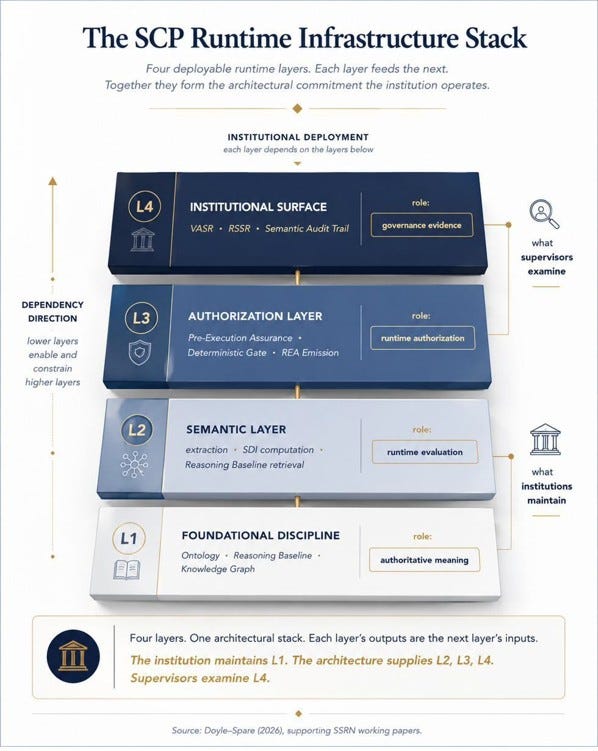
Figure 3. The SCP Runtime Infrastructure Stack Source: Doyle-Spare (2026), supporting SSRN working papers.
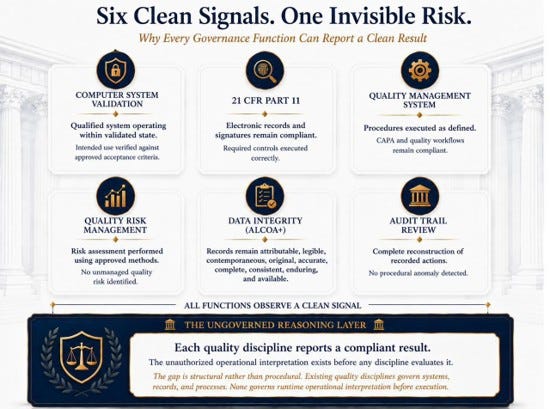
Figure 4. Six Clean Signals. One Invisible Risk.
Source: Doyle-Spare (2026), supporting SSRN working papers.
COMMENT 2, Strategic Governance Open Design Area
Draft reference, Strategic Governance and Executive Translation (Open Design Area): “We seek inputs, including use cases, operational scenarios, and references to regulations and other governance artifacts, to help executive leadership map high-level governance, organizational missions, and compliance obligations to the practices in this document.”
Reasoning-Layer Governance Within a Comprehensive Control Strategy
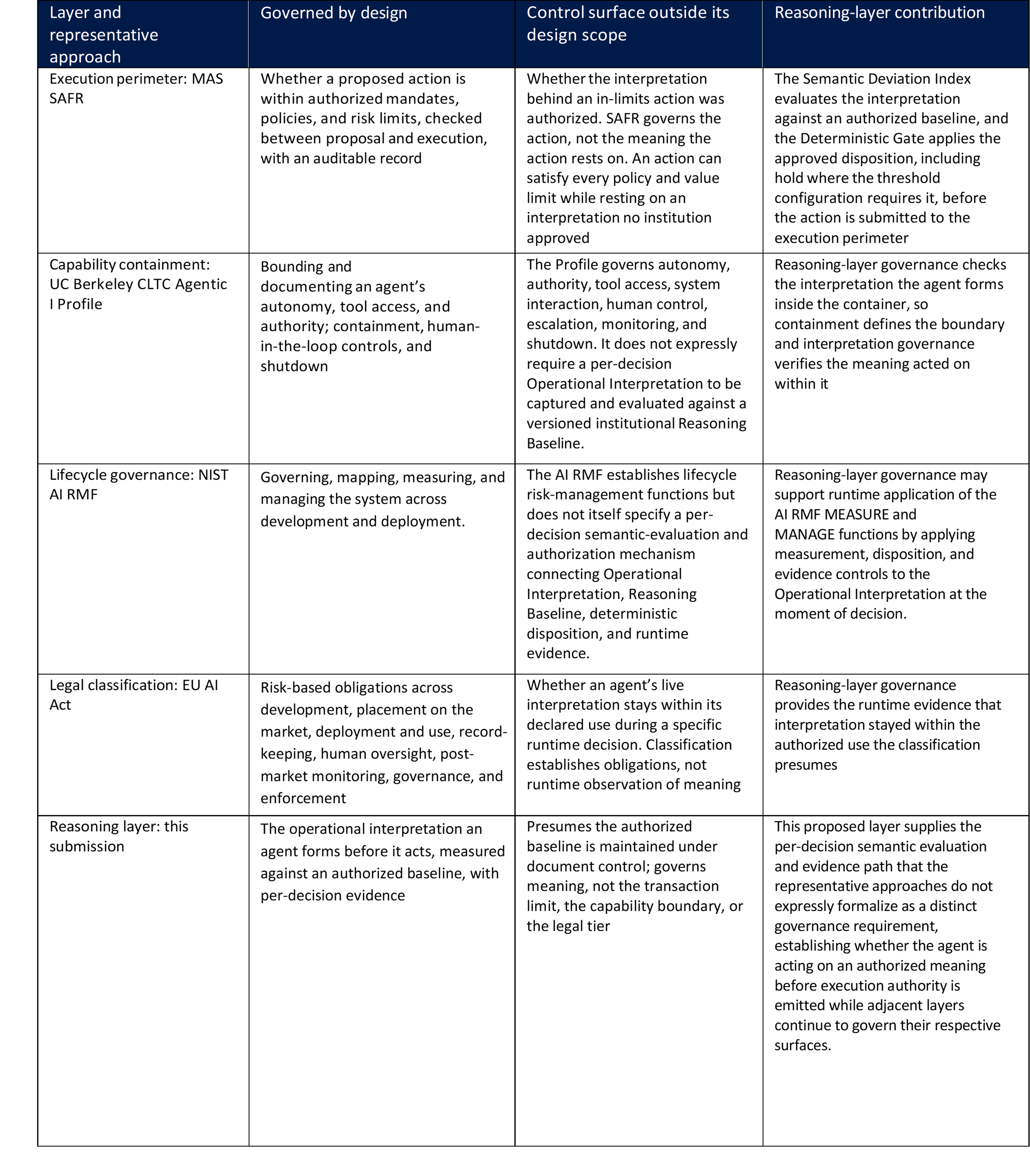
Runtime governance of agentic AI is being approached at several distinct layers of the system, and the pace of new frameworks has made it difficult for institutions to see how these approaches relate. They are frequently read as competing alternatives, though each governs a different layer of the same deployment and no single layer is sufficient on its own. An institution deploying agentic AI needs these approaches working together, as layers of one comprehensive control strategy and not as choices among which to select one.
Each of the established approaches governs its layer correctly and by design. What none of them was designed to govern is the operational interpretation an agent forms before it acts, the meaning it resolves for a regulated term by reconciling multiple authoritative sources at runtime. This reflects no deficiency in
any of these frameworks. It is a control surface the field has only recently recognized, sitting outside the scope each existing approach was built to address. An agent can pass an execution-perimeter check, operate correctly inside a capability container, satisfy every lifecycle control, and hold a valid legal classification, while acting on a meaning no institution authorized. Reasoning-layer governance addresses precisely that layer. It completes the strategy instead of competing with any part of it.
The table below sets out each layer, what it governs well, the specific control surface outside the scope it was designed for, and how reasoning-layer governance fills exactly that surface.
The representative sources below differ in legal status, enforceability, scope, and intended audience. The comparison concerns the governance object each addresses and does not imply equivalence in regulatory authority.
Table 2. Agentic AI Governance as a Layered Strategy Source: Doyle-Spare (2026), supporting SSRN working papers.
Recommended addition. Executive governance should connect mission, policy, and compliance obligations to versioned Reasoning Baselines, decision-class thresholds, accountable owners, and per-decision evidence. Context establishes the authorized meaning, Control determines whether the runtime interpretation may proceed, and Coordination governs how meaning and authority propagate across connected systems.
COMMENT 3, Implementation 3.2.2
Draft reference, Implementation 3.2.2, Define deterministic, operational constraints that the AI system should remain within: “Define the boundary that the AI system should remain within for safe operation. These might be in-and out-of-range values, semantic and behavioral constraints, rate-of-change violations, and deterministic logical constraints that should be respected regardless of the AI system’s confidence level.”
A Deterministic, Measurable Constraint at the Reasoning Layer
Implementation 3.2.2 asks organizations to define deterministic operational constraints, including semantic and behavioral constraints that must be respected regardless of the AI system’s confidence level. The reasoning-layer constructs below are one way to make a semantic constraint measurable and enforceable at runtime: a divergence measure that scores the resolved interpretation against an authorized definition, a deterministic enforcement point that acts on that score, and controlled governance of the authorized definition and thresholds. This responds directly to the semantic-constraint requirement in Implementation 3.2.2 and aligns with the draft’s broader change-management and mitigation provisions.
A blunt containment instrument, a shutdown, a throttle, or a blanket suspension, acts on the whole system after a condition is met. Runtime reasoning-layer governance applies an approved disposition to the specific evaluated interpretation before execution, and it does so through mechanisms that are measurable, enforceable, and reconstructable. This is the difference between switching a system off and governing which computation proceeds beyond the checkpoint.
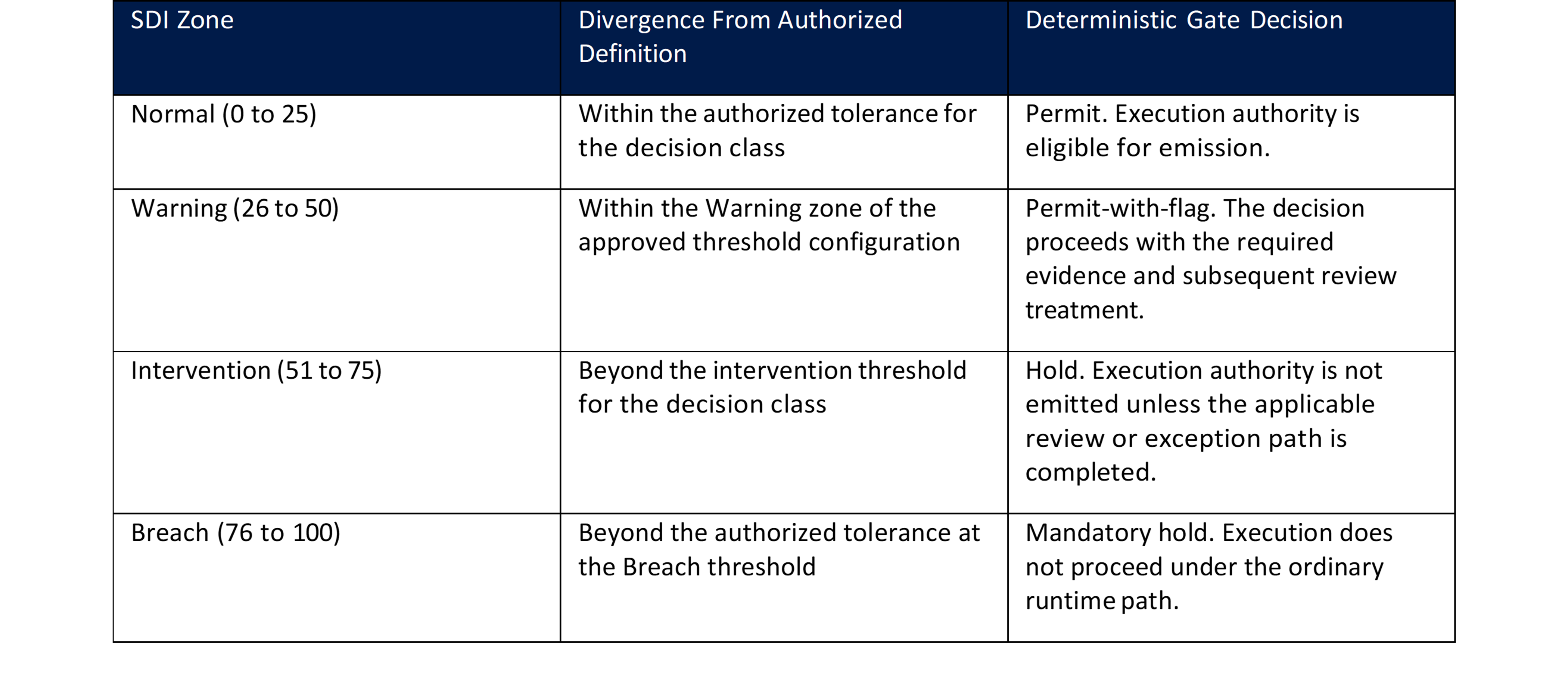
Effective runtime governance depends on two complementary capabilities. The first is a measurable indication that runtime interpretation has diverged from the authorized Reasoning Baseline. Semantic Deviation Index scoring quantifies divergence between the Runtime Semantic State and the institution’s authorized Reasoning Baseline under an approved, versioned component method and configuration. The composite aggregation and zone classification are deterministic and reproducible, producing identical results for identical governed inputs, component outputs, weights, thresholds, Baseline versions, and configuration artifacts. The extraction and component methods that generate those inputs remain governed inputs that require validation and evidence. The second capability is enforcement before execution. The Deterministic Gate is the enforcement boundary between runtime semantic evaluation and authorization. It consumes the governed score and applies the corresponding disposition without independently reinterpreting the decision, so that execution authority is emitted only when the disposition permits it and the required evidence is preserved. It does not reason; it enforces, applying the same disposition to the same measured divergence every time. Given the same SDI input and threshold configuration, the Gate produces the same enforcement action.
The thresholds that separate the zones are institutional parameters, not fixed constants. Each institution sets the tolerance for a decision class through its change-management process, and the same process governs any later adjustment, so a change to a threshold is itself a controlled, audited event rather than a silent reconfiguration. This is the controlled-governance discipline the draft calls for when a constraint is exceeded, consistent with Implementation 3.2.2’s deterministic constraints and the draft’s broader change-management and mitigation provisions. The zones are ordered by increasing divergence, and the
disposition attached to each zone is fixed for a given configuration, so the mapping from a measured score to an enforcement decision is reproducible and independently checkable. The draft’s recurrent model-risk evaluation cadence and the Gate’s threshold-recalibration review are separate governance activities. Recurrent evaluations may follow the drift-velocity and operational-volatility logic in Implementation 2.3.4, while evaluation of whether Gate thresholds remain appropriately calibrated can follow the institution’s existing controls-testing cadence, with any adjustment authorized, versioned, and recorded through the standing change-management workflow.
Measurement without enforcement stays advisory, and enforcement without measurement is arbitrary. Together they make authorization a decision the system reaches at runtime instead of an assumption it inherits.
The Reasoning Baseline is distinct from the performance and operational baselines the draft already addresses. A performance baseline describes expected system behavior under defined conditions. The Reasoning Baseline is the authoritative institutional artifact defining the authorized meaning of a governed term for a decision class, maintained under institutional change control, against which the resolved interpretation is evaluated. The two are different control objects, and a profile that names both should keep them separate.
The Deterministic Gate maps the score to graded dispositions familiar to anyone who has run a control function: permit, permit-with-flag, hold, and mandatory hold. Interpretations within the Normal zone are permitted. Those in the Warning zone are permitted with a recorded flag for later scrutiny. Those in the Intervention zone are held for the applicable review or exception path, and those in the Breach zone are subject to a mandatory hold.
Table 3. Semantic Deviation Index Threshold Zones and the Deterministic Gate Source: Doyle-Spare (2026), supporting SSRN working papers.
These mechanisms produce evidence at two levels. The Runtime Semantic State Record is the per-execution record. For each decision that crosses the institution’s Governance Threshold, it captures the authoritative Reasoning Baseline active for the decision class, including its version, authorizing source, and effective date; the Runtime Semantic State, including the regulated terms and Operational Interpretations resolved; the SDI computation, including component scores, composite score, and threshold zone; the Deterministic Gate decision and routing destination; and the operational context, including workflow identifier, decision class, temporal context, and Knowledge Graph relationship dependencies. Where propagation or containment is relevant to a later reconstruction, the Semantic Audit Trail preserves the broader evidentiary context across dependent workflows. The Semantic Audit Trail aggregates and links those per-execution records into the organizational evidence surface. It preserves the authoritative baseline version, the resolved interpretation, the scores and Gate decisions at each checkpoint, and the propagation of meaning and authority across agents and systems, including the lag between an authorized change to a definition and its propagation into runtime. Subject to the completeness, integrity, and extraction fidelity of the evidence captured at the decision point, these artifacts allow the institution to determine what Operational Interpretation was represented, which Reasoning Baseline version applied, what measurement was produced, and what the Gate decided. That is the per-decision evidence a reviewer or oversight authority needs when something goes wrong, and it is precisely what a blanket shutdown authority does not produce.
Recommended addition. For consequential agentic decisions, define deterministic semantic constraints by evaluating the agent-resolved Operational Interpretation against a versioned and authorized Reasoning Baseline. Apply an approved threshold configuration to produce a deterministic disposition before authorization proceeds into execution, and preserve the baseline, interpretation, measurement, configuration, disposition, and authorization treatment as decision-level evidence.
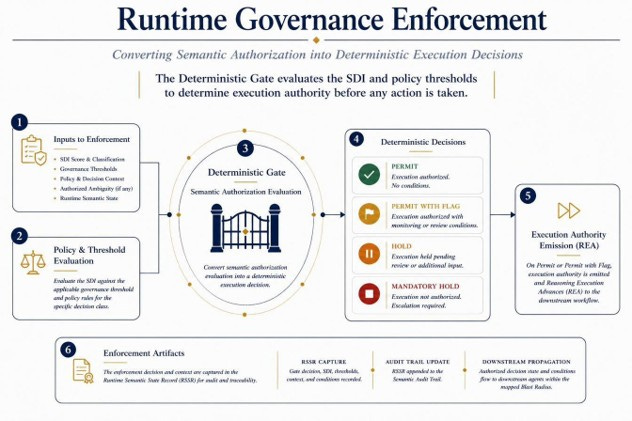
Figure 5. Runtime Governance Enforcement
Source: Doyle-Spare (2026), supporting SSRN working papers.
COMMENT 4, Task 4.5
Draft reference, Task 4.5, Define operational regimes for human-on-the-loop and human-out-of-the-loop operation: “Identify operational contexts where real-time, manual human-in-the-loop (HITL) oversight is physically or technically infeasible due to tight system time constants (such as stability anomalies operating in milliseconds, real-time industrial control loops, or machine-speed cyber defense events).”
Calibrated Oversight Where Per-Decision Human Review Does Not Scale
This architecture addresses the subset of Task 4.5 regimes in which manual review is infeasible at orchestration cadence but a deterministic pre-execution checkpoint remains operationally tolerable. It is not proposed for millisecond or microsecond control loops that cannot support that checkpoint. The Runtime Governance Applicability Test places those deployments outside enforceable scope and requires an alternate deterministic safeguard, reduced autonomy, or another approved control path.
Organizations deploying agentic AI in consequential workflows operate within a structural ceiling. Governance at the reasoning layer is often sustained through pervasive human-in-the-loop supervision, a model in which the institutional reviewer remains the authorization point for every material decision. That
model is consistent with established oversight and control expectations, and it imposes a ceiling on scale. When a human must authorize every material decision, the institutional benefit of agentic AI is bounded by the review capacity available to sustain that coverage, and the autonomy the profile is written to govern cannot be realized.
Runtime reasoning-layer governance applies the discipline every control function already uses: review by exception. Reviewing every compliant action is neither practical nor necessary. Interpretations that remain within authorized semantic tolerance may proceed under the approved operating regime, while flagged or held interpretations receive the review, exception, containment, or safe-state treatment assigned to their disposition and decision class. The measurement adds no blanket burden; it concentrates existing review onto the decisions that actually departed from authorized meaning.
The shift is from Human-in-the-Loop, where a human is present at each decision point, to Human-on-the-Loop, where human authority defines the runtime boundaries within which agentic reasoning is permitted to operate.
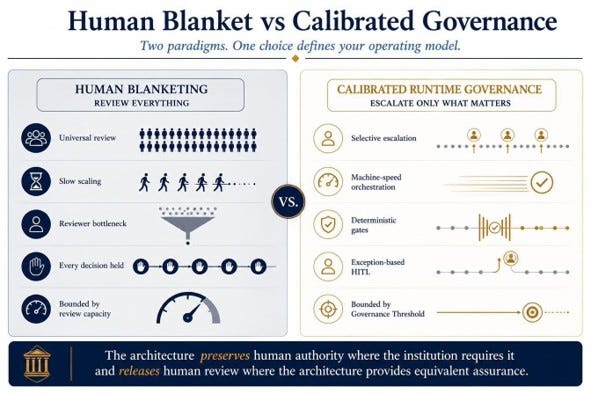
Figure 6. Human Blanket vs Calibrated Governance Source: Doyle-Spare (2026), supporting SSRN working papers.
This is calibrated governance, applied where institutional authority thresholds justify it, and not blanket runtime governance applied across the entire agentic surface. The target domain is the set of workflows in which an institution already tolerates governance latency because an unauthorized Operational
Interpretation carries material governance, safety, or operational consequence. Governance is not imposed on every agentic decision, and it is not imposed on workflows that already run end to end without institutional adjudication. It applies selectively to the decision classes that cross the institution’s Governance Threshold, which keeps the added latency bounded and confined to the decisions where the institution would accept it in exchange for assurance. Where a deployment does not expose the runtime representations required to evaluate resolution against an authorized baseline, the Runtime Governance Applicability Test scopes that deployment out rather than assuming coverage the architecture cannot provide. For a consequential decision class, an out-of-scope result does not establish that the deployment is safe; it indicates that the organization must add the required runtime representation, reduce autonomy, apply an alternate deterministic safeguard, or route the decision through another approved control path. The result is institutional enablement: high-consequence autonomous execution under preserved accountability, at the cadence the orchestration requires, with the traceability the setting demands.
Recommended addition. Where real-time human-in-the-loop review is infeasible, define the decision classes, semantic tolerances, deterministic dispositions, safe-state or exception routes, and evidence requirements that will govern autonomous execution. Human-on-the-Loop oversight retains institutional authority over those boundaries and over the approved treatment of flagged or held decisions.
COMMENT 5, Task 2.4
Draft reference, Task 2.4, linguistic and domain-context robustness testing: “Integrate domain-specific linguistic
and contextual validation into the system’s TEVV protocols.”
Testing for Divergent Meaning Across Authoritative Sources
The August 3 draft now addresses domain knowledge and linguistic alignment in Task 1.4 and tacit institutional knowledge for generated operational artifacts in Implementation 1.4.4. Those provisions strengthen the requirements and artifact-validation surfaces. The remaining gap addressed here is different: whether an agent resolving multiple individually authoritative but non-aligned sources synthesizes an Operational Interpretation that remains within the applicable Reasoning Baseline at the moment of decision.
Integrating domain-specific linguistic and contextual validation into TEVV protocols is the natural place to evaluate the failure this comment describes, because the failure originates in how an agent reconciles domain terminology across sources rather than in how it parses any single input. Standard robustness testing asks whether the system interprets a term correctly. The reasoning-layer condition asks a further question: whether the system, when several individually authoritative sources assign different meanings, thresholds, exception structures, or authority implications to the same governed term, synthesizes an operational interpretation that corresponds to none of them.
A practical test constructs cases in which contributing systems carry divergent working definitions of a governed term and evaluates whether the agent resolves an operational interpretation that remains
within the institution’s authorized meaning. The biologics scenario in Comment 1 is one instance: the procedure, the specification, and the accumulated history each define the criticality boundary differently, and the test succeeds when it detects that the agent has resolved an Operational Interpretation outside the applicable Reasoning Baseline. The evaluation records the sources consulted and the operational definition applied, which are the same externally observable governance artifacts the reasoning layer is evaluated through.
Adding this case to domain-context robustness testing would let the profile detect divergent-meaning synthesis before deployment, complementing the runtime measurement described in the preceding comments. Pre-deployment testing establishes that the condition can occur for a given decision class, and runtime governance addresses it at the moment of the decision.
Recommended addition. For consequential agentic decisions, construct test cases in which individually authoritative sources assign different meanings, thresholds, exception structures, or authority implications to the same governed term. Verify that the system does not synthesize an Operational Interpretation outside the applicable Reasoning Baseline without detection and governed routing, and preserve the evaluated source versions, baseline version, resolved interpretation, measurement result, and disposition.
COMMENT 6, Implementations 8.1.2, 10.1.2, 3.5.1, and 4.4.2
Draft reference, Implementations 8.1.2, Identify AI systems that may not satisfy root cause analysis requirements; 10.1.2, Immutable Runtime Telemetry and Artifact Tracking; 3.5.1, Map direct functional and algorithmic dependencies; and 4.4.2, Adapting legacy alarm management for AI’s non-deterministic failure modes. The first three address forensic reconstruction, immutable runtime telemetry, and dependency mapping. Implementation
4.4.2 identifies the additional problem of dynamic and undocumented agent dependencies and requests partial mitigations for multi-agent feedback loops.
Runtime Evidence for Forensic Reconstruction and Adjacent-System Risk
Implementations 8.1.2 and 10.1.2 call for forensic evidence that ordinary runtime telemetry may not fully provide for agentic systems. Implementation 3.5.1 adds the dependency-mapping requirement, and Implementation 4.4.2 adds the distinct problem of dynamic and undocumented dependencies in multi-agent workflows. Runtime telemetry records what an agent did, and for a critical-infrastructure profile the examinable question is also what meaning the agent acted under when it did it. The Runtime Semantic State Record described in Comment 3 supplies the semantic portion of that per-decision evidence: it preserves, for each in-scope decision, the captured Runtime Semantic State representing the Operational Interpretation, together with the applicable Baseline, measurement, and Gate decision.
Applied to these forensic implementations, that record lets a reviewer reconstruct the captured representation of the interpretation under which the agent acted, not only the action it took, which is the part of the forensic picture runtime telemetry leaves open for agentic systems with ephemeral context.
The draft’s concern with cascading failure across interdependent systems corresponds to a defined
construct in the supporting corpus. The Agentic Blast Radius is the propagation surface across which an
upstream agent’s resolved state flows into downstream agentic decisions, mapped by the Knowledge Graph and contained through the architecture’s runtime mechanisms. It supports containment and reconstruction by identifying the governed relationships through which an unauthorized Operational Interpretation and its resulting outputs traveled. The completeness of that view depends on the coverage, currency, and version integrity of the relationship model the architecture maintains. Where the
reasoning-layer evidence preserves the captured Runtime Semantic State for a single agent, the Agentic Blast Radius indicates how far the represented Operational Interpretation and its resulting outputs may have propagated across the dependencies represented in the relationship model before detection or containment.
The August 3 draft also identifies, in Implementation 4.4.2, a difficult case in which agentic systems form dynamic and undocumented dependencies and asks for partial mitigations for multi-agent feedback loops. The Agentic Blast Radius provides such a partial mitigation where the relevant semantic relationships are represented, versioned, and kept current in the relationship model. It makes known dependencies traceable for containment and reconstruction, but it does not by itself discover every undocumented runtime dependency. That residual discovery limitation should remain explicit.
The table below maps each construct to the specific provision it supports.
Table 4. Reasoning-Layer Extensions Mapped to the Draft’s Provisions
Source: Doyle-Spare (2026), supporting SSRN working papers.
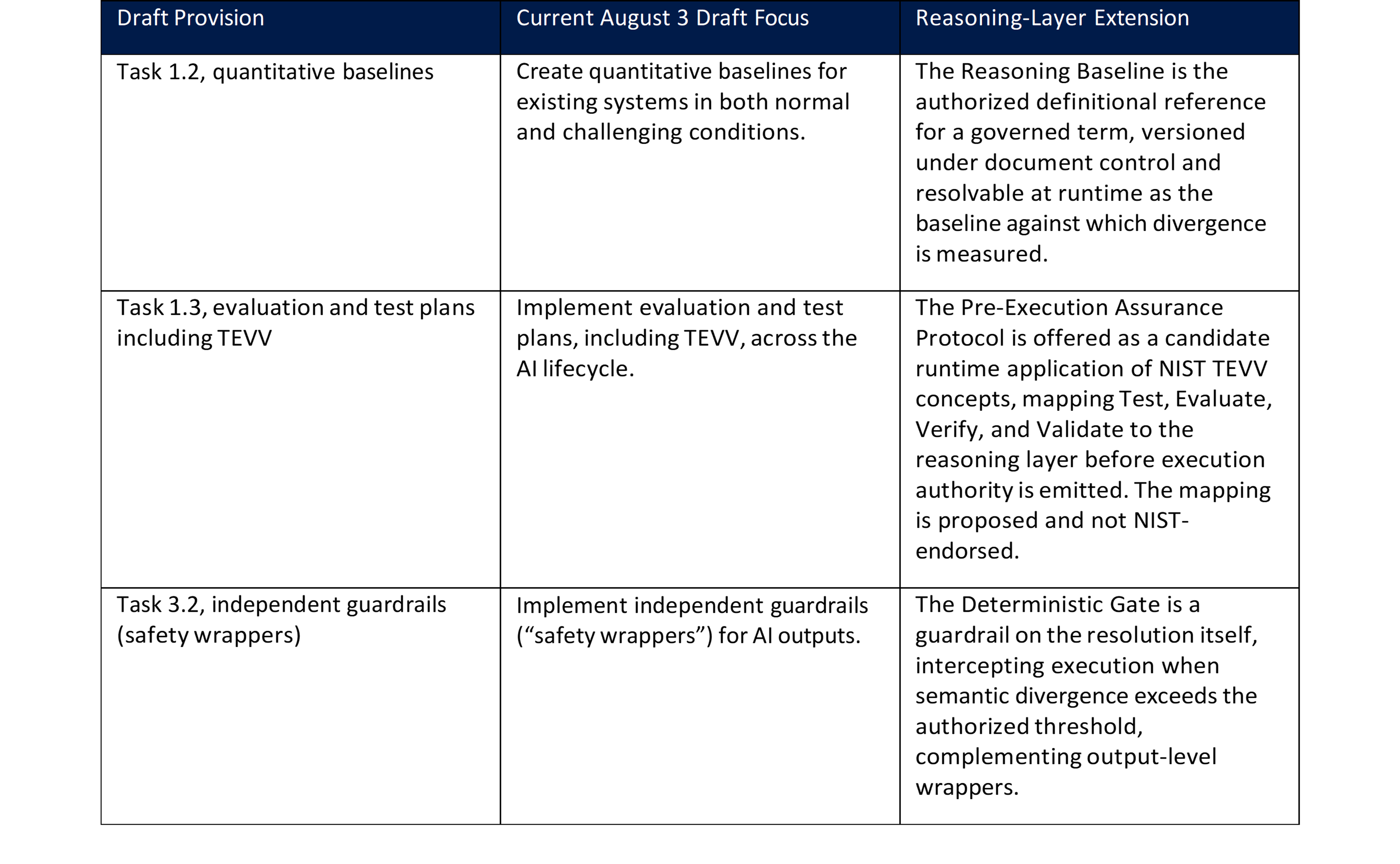
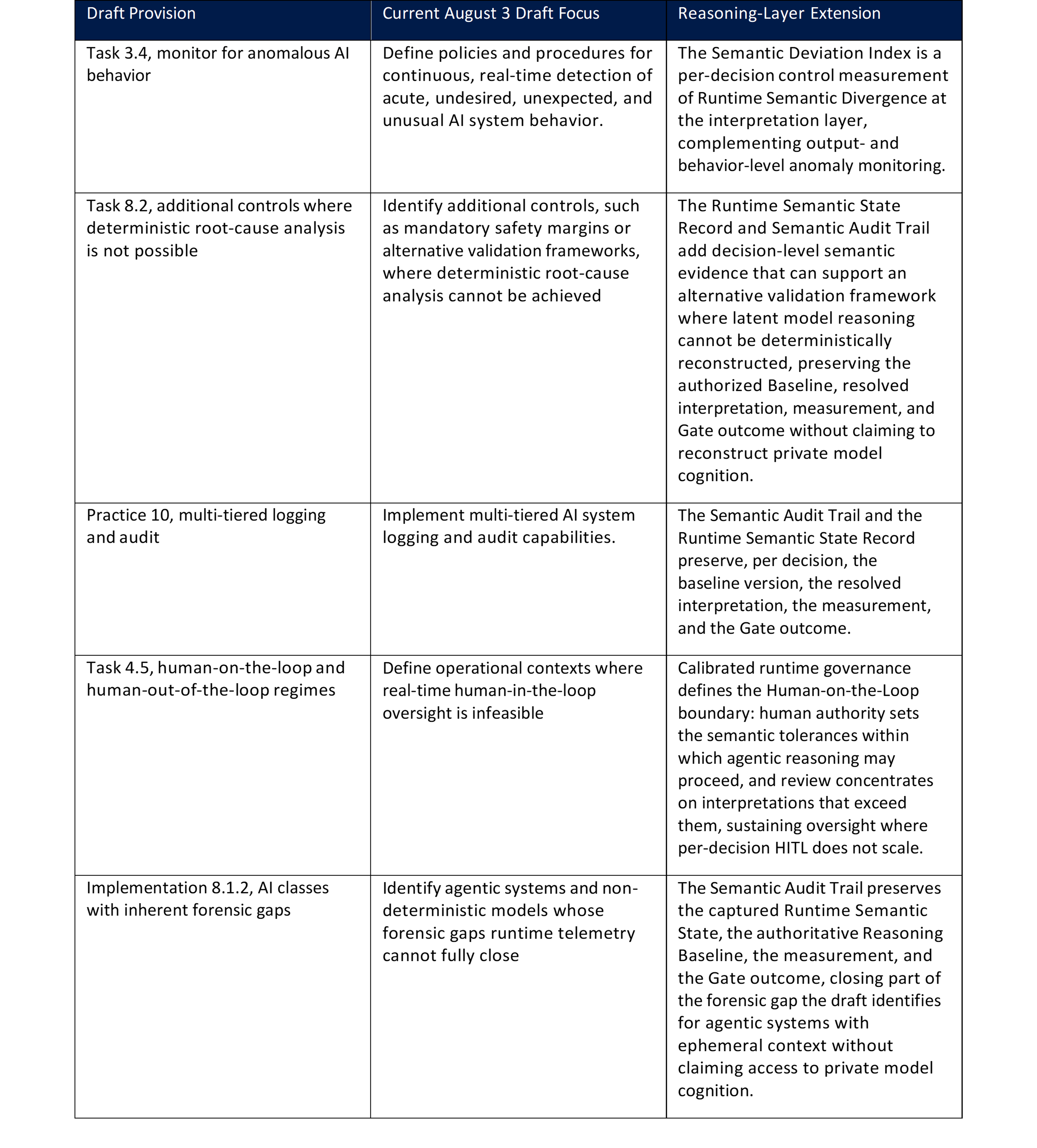
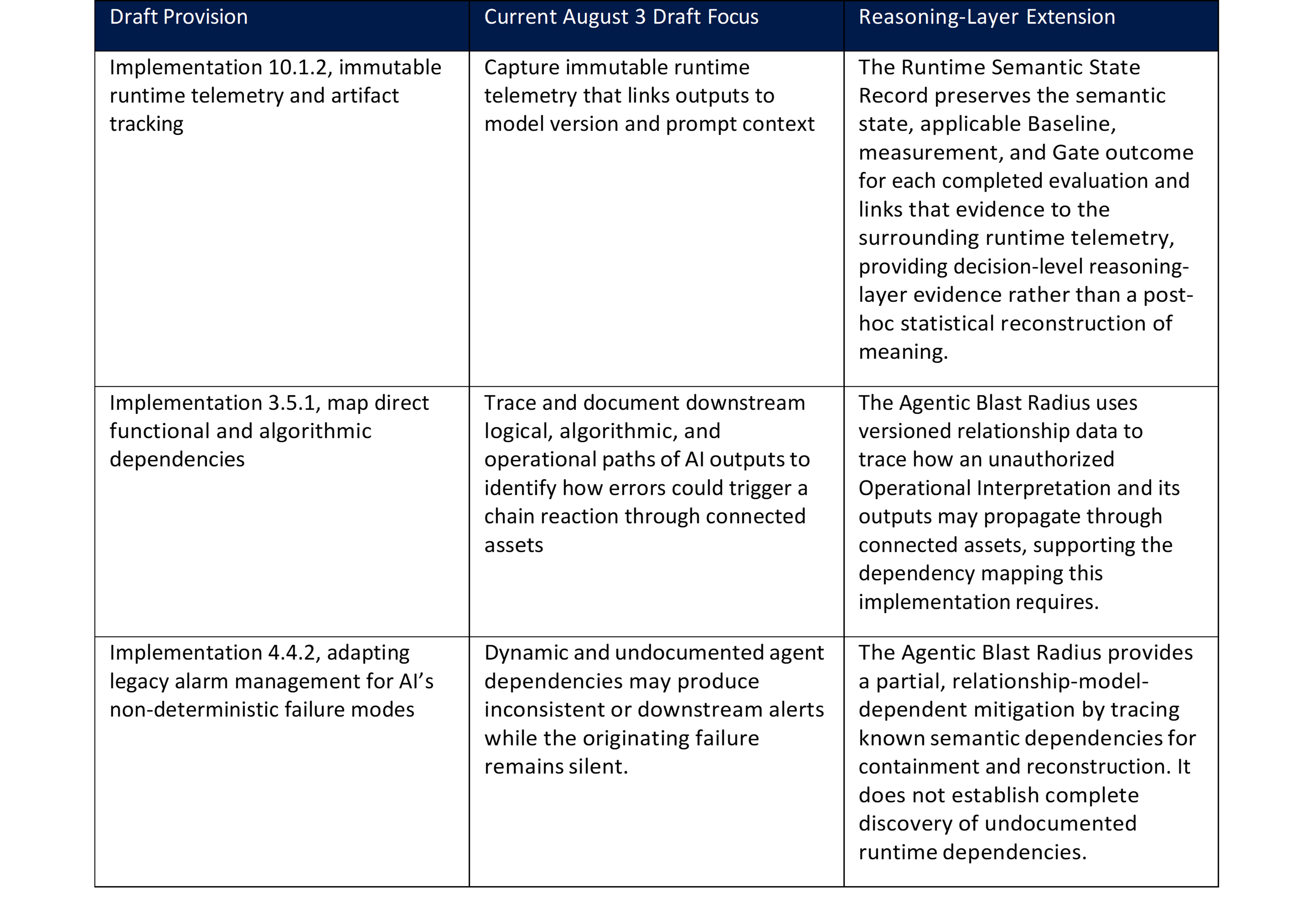
The constructs above are not a parallel framework. They map onto specific provisions of the draft, its Tasks, Practices, and Implementations, extending each into the reasoning layer it does not yet reach.
Recommended addition. For consequential agentic decisions, immutable runtime evidence should link the applicable Reasoning Baseline and version, the resolved Operational Interpretation or Runtime Semantic State, the governed measurement inputs and results, the threshold configuration, the Gate disposition, the authorization treatment, and the affected dependencies to the extent represented by versioned relationship data.
COMMENT 7, Scope and Sector Alignment
Draft reference, Scope and Sector Alignment: “We prioritize shared challenges that offer transferable, cross-sector
insights. What universally critical elements are missing?”
A Common Pattern Across Jurisdictions and Three Regulated Sectors
The reasoning-layer governance object sits within existing governance and oversight expectations without requiring the cited frameworks to be reinterpreted. The crosswalks below are drawn from the published corpus. They demonstrate a consistent pattern: existing frameworks govern artifacts, processes, models,
controls, and outcomes, while runtime governance governs the semantic-resolution process through which execution authority is formed.
NIST AI RMF and the runtime application of TEVV
The Semantic Control Plane may support institutional application of the AI RMF MEASURE function by producing runtime evidence relevant to behavior assessment at the reasoning layer. Its Pre-Execution Assurance Protocol steps are offered as a candidate runtime application of NIST TEVV concepts. The mapping below is a candidate runtime application, not a NIST-endorsed mapping.
Table 5. Runtime Application of NIST TEVV Concepts to the Pre-Execution Assurance Protocol Source: Doyle-Spare (2026), supporting SSRN working papers.
Cross-jurisdictional convergence
The same institutional governance pattern appears across jurisdictions. Existing frameworks increasingly expect institutions to demonstrate accountable governance, oversight, and risk management of AI-enabled decisions, not merely observation of their outputs. The crosswalk below maps the reasoning-layer contribution against the major supervisory and standards frameworks.
The instruments below differ in legal status, jurisdiction, scope, enforceability, and intended audience. The comparison identifies their principal governance objects and does not imply equivalence in authority or legal effect.
Table 6. Reasoning-Layer Contribution Mapped Against Representative Governance, Supervisory, and Standards Frameworks Source: Doyle-Spare (2026), supporting SSRN working papers.
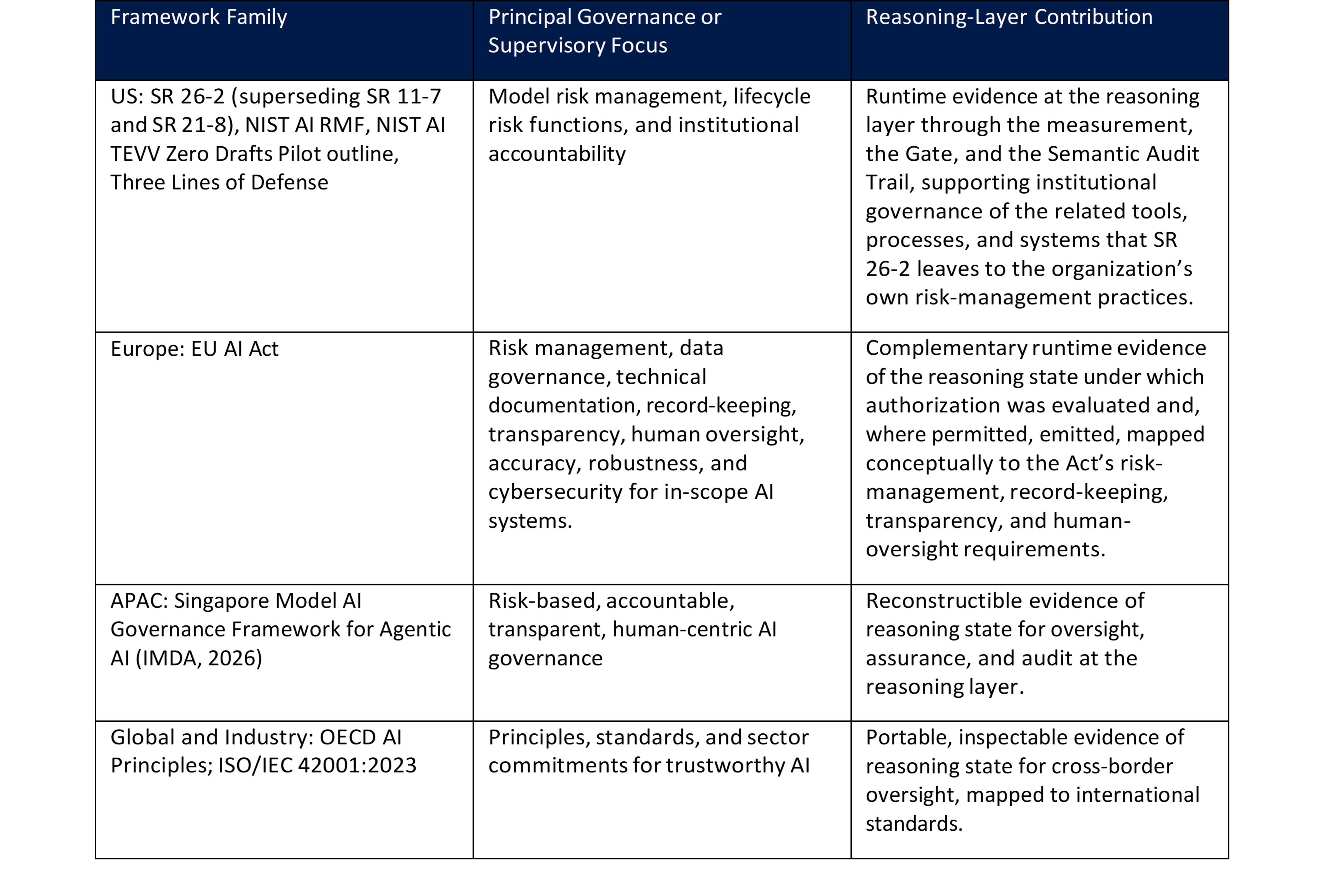
Three crosswalks in the supporting corpus develop this mapping at the operating-principle level: the Agentic 3 C’s Framework maps to the NIST AI RMF functions, to the EU AI Act at the article level, and to the Financial Services AI Risk Management Framework. Each governs an object adjacent to runtime interpretation, the process, the organization, the software, the model, and each is necessary. None governs, as a distinct object, the interpretation an agent forms in the moment it acts.
A common gap across three regulated sectors
The reasoning-layer gap is not a financial-services artifact. It appears wherever agentic systems resolve the operational meaning of a governed term before acting, and the frameworks that govern each sector share the same structural limitation. The crosswalk below places the primary regulatory instruments of financial services, defense, and life sciences side by side. Each governs the system, the model, the documentation, or the lifecycle. In each sector, the runtime interpretation an agent forms before it acts is not formalized as a distinct governed object. The regulatory instruments differ across sectors, while the same structural gap recurs in each of the three sectors examined.
Table 7. A Common Reasoning-Layer Gap Across Three Regulated Sectors Source: Doyle-Spare (2026), supporting SSRN working papers.
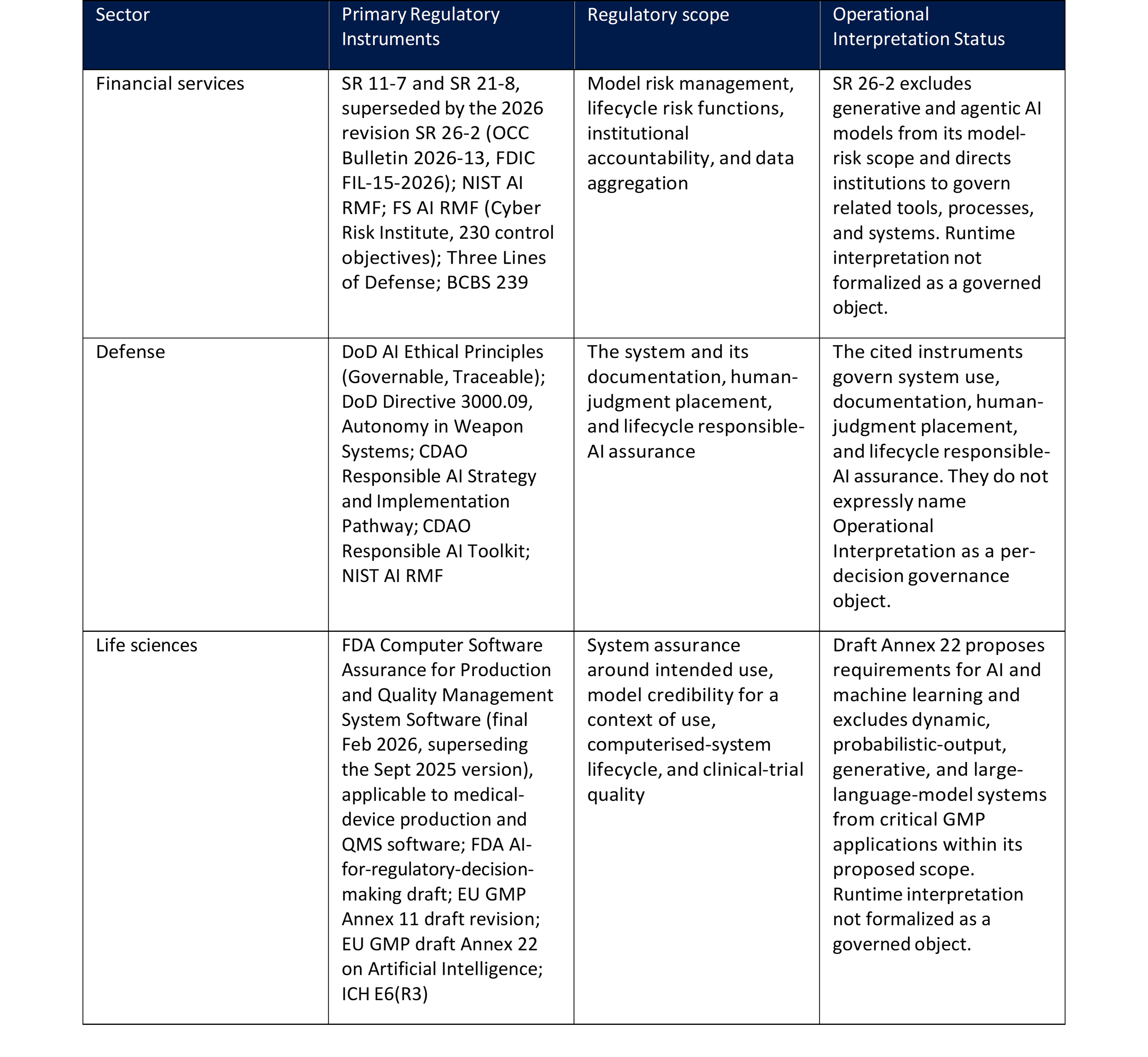
The consistency across the reviewed instruments is the finding. Each governs an object adjacent to the runtime interpretation, including the system, the model, the record, the process, or the organization, and each remains necessary. The cited instruments do not expressly formalize the Operational Interpretation an agent resolves at the moment of decision as a distinct governed object with a per-decision evaluation and evidence path. A critical-infrastructure profile that names this object once would address a cross-sector gap demonstrated in the three sectors examined here and provide a common object that other sectors can assess against their own requirements.
Recommended addition. A critical-infrastructure profile can name the Operational Interpretation once, as a cross-sector runtime governance object, and let each sector map its own regulatory instruments to that object rather than restating the requirement sector by sector.
COMMENT 8, Tasks 3.5 and 3.8
Draft reference, Task 3.5, Define and control risks to adjacent and related systems: “Define and control risks to other systems that may be affected by a failure in this system, including: Systems that are intentionally interdependent with this system, where errors travel along functional, data, or operational dependencies (“cascading failures”). Systems that may be unrelated except for shared adjacency in a physical, logical, network, resource, supply chain, or other sense (“splash damage” or “blast radius”).”
Draft reference, Task 3.8, Scope and map the expanded AI Attack Surface and Risk Surface: “Catalog both the adversarial exploitation vectors (AI Attack Surface) and the non-adversarial, systemic vulnerability vectors (AI Risk Surface) introduced by AI deployment across all lifecycle stages.”
Naming the Governance Surface Also Names an Attack Surface
This comment responds directly to the draft’s request for ways to bring cybersecurity concepts into the
profile without duplicating the guidance of the Cyber AI Profile (NIST IR 8596).
Formalizing the reasoning layer as a governance surface also identifies a corresponding cybersecurity and integrity surface whose protection is necessary to preserve institutional control. The reasoning layer is a governance surface, and it is also a target surface where adversaries may operate. The same properties that make it governable make it a candidate target for adversarial manipulation.
That deliberate form is the Semantic Layer Integrity Attack (SLIA), named as a candidate cross-system threat class operating at the reasoning-layer control surface. It is defined by its architectural target, the Runtime Semantic State artifacts and adjacent governance dependencies through which Operational Interpretation is inferred and evaluated, rather than by any single compromise mechanism. The attack does not require modification of model behavior or model parameters. It succeeds when manipulation of those artifacts or dependencies produces a false Gate outcome, including authorization under a corrupted interpretation or improper denial of an authorized one, while the underlying model continues to operate nominally.
This matters for a TACIP profile in the specific way the draft scopes its own cybersecurity boundary. The draft deconflicts from the Cyber AI Profile and focuses on bounding and containing downstream operational consequences rather than mitigating exploit payloads or threat vectors. The reasoning-layer integrity concern sits precisely on the operational-consequence side of that boundary: the exploit mechanism is a matter for the Cyber AI Profile, while the operational consequence, execution proceeding under a corrupted interpretation while the model operates nominally, is exactly the kind of downstream operational effect this profile is written to contain. Institutions organize controls, ownership, reporting, detection, and supervisory engagement around named categories of risk. Adjacent AI-security taxonomies catalog attacks against the model and data layers, including adversarial inputs, prompt injection, and training-data poisoning. A Semantic Layer Integrity Attack operates against the artifacts through which the governance architecture infers the operational interpretation, a surface that adjacent model-, prompt-, identity-, tool-, and data-security controls do not by themselves establish as a distinct runtime integrity object, and it does not require the adversary to break the model, breach the network, or force an unauthorized tool call, which may be entry mechanisms but are not the target. The runtime evaluation described in the preceding comments supplies the authorization and containment point, but it cannot by itself assure the integrity of the artifacts on which that evaluation depends. A Semantic Layer Integrity Attack may manipulate the Reasoning Baseline, semantic extraction artifacts, relationship model, threshold configuration, Gate configuration, or runtime evidence while the underlying model continues to operate nominally. The Cyber AI Profile should address the technical threat mechanisms and integrity controls. This profile should address the resulting authorization, fail-safe, containment, continuity, and reconstruction requirements when integrity cannot be established. Naming the operational integrity requirement alongside the governance surface allows an institution to assign ownership and reporting for it rather than absorbing it as an unnamed byproduct of adjacent attack classes. A profile that names the reasoning layer as a governance object should name its operational integrity as a control requirement in the same place.
Recommended addition. Under Task 3.8, classify deliberate manipulation of Reasoning Baselines, semantic extraction, relationship models, threshold and Gate configurations, or runtime evidence within the AI Attack Surface. Classify non-adversarial corruption, version drift, synchronization failure, or misconfiguration affecting the same artifacts within the AI Risk Surface. Under Task 3.5, treat the resulting false authorization, improper denial, propagation, containment, continuity, and reconstruction impacts as adjacent-system operational consequences. Coordinate technical threat mechanisms and integrity controls with the Cyber AI Profile.
COMMENT 9, Glossary Priorities
Draft reference, Glossary Priorities: “Which terms are most likely to cause confusion when bridging the gap between AI development and real-world critical infrastructure governance? What specific definitions or semantic conflicts should we explicitly clarify to prevent communication breakdowns between sectors or along the supply chain?”
Terminology at the Reasoning Layer
The draft asks which terminology conflicts are most likely to cause communication breakdowns across sectors and the supply chain. The reasoning-layer constructs in this comment depend on a small set of terms whose meaning is easily confused with adjacent, more familiar terms. The following definitions and distinctions are offered for a glossary.
Operational Interpretation. The decision-specific meaning an agent resolves from applicable policy, data, context, and governed terms before it acts.
Reasoning Baseline. The versioned, institutionally authorized semantic reference against which the Operational Interpretation for a decision class is evaluated.
Runtime Semantic Divergence. The single-decision condition in which the Runtime Semantic State departs from the applicable Reasoning Baseline.
Semantic Authorization. The runtime verdict produced after the Operational Interpretation has been evaluated under the applicable governance configuration.
Authorization Emission. The event at which the authorization verdict crosses the runtime trust boundary into execution.
Runtime Semantic State Record. The per-decision evidence record preserving the semantic evaluation inputs, governing artifacts, result, disposition, authorization treatment, and context required for reconstruction.
Three distinctions are worth preserving explicitly, because each pairs a reasoning-layer term with a more familiar one that means something different.
Reasoning Baseline versus performance or operational baseline. One defines authorized meaning; the other characterizes expected system behavior under defined conditions.
Runtime Semantic Divergence versus model, concept, or data drift. Runtime Semantic Divergence is a single-decision semantic condition, not a statistical change measured across a population or over time.
Semantic Authorization versus identity and access authorization. Identity and access controls establish who or what may invoke a resource. Semantic Authorization establishes whether the resolved meaning for a particular decision may proceed into execution.
Recommended addition. A glossary that distinguishes these six terms, and the three pairings above, would reduce cross-sector and supply-chain ambiguity when institutions describe reasoning-layer controls to each other and to reviewers, auditors, regulators, and other oversight authorities.
Summary and Recommendations
The reasoning layer of agentic AI is a governance layer the existing perimeter does not directly address, not because the perimeter is deficient but because it was calibrated to surfaces producing observable artifacts and the reasoning layer does not produce them by default. The recommendation is narrow and specific.
First, the draft should treat the runtime operational interpretation an agent resolves before acting as a distinct governance object, alongside the system, the model, the data, and the process it already addresses. Second, it should recognize that governing this object is a runtime function, measurable, enforceable, and reconstructable, and not a post-hoc review or a blunt containment control. Third, it should acknowledge the evidence artifacts an oversight authority would expect for this object: a measurable divergence signal, a deterministic enforcement decision, and a per-decision record of the baseline, the resolved interpretation, the measurement, and the outcome.
In examination terms, that evidence answers three questions: what Operational Interpretation was represented at the decision point, what institutional authority and authorized Reasoning Baseline governed the decision, and what record demonstrates alignment. These are the questions a critical-infrastructure profile is ultimately written to let an institution answer.
Authority is verified before execution instead of assumed at execution.
Existing controls still matter. Runtime reasoning-layer governance extends that assurance into the one part of execution the existing framework was never designed to supervise: the operational interpretation an autonomous agent forms immediately before it acts, so both approaches are necessary. The institutions that scale agentic AI safely will govern the second with the same discipline they bring to the first.
The recommendations and frameworks referenced are the independent research of the submitter and are not associated with any employer. This submission is offered in an individual capacity as an independent researcher in AI governance.
References
American Bankers Association and Bank Policy Institute. (2026). Joint letter to NIST re: Request for Information Regarding Security Considerations for Artificial Intelligence Agents (Docket No. NIST-2025-0035). March 9, 2026.
Basel Committee on Banking Supervision. (2013). Principles for effective risk data aggregation and risk reporting (BCBS 239). Bank for International Settlements.
Board of Governors of the Federal Reserve System. (2021). Interagency Statement on Model Risk Management for Bank Systems Supporting Bank Secrecy Act/Anti-Money Laundering Compliance (SR 21-8). April 9, 2021.
Board of Governors of the Federal Reserve System. (2026). Supervision and Regulation Letter SR 26-2: Revised Guidance on Model Risk Management. April 17, 2026. Supersedes SR 11-7 and SR 21-8.
Cyber Risk Institute. (2026). Financial Services Artificial Intelligence Risk Management Framework (FS AI RMF), Version 1.0. Developed through the Financial Services Sector Coordinating Council AI Executive Oversight Group.
Doyle-Spare, M. (2026). Agentic AI Cyber Subversion: The Semantic Layer Integrity Attack as a New Threat Class Against the Reasoning Layer. SSRN Working Paper No. 6926219.
Doyle-Spare, M. (2026). Agentic AI Systems Governance: A Runtime Reference Architecture for the Reasoning Layer and the Semantic Control Plane in Regulated Financial Institutions. Zenodo. https://doi.org/10.5281/zenodo.20749051
Doyle-Spare, M. (2026). Agentic Workflow Drift and Agentic Workflow Subversion: A New Risk Taxonomy for the Governance of Agentic AI in Financial Services. SSRN Working Paper No. 6459612.
Doyle-Spare, M. (2026). The Agentic 3 C’s Framework: A Reasoning-Layer Risk Governance Model for Agentic AI in Financial Services. SSRN Working Paper No. 6674761.
Doyle-Spare, M. (2026). The Economics of Agentic AI: Runtime Governance as a Distinct Determinant of Enterprise AI Cost. SSRN Working Paper No. 7129939.
Doyle-Spare, M. (2026). The Semantic Deviation Index (SDI): A Runtime Measurement Standard for the Governance of Agentic AI in Financial Services. SSRN Working Paper No. 6531238.
European Commission. (2025). EudraLex Volume 4, Draft Annex 22, Artificial Intelligence. Stakeholder consultation, 7 July to 7 October 2025. https://health.ec.europa.eu/consultations (accessed July 2026).
European Commission. (2025). EudraLex Volume 4, Draft Revised Annex 11, Computerised Systems. Stakeholder consultation, 7 July to 7 October 2025. https://health.ec.europa.eu/consultations (accessed July 2026).
European Parliament and Council of the European Union. (2024). Regulation (EU) 2024/1689 laying down harmonised rules on artificial intelligence (Artificial Intelligence Act). Official Journal of the European Union.
Federal Deposit Insurance Corporation. (2026). FIL-15-2026, Agencies Revise the Interagency Model Risk Management Guidance. April 17, 2026.
Federal Reserve Board. (2011). Supervisory Guidance on Model Risk Management (SR 11-7). Board of Governors of the Federal Reserve System.
Infocomm Media Development Authority. (2026). Model AI Governance Framework for Agentic AI, Version 1.5. Published 20 May 2026; updated 5 June 2026. IMDA.
International Council for Harmonisation. (2025). ICH E6(R3): Guideline for Good Clinical Practice. Step 4 final guideline, adopted 6 January 2025. https://database.ich.org (accessed July 2026).
ISO/IEC. (2023). ISO/IEC 42001:2023, Information technology, Artificial intelligence, Management system. International Organization for Standardization.
Madkour, N., Newman, J., Raman, D., Jackson, K., Murphy, E.R. and Yuan, C. (2026). Agentic AI Risk-Management Standards Profile. Artificial Intelligence Security Initiative, UC Berkeley Center for Long-Term Cybersecurity, February 2026. Available at: https://cltc.berkeley.edu/wp-content/uploads/2026/02/Agentic-AI-Risk-Management-Standards-Profile.pdf (accessed July 2026).
Monetary Authority of Singapore. (2026). Safeguards for Agentic Finance at Runtime (SAFR). White paper, Version 1.0, July 2026. BuildFin.ai initiative, Monetary Authority of Singapore. Available at: https://www.mas.gov.sg/publications/monographs-or-information-paper/2026/safeguards-for-agentic-finance-at-runtime (accessed August 2026).
National Institute of Standards and Technology. (2023). Artificial Intelligence Risk Management Framework (AI RMF 1.0). NIST AI 100-1.
National Institute of Standards and Technology. (2025). Outline: Proposed Zero Draft for a Standard on AI Testing, Evaluation, Verification, and Validation (TEVV). AI Standards Zero Drafts Pilot.
National Institute of Standards and Technology. (2026). NIST AI RMF Profile on Trustworthy AI in Critical Infrastructure: Community of Interest Discussion Draft. August 3, 2026.
Office of the Comptroller of the Currency. (2011). Sound Practices for Model Risk Management: Supervisory Guidance on Model Risk Management (OCC 2011-12).
Office of the Comptroller of the Currency. (2026). Bulletin 2026-13: Revised Interagency Guidance on Model Risk Management. April 17, 2026.
Organisation for Economic Co-operation and Development. (2019). Recommendation of the Council on Artificial Intelligence (OECD AI Principles). OECD/LEGAL/0449.
U.S. Department of Defense. (2020). DoD Adopts Ethical Principles for Artificial Intelligence (Responsible, Equitable, Traceable, Reliable, Governable). Adopted 24 February 2020. https://www.defense.gov (accessed July 2026).
U.S. Department of Defense. (2023). Directive 3000.09, Autonomy in Weapon Systems. Updated 25 January 2023. https://www.esd.whs.mil (accessed July 2026).
U.S. Department of Defense, Chief Digital and Artificial Intelligence Office. (2022). Responsible Artificial Intelligence Strategy and Implementation Pathway. https://www.ai.mil (accessed July 2026).
U.S. Department of Defense, Chief Digital and Artificial Intelligence Office. (2023). Responsible AI Toolkit. Released November 2023. https://rai.tradewindai.com (accessed July 2026).
U.S. Food and Drug Administration. (2026). Computer Software Assurance for Production and Quality Management System Software. Final guidance, February 2026 (Docket FDA-2022-D-0795), superseding the 24 September 2025 final guidance titled Computer Software Assurance for Production and Quality System Software. https://www.fda.gov (accessed August 2026).
U.S. Food and Drug Administration. (2025). Considerations for the Use of Artificial Intelligence to Support Regulatory Decision-Making for Drug and Biological Products. Draft guidance for industry, published 7 January 2025, Docket FDA-2024-D-4689. https://www.fda.gov (accessed July 2026).
Submitter’s Research
Capstone reference architecture: https://doi.org/10.5281/zenodo.20749051
ORCID: https://orcid.org/0009-0009-6655-1394
SSRN Author Page: https://papers.ssrn.com/Sol3/Cf_Dev/AbsByAuth.cfm?per_id=10836296
ResearchGate: https://www.researchgate.net/profile/Maureen-Doyle-Spare/research
LinkedIn: https://www.linkedin.com/in/maureendoylespare/
GitHub: https://github.com/maureendoylespare/maureendoylespare
INTELLECTUAL PROPERTY: © 2026 Maureen Doyle-Spare. All rights reserved. No part of this article, including its text, figures, tables, and images, may be reproduced or distributed without the author’s prior written permission.
About the Author
Maureen Doyle-Spare
Maureen Doyle-Spare is an enterprise governance architect and independent researcher in AI governance, specializing in agentic AI oversight and cybersecurity for autonomous and multi-agent systems. She is the originator of an agentic AI governance taxonomy built on a set of named constructs, developed for the layer above conventional AI controls, where autonomous agents interpret business meaning across fragmented enterprise systems and commit to it before acting.
Her research develops a runtime governance architecture and a foundational risk and threat taxonomy for the reasoning layer, the pre-execution stage at which an agent’s Operational Interpretation is formed and evaluated. The named constructs include Agentic Workflow Drift and Subversion (AWD/AWS), the Semantic Layer Integrity Attack (SLIA) as a cyber threat class targeting the reasoning-layer attack surface, the Semantic Control Plane (SCP) as a runtime governance mechanism, and the Semantic Deviation Index (SDI) as a measurement standard for semantic divergence. Her central thesis is that agentic systems do not fail the way traditional models fail: an agent can execute flawless steps against a meaning no institution authorized.
Her work spans behavioral visibility, pre-execution oversight, adversarial resilience, autonomous systems evaluation, and safe deployment, and policy crosswalks against the NIST AI RMF, MITRE ATLAS, STRIDE, ISO/IEC 42001, and the EU AI Act. She has provided public comments across multiple NIST AI initiatives, including the AI RMF, CAISI, COSAiS, NCCoE, and TEVV. Her working papers are available on SSRN and Zenodo.
Capstone reference architecture: https://doi.org/10.5281/zenodo.20749051
ORCID: https://orcid.org/0009-0009-6655-1394
SSRN Author Page: https://papers.ssrn.com/Sol3/Cf_Dev/AbsByAuth.cfm?per_id=10836296
ResearchGate: https://www.researchgate.net/profile/Maureen-Doyle-Spare/research
LinkedIn: https://www.linkedin.com/in/maureendoylespare/
GitHub: https://github.com/maureendoylespare/maureendoylespare
Substack:

About this series
Part of the Regulatory Submission Record, a documented archive of practitioner research submitted to standards bodies, financial regulators, insurance regulators and cybersecurity agencies on agentic AI governance, policy and regulation, beginning March 2026.