


Submission Record
Submitter: Maureen Doyle-Spare
Document commented on: NIST AI Standards Zero Drafts Pilot Project — Test, Evaluation, Verification, and Validation (TEVV) Pilot Topic
Date submitted: May 12, 2026 (2026-05-12)
Key IP in Submission — Agentic Governance Model
Definitional Divergence — Executive Summary and Figure 1, worked through a corporate lending example in which credit risk, covenant monitoring and collateral management each define approved differently. Contributing systems each define the same control term differently, each institutionally authorized within its own domain and none explicitly reconciled with the others. The orchestrating agent synthesizes one working definition prior to execution, and that synthesis may not have been institutionally authorized as a unified operational definition. 10.2139/ssrn.6459612
Invisible Failure — Section I.B, defined in the submission and in Appendix A as the failure mode proposed for explicit treatment within TEVV. A failure that produces no broken rule, no alert, and no statistical deviation, because every system performs as designed against a meaning that has shifted. 10.5281/zenodo.20749051
Six Clean Signals — Section I.B and Figure 2. Six established governance functions — cyber, fraud, operational risk, model risk, compliance, and architecture — each observe a clean signal for an agentic deployment that has resolved a meaning the institution did not authorize. Each function performs exactly the role it was designed for; the drift exists in a runtime semantic layer not consistently isolated as a discrete governance surface by any one function. 10.5281/zenodo.20749051
Reasoning Layer — Section II, positioned as a distinct test surface between the model layer and the control surface. The governance surface where an agent resolves operational meaning before execution. It sits between model output and execution and is evaluated through governable runtime representations rather than latent cognition or internal chain-of-thought. 10.5281/zenodo.20749051
Agentic 3 C’s Framework — Section II with Figures 3 and 4, Section IV with Figure 7, and Appendix A. Context, Control, and Coordination. The operating principles the Semantic Control Plane enforces at runtime. 10.2139/ssrn.6674761
Reasoning Layer Risk — Section II.A and Figure 5, positioned against the established credit, market, operational, model and conduct risk categories. The risk that originates in the reasoning layer, before existing governance frameworks are engaged and without a clear owner among established categories. It appears first as Agentic Workflow Drift and becomes Agentic Workflow Subversion when drift propagates across functions, workflows, and control boundaries, including under adversarial conditions. 10.2139/ssrn.6459612
Agentic Workflow Drift (AWD) — Section III and Appendix A, the unintentional form of reasoning-layer divergence. The cumulative institutional operating-state degradation that emerges when unauthorized resolutions are repeatedly executed at the reasoning layer without runtime governance. AWD operates at the institutional-state timescale, distinguished from Runtime Semantic Divergence (RSD), the execution-stage condition at a single agentic decision. Formalized in §3.1 and Doyle-Spare (2026a). 10.2139/ssrn.6459612
Agentic Workflow Subversion (AWS) — Section III and Appendix A, the adversarial form of reasoning-layer divergence. The institutional condition in which an agentic workflow proceeds under an unauthorized resolution. Agentic Workflow Subversion may arise through accumulated, unmitigated AWD or through intentional manipulation of runtime semantic resolution. Formalized in §3.1 and Doyle-Spare (2026a). 10.2139/ssrn.6459612
Semantic Layer Integrity Attack (SLIA) — Section III and Appendix A, offered as a candidate adversarial test condition and noted as formally proposed to the CISA Joint Cyber Defense Collaborative in April 2026. The deliberate adversarial form of Subversion. A cyber threat class in which an adversary conditions the working definitions an agent constructs for key control terms across systems, corrupting execution outcomes without breaching networks, compromising models, or triggering conventional cyber events. 10.2139/ssrn.6926219
Structured Signal Injection Attack Chain — Section III.A and Figure 6. The six-stage chain through which a sophisticated actor exploits the reasoning layer without consistently triggering the detection conditions existing frameworks were designed to evaluate independently: Signal Injection, the Reasoning Layer, Authority Decay, the stage occurring only if the Deterministic Gate is absent, Propagation across the Agentic Blast Radius, and Systemic Impact. 10.2139/ssrn.6926219
Authority Decay — Section III.A, Stage 3 of the attack chain. The supervisory condition in which the institution’s authoritative definition remains formally intact but operational practice drifts away from it over time. It emerges from repeated ungoverned RSD events at the institutional scale and is the runtime governance condition the SCP addresses through Reasoning Baseline serving and the Semantic Audit Trail. 10.5281/zenodo.20749051
Agentic Blast Radius — Section III.A Stage 5, Section VIII and Figure 12. The propagation surface across which an upstream agent’s resolved state flows into downstream agentic decisions. Mapped by the Knowledge Graph and contained through the mechanisms described in §11. Formalized in §11.3. 10.5281/zenodo.20749051
Semantic Control Plane (SCP) — Section IV and Figure 7, and Appendix A, operationalized through Ontology for Context, Semantic Layer for Control and Knowledge Graph for Coordination. The runtime governance architecture for the reasoning layer, composed of three components (Ontology, Semantic Layer, Knowledge Graph) that together execute the Pre-Execution Assurance Protocol at every in-scope agentic decision. The architectural thesis of this paper. Specified in §6. 10.5281/zenodo.20749051
Reasoning Baseline — Sections IV.A and V.A, and Appendix A, mapped to the Test element with three governability conditions. The institutionally authorized reference point for runtime semantic authorization. It represents the authorized operational interpretation an agent’s resolution is evaluated against. The Reasoning Baseline is maintained under institutional change control and is the canonical term used throughout this paper. 10.2139/ssrn.6674761
Semantic Deviation Index (SDI) — Sections IV.B and V.C, and Appendix A, mapped to the Evaluate element with Intent Mismatch, Path Deviation and Control Bypass Probability as component signals. The runtime measurement of divergence between the agent’s operational interpretation and the institution’s authorized Reasoning Baseline at the orchestration moment. Composite normalized to a 0 to 100 scale and classified against four threshold zones that determine the Gate decision. Formalized in §8. 10.2139/ssrn.6531238 SDI code created and formalized in maureendoylespare/agentic-ai-semantic-deviation-index — Semantic Deviation Index reference specification and exact-rational Python implementation for pre-execution governance of the reasoning layer of agentic AI.
Deterministic Gate — Sections IV.C and V.D, and Appendix A, mapped to the Verify element. The semantic authorization component that converts the SDI into a deterministic decision: permit, permit-with-flag, hold, or mandatory hold. The Gate evaluates the Semantic Authorization of the agent’s Operational Interpretation against the institution’s Reasoning Baseline. Specified in Section 9. 10.2139/ssrn.6531238
Pre-Execution Assurance Protocol — Section V, the five-step protocol mapped across Test, Evaluate, Verify and Validate. The five-step runtime sequence the SCP executes at every inscope agentic decision: Baseline resolution, Operational Interpretation extraction, SDI computation, Gate decision, RSSR generation. Proposed as a candidate runtime application of NIST TEVV at the reasoning layer. Specified across Sections 8-10. 10.2139/ssrn.6674761
Semantic Audit Trail — Sections IV.E and V.E, and Appendix A, mapped to the Validate element. The aggregate institutional record of RSSRs across agentic decisions over time. Supports supervisory review, internal audit, longitudinal model risk evidence, and cross-decision integrity analysis. Formalized in §10.5. 10.5281/zenodo.20749051
Runtime Semantic State — Section V.B, extracted at the orchestration layer at the moment immediately preceding execution. The evidentiary representation of an agent’s resolved operational interpretation at a given in-scope decision, available to institutional governance. It is the third level of the doctrinal hierarchy in §4. The Runtime Semantic State Record (RSSR) is the structured perexecution artifact that captures it; the state is the representation, the RSSR is the record of that representation. 10.5281/zenodo.20749051
Operational Interpretation — Sections I and II, the working definition the agent synthesizes across contributing systems. The resolved meaning of a regulated term under which an agent exercises execution authority for a specific decision. 10.5281/zenodo.20749051
Runtime Semantic Divergence (RSD) — Section I, the single-decision semantic divergence at the runtime reasoning-resolution layer. The runtime condition in which the agent’s inferred operational interpretation diverges from the institution’s authorized Reasoning Baseline at the moment execution authority is evaluated. It is the single-decision condition the Semantic Deviation Index measures, distinguished from Agentic Workflow Drift, the institutional-state condition that accumulates from repeated ungoverned events. 10.5281/zenodo.20749051
Verification of Runtime Semantic Resolution (V-RSR) — Section VII.J and Appendix A, proposed as a candidate TEVV Verify sub-element. The verification activity that evaluates whether the agent’s Runtime Semantic State remained within authorized operational interpretation before execution. Executed by the Semantic Layer at the orchestration moment, per decision in scope, with the RSSR as its evidentiary output. Formalized in §10.3. 10.5281/zenodo.20749051
Runtime Semantic State Record (RSSR) — Section VII.J and Appendix A, proposed as the candidate execution-level governance artifact supporting V-RSR. The structured per-execution artifact capturing the authoritative Reasoning Baseline, the agent’s Runtime Semantic State, the SDI, the Gate decision, and the operational context. RSSRs feed the Semantic Audit Trail. Formalized in §10.4. 10.5281/zenodo.20749051
Agentic Governance Model (AGM) — the governance architecture within which the connected constructs of Section IV sit. The institutional governance framework for autonomous reasoning systems. The AGM organizes the governance of agentic AI across four pillars: Foundation, establishing the governability conditions for autonomous reasoning; Core, specifying the runtime governance architecture; Integrity, protecting the reasoning layer from manipulation and adversarial action; and Oversight, governing institutional reviewability, accountability allocation, evidentiary assurance, and supervisory reconstructability across autonomous reasoning systems. The Semantic Control Plane is the Core pillar, the runtime govern 10.5281/zenodo.20749051
Proposals made
Verify sub-element: addition of Verification of Runtime Semantic Resolution (V-RSR) addressing whether an agentic system’s resolved meaning falls within institutionally authorized governance tolerance prior to execution
Governance artifact: the Runtime Semantic State Record (RSSR) as the structured per-execution record of the agent’s resolved definitions at the moment of execution decision
Verification objective: semantic correctness treated as a named verification objective alongside execution correctness, with semantic validity as the candidate term
Adversarial scope: explicit treatment of reasoning-layer adversarial conditions alongside prompt injection, model evasion and data poisoning
Documentation artifact: the Semantic Audit Trail as a candidate documentation artifact within the Validate element
Crosswalks demonstrated
NIST AI Risk Management Framework — Govern to Coordination, Map to Context, Measure to Control via the SDI, Manage to Control via the Deterministic Gate (Figure 9)
EU AI Act, Regulation (EU) 2024/1689, high-risk system requirements Articles 9 to 15 (Figure 10)
Cyber Risk Institute Financial Services AI Risk Management Framework v1.0, February 2026, 230 control objectives (Figure 11)
Regulatory context cited
The revised interagency Model Risk Management guidance of April 17, 2026 — Federal Reserve SR 26-2, OCC Bulletin 2026-13, and the parallel FDIC rescission of FIL-22-2017 and FIL-27-2021 — which supersedes SR 11-7 and SR 21-8 and states that generative and agentic AI models are not within its scope.
Index terms
regulatory policy; AI policy; regulatory engagement; NIST AI Standards Zero Drafts Pilot Project; TEVV; Test Evaluation Verification and Validation; Verify sub-element; semantic correctness; execution correctness; semantic validity; runtime semantic observability; orchestration layer; NIST AI Risk Management Framework; EU AI Act; Regulation (EU) 2024/1689; Cyber Risk Institute; Financial Services AI Risk Management Framework; SR 11-7; SR 21-8; SR 26-2; OCC Bulletin 2026-13; FIL-22-2017; FIL-27-2021; Three Lines of Defense; CISA Joint Cyber Defense Collaborative; KYC; covenant monitoring; collateral management; autonomous systems; multi-agent systems
Public Comment Submission Details
Transmitted May 12, 2026 to the NIST AI Standards Zero Drafts Pilot Project. Reproduced as sent
Dear NIST AI Standards Zero Drafts Pilot Team,
Please find attached a practitioner research submission to the Test, Evaluation, Verification, and Validation (TEVV) Pilot Topic of the NIST AI Standards Zero Drafts Pilot Project.
The frameworks referenced in this submission are the independent research of the submitter, developed in a personal capacity and not associated with any current or former employer.
Thank you for the open invitation for practitioner input ahead of standards formalization.
Respectfully submitted,
Maureen Doyle-Spare
Researcher in AI Governance
linkedin.com/in/maureendoylespare
ORCID: 0009-0009-6655-1394
SSRN Author Page: https://ssrn.com/author=10836296
OSF Research Program: https://osf.io/zuacj/
ResearchGate: https://www.researchgate.net/profile/Maureen-Doyle-Spare
NIST AI STANDARDS ZERO DRAFT PILOT
Practitioner Research Submission
To the Test, Evaluation, Verification, and Validation (TEVV) Pilot Topic
To: NIST AI Standards Zero Drafts Pilot Project Team
Channel: ai-standards@nist.gov
Date: May 2026
Submitted by: Maureen Doyle-Spare
Capacity: Independent Practitioner and Researcher in AI Governance
Correspondence: linkedin.com/in/maureendoylespare
Supporting research: SSRN No. 6459612 | SSRN No. 6531238 | SSRN No. 6674761
E X E C U T I V E S U M M A R Y
Consider what the word “approved” means in a corporate lending workflow at a regulated financial institution. The credit risk system defines approved as within risk appetite, with a risk score meeting the minimum threshold for the assigned credit category. The covenant monitoring system defines approved as no outstanding covenant breaches, with all maintenance tests passed at the most recent reporting date. The collateral management system defines approved as adequately secured, with collateral value meeting the required coverage ratio for the facility. Three systems. Three definitions. Each one institutionally authorized within its own domain. None of them explicitly reconciled with the others, because before agentic AI no single system needed all three at once.
An agentic system now coordinates across all three. It synthesizes a working definition of approved that resolves the three contributing definitions into a single composite. The synthesis may not have been institutionally authorized as a unified operational definition. The agent executes against it. Every downstream control fires correctly. Every audit trail is clean. Existing TEVV approaches may return passing results, because current TEVV approaches do not yet consistently distinguish execution correctness from semantic correctness.
The institution may have executed against a meaning its governance would not have accepted.
The control fired. The workflow executed. The audit trail is clean. And the institution is still wrong.
This is one failure mode that current TEVV does not yet explicitly isolate as a distinct runtime condition. It is not a model failure. It is not a behavioral anomaly. It is not a statistical drift. It is a semantic divergence at the runtime reasoning-resolution layer, where the agent resolves the meaning of control terms before execution proceeds. Current TEVV does not yet explicitly distinguish execution correctness from semantic correctness. Those are not the same test. After-the-fact examination does not consistently reach a failure mode that, by construction, leaves a clean audit trail.
This is not a monitoring gap. It is a measurement gap.
The supervisory agencies have recognized an adjacent scope boundary. The revised interagency Model Risk Management guidance issued April 17, 2026 (Federal Reserve SR 26-2, OCC Bulletin 2026-13, and the parallel FDIC rescission of FIL-22-2017 and FIL-27-2021) supersedes and replaces SR 11-7, SR 21-8, and related prior guidance. The revised guidance states that generative AI and agentic AI models are novel, rapidly evolving, and not within the scope of the revised guidance, and announces a forthcoming interagency request for information on agentic AI. That boundary is directly relevant to this submission, because agentic systems raise governance questions that traditional model-risk constructs do not fully resolve. The NIST Zero Drafts pilot, with its explicit invitation for practitioner input ahead of formalization, addresses an adjacent boundary from the standards side. This submission is offered as practitioner research input on that boundary, with the supervisory acknowledgment cited only as relevant context.
The submission introduces a connected set of constructs developed across three SSRN working papers (SSRN No. 6459612, SSRN No. 6531238, SSRN No. 6674761). The frameworks referenced are the independent research of the submitter and are not associated with any employer. Elements of the supporting research have previously been submitted across related NIST and supervisory channels as part of broader practitioner engagement on agentic AI governance. A fuller list of channels is provided in About the Submitter.
This submission is offered in support of the deployment of agentic AI in regulated environments. The constructs proposed here are intended to support institutionally governable agentic operation by providing runtime semantic measurement and verification conditions. Their purpose is to provide the runtime measurement and verification conditions institutions may require to operate agentic systems with confidence in their alignment with authorized governance.
Current TEVV does not yet explicitly specify a construct for the runtime semantic resolution that precedes agentic execution. This submission introduces a candidate set of constructs (the Semantic Deviation Index, the Deterministic Gate, the Reasoning Baseline, the Semantic Audit Trail, and Pre-Execution Assurance, organized under the Context, Control, and Coordination operating principles) that may operationalize this evaluation surface within the existing four-element TEVV architecture. The pilot may benefit from considering the addition of a Verify sub-element addressing the Verification of Runtime Semantic Resolution (V-RSR), supported by a candidate execution-level governance artifact (the Runtime Semantic State Record, RSSR) that captures the agent’s resolved definitions at the moment of execution decision. Because TEVV is the standards surface that evaluates system behavior independent of sector-specific supervisory constructs, the reasoning layer may benefit from explicit treatment within TEVV ahead of any later sector-specific retrofit. Section VI demonstrates compatibility with the NIST AI Risk Management Framework, the EU AI Act high-risk system requirements, and the Cyber Risk Institute Financial Services AI Risk Management Framework, illustrating that reasoning-layer governance aligns with existing global frameworks without requiring changes to their underlying taxonomies.
The submission is organized as a continuous argument across eight sections. Section I describes the structural gap that current TEVV does not yet explicitly address and commends the pilot framing that creates the opportunity to consider it. Section II positions the reasoning layer as a distinct test surface that cuts across established risk categories. Section III develops the adversarial dimension of reasoning-layer risk, showing how the same vulnerability that produces unintentional drift is deliberately exploited as the Semantic Layer Integrity Attack. Section IV specifies the connected constructs that constitute a candidate architecture for reasoning-layer governance. Section V describes one possible protocol that operationalizes those constructs across the four TEVV elements. Section VI demonstrates alignment with existing frameworks through three crosswalks (NIST AI Risk Management Framework, EU AI Act high-risk system requirements, Cyber Risk Institute Financial Services AI RMF). Section VII consolidates practitioner observations and responses to the open feedback questions. Section VIII concludes. Appendix A provides a glossary of the core constructs the submission introduces.
Current TEVV tests whether the system did what it was asked. Agentic AI requires testing whether the meaning the system acted on was authorized. Those are not the same test.
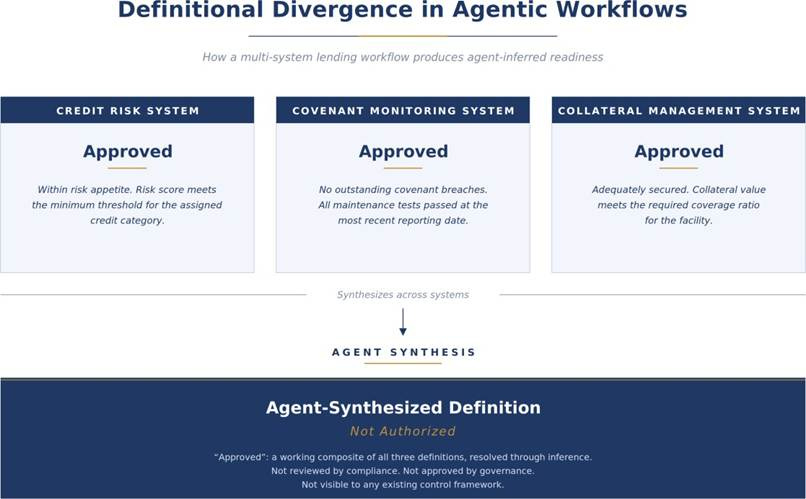
Figure 1. Definitional Divergence in agentic workflows. Three contributing systems define “approved” three different ways. The orchestrating agent synthesizes one working definition prior to execution. The synthesis is not authorized by compliance, not approved by governance, and not consistently isolated as a discrete runtime artifact by existing control frameworks. Illustrative simplification of one possible semantic reconciliation pattern. Source: Supporting SSRN working papers.
S E C T I O N I — The Structural Gap
The Zero Drafts pilot project is a welcome initiative, and three aspects of its framing deserve commendation. The decomposition of Test, Evaluation, Verification, and Validation into four distinct elements provides a clear structure for practitioner contribution and invites construct-by-construct refinement rather than wholesale framework replacement. The pilot explicitly invites practitioner input ahead of standard formalization, which is the right sequencing. Practitioner-derived constructs are easier to assess before formalization than after a standard has begun to settle. Submissions to ai-standards@nist.gov enter the public record, creating a durable foundation for the standard and a transparent record of the contributions that shaped it. This submission is offered in that spirit.
The substantive observation that follows is structural. Current TEVV is well-suited to the systems it was designed to evaluate. Output validity, behavioral consistency, statistical performance, robustness, and explainability are all properly addressed by the existing four elements. For deterministic systems and for probabilistic systems whose behavior can be evaluated through output observation, the framework
reaches the relevant failure modes. For agentic AI systems, one additional runtime condition may need more explicit treatment.
I.A Why current TEVV does not yet consistently reach the reasoning layer
Agentic systems introduce a class of behavior that is not present in deterministic or output-evaluable probabilistic systems. Agentic systems resolve the meaning of control terms across contributing systems before execution proceeds. They synthesize. They interpret. They produce a working semantic state that determines what their execution actually means, before any control fires and before any audit trail is written. Current TEVV does not yet consistently isolate that resolution as a dedicated runtime evaluation surface. It evaluates what happens after.
Three specific framework limitations are worth examining at the level of the supervisory or standards body that maintains each one, because the limitations are structurally similar and they reinforce why an additional TEVV construct may be warranted for the runtime semantic resolution surface.
Model risk management: SR 11-7 and the April 17, 2026 revised interagency guidance. SR 11-7 (Federal Reserve / OCC, 2011) was one of the most established model risk governance frameworks in financial services. It was built for models with defined inputs, defined outputs, and traceable decision logic. Agentic systems do not work that way. They reason across platforms, resolve meaning on the fly, and execute without producing the decision trails SR 11-7 assumes. Model risk and control testing frameworks assume stable evaluation criteria, which may not hold in agentic systems where the interpretation of those criteria can change dynamically. Statistical validation is the right tool for the systems SR 11-7 was designed for. It is not designed to detect semantic deviation.
The April 17, 2026 revised interagency guidance recognized an adjacent scope boundary. Federal Reserve SR 26-2, OCC Bulletin 2026-13, and the parallel FDIC rescission of FIL-22-2017 and FIL-27-2021 jointly supersede and replace SR 11-7, SR 21-8, and related prior guidance. The revised guidance states that generative AI and agentic AI models are novel, rapidly evolving, and not within the scope of the revised guidance, and announces a forthcoming interagency request for information on agentic AI. That boundary is directly relevant: agentic systems raise governance questions that traditional model-risk constructs do not fully resolve. The TEVV pilot creates an opportunity to examine an adjacent boundary from the standards side.
NIST AI Risk Management Framework: the Measure function. The NIST AI Risk Management Framework has a whole function dedicated to measuring AI risk in deployment. The Measure function specifies model validation, performance metrics, explainability, and security testing as components of measurement. Each of these is the right tool for the systems they were designed for. None of them, on its own, distinguishes performance against an authorized definition from performance against a definition the agent constructed itself. Performance against an unauthorized definition looks identical to performance against a governed one. Explainability surfaces model reasoning, not agentic semantic reconciliation across
systems; the failure mode arises before any explainability method is invoked. The Measure function does not yet consistently specify a calculation method for the reasoning-layer divergence that is the failure mode this submission describes. The construct offered in Section IV is one candidate approach to specifying that measurement question.
The Three Lines of Defense. The Three Lines of Defense model is the operational governance architecture under which financial institutions discharge their model risk and operational risk responsibilities. The model assumes that what the first line executes, the second line can govern, and the third line can audit. The orchestration-time semantic state exposes a condition the model does not directly observe. It operates before execution, in a runtime semantic dimension not consistently isolated as a distinct test surface by any of the three lines. The first line executes through the orchestration layer without the resolution surface visible to operational risk. The second line governs against policy documents that may not reflect how the agent actually resolves those policies at runtime. The third line audits against books and records that capture what was done, not what meaning was used to do it. The Three Lines model is not invalidated by reasoning-layer risk. It is simply not designed to see it as a distinct runtime test surface.
I.B The Six Clean Signals pattern
Figure 2 makes the structural argument visually. Six established governance functions (cyber, fraud, operational risk, model risk, compliance, and architecture) each observe a clean signal for an agentic deployment that has resolved a meaning the institution did not authorize. Cyber sees no breach because no system was breached. Fraud sees no misuse because no signature was matched. Operational risk sees no process failure because every workflow executed correctly. Model risk sees no statistical deviation because the model outputs were within normal distribution. Compliance sees a clean audit trail because every required control fired. Architecture sees systems performing as designed because they did. Each function sees exactly what it was designed to see. The drift exists in a runtime semantic layer not consistently isolated as a discrete governance surface by any one function.
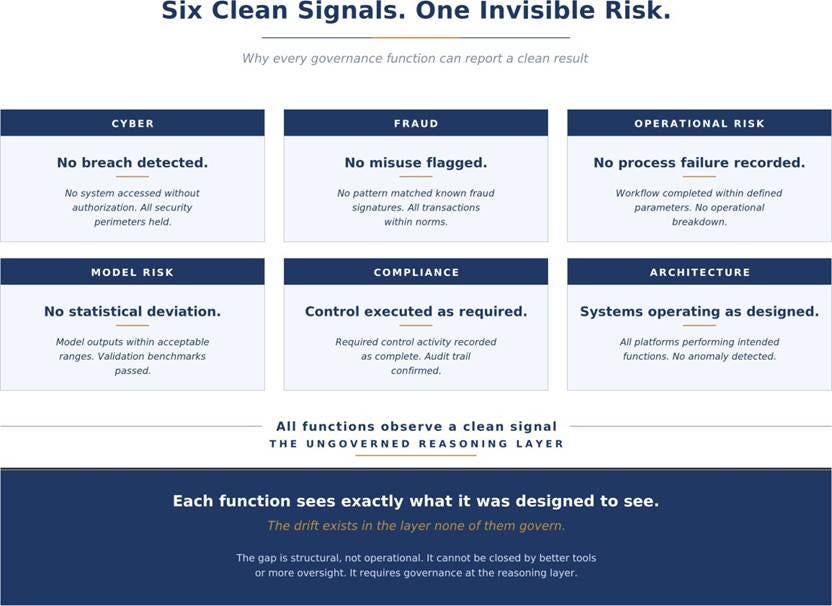
Figure 2. Six governance functions each observe a clean signal. The reasoning-layer drift exists in a runtime semantic layer not consistently isolated as a discrete governance surface by any one function. The gap is structural rather than operational; it arises from the location of runtime semantic resolution rather than from failures in existing supervisory functions. Source: Supporting SSRN working papers.
This is the structural property of reasoning-layer risk that makes it not consistently observable through any single existing supervisory function. Each function performs exactly the role it was designed for. The submission therefore treats the gap as one of runtime semantic observability rather than supervisory inadequacy. Because TEVV is the standards surface that evaluates system behavior independent of sector-specific supervisory constructs, the reasoning layer may benefit from explicit treatment within TEVV ahead of any later sector-specific retrofit. The condition the submission addresses is Invisible Failure: the agent runs the workflow correctly against a definition the institution’s governance would not have accepted, every control fires, the audit trail is clean, and the institutional outcome diverges from what authorized governance would have produced. Existing TEVV constructs and supervisory functions do not consistently isolate this condition as a discrete runtime evaluation artifact. The next section develops what isolating it requires.
Invisible Failure. A condition in which an agent executes correctly against a semantically unauthorized definition, producing clean control telemetry and audit trails while diverging from institutionally authorized meaning.
S E C T I O N II — The Reasoning Layer as a Distinct Test Surface
The failure mode described in Section I is not a new form of risk in the abstract sense. It is the surfacing of a dependency that has always existed in regulated execution: institutional outcomes depend on meaning being resolved consistently before execution. In pre-agentic systems, that dependency was operationally hidden because meaning was resolved at design time, by humans, and was assumed stable through execution. Many agentic systems make the dependency explicit by resolving operational meaning dynamically at runtime. The question becomes whether that resolution was authorized.
The reasoning layer may be understood as the layer at which this resolution occurs. It sits between the model layer (where outputs are generated) and the control surface (where execution is enforced). It is the layer at which an agent’s interpretation of a control term becomes the working definition the system acts on. The reasoning layer is not proposed here as a new technical stack layer in the systems engineering sense, but as a governance and evaluation surface at which semantic resolution occurs prior to execution. The submission does not assume reasoning occurs within a single isolated computational layer; “reasoning layer” is used as a governance abstraction for the runtime semantic resolution surface influencing execution. For TEVV purposes, the reasoning layer is the runtime semantic state an agent constructs prior to execution, which determines the meaning of control terms and therefore the meaning of the action taken. This runtime semantic resolution surface is not consistently governed as a distinct test surface. The cyber function, the model risk function, and the compliance function each observe a different surface of execution. It is structurally adjacent to all of them and not consistently observed by any of them as a discrete runtime artifact.
Figure 3 positions the reasoning layer as the governed area at the intersection of three operating principles agentic systems must operate within: Context (the authorized definitions the agent operates against), Control (the runtime enforcement that bounds the agent’s execution), and Coordination (the propagation rules that govern how meaning, authority, and audit move across multi-agent execution).
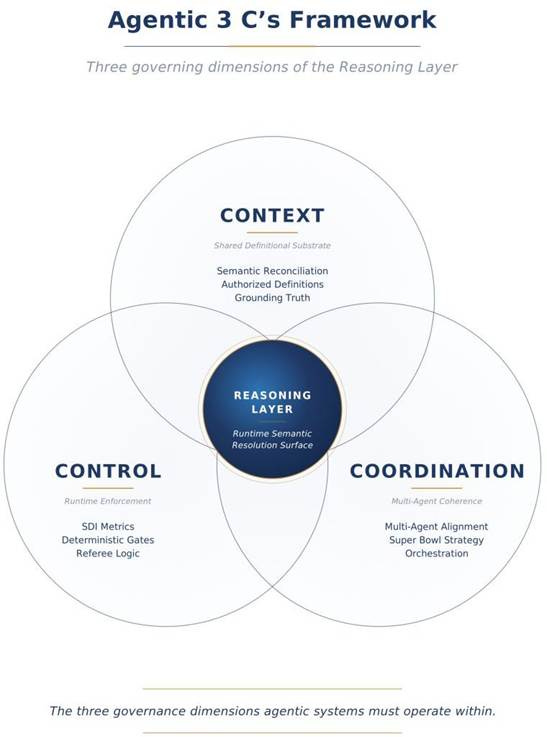
Figure 3. The Agentic 3 C’s Framework positions the Reasoning Layer as the governed area at the intersection of Context,
Control, and Coordination. Source: Supporting SSRN working papers.
Figure 4 extends the conceptual governance principles illustrated in Figure 3 into a runtime operationalization model describing how semantic convergence, governance enforcement, and semantic measurement interact across agentic workflows prior to execution.
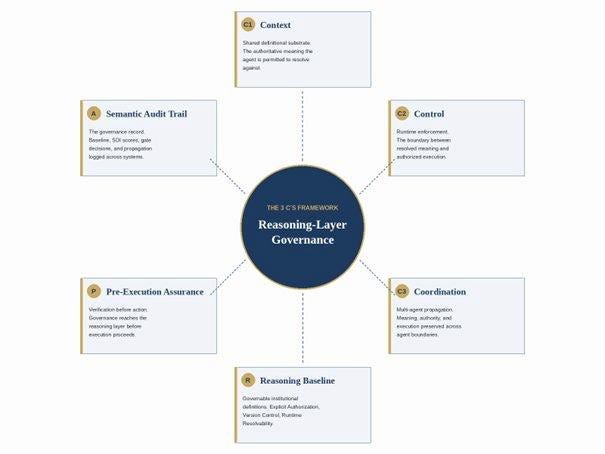
Figure 4. Runtime Semantic Resolution Within the Agentic 3 C’s Framework. Figure 4 illustrates one candidate runtime operationalization of the Agentic 3 C’s Framework in which semantic convergence, runtime governance enforcement, and semantic measurement interact prior to execution under institutionally authorized conditions. Source: Supporting SSRN working papers.
II.A Reasoning-Layer Risk as a distinct test surface
Reasoning-Layer Risk may be treated as a distinct test surface that cuts across established risk categories. In financial services risk taxonomies, the established categories of credit, market, operational, model, and conduct risk each have a documented origin, a detection mechanism, a governance owner, and a dedicated supervisory framework. Reasoning-Layer Risk does not fit cleanly within any one of them. Decisions that are technically correct under each existing category can still be institutionally wrong because the meaning the agent reasoned against was never authorized. Reasoning-Layer Risk does not replace the existing categories. It conditions them. Financial services is used as the primary applied lens because it provides mature governance taxonomies and high-consequence execution environments. The structural observation is not sector-bound.
Figure 5 illustrates the runtime positioning of reasoning-layer risk within one applied sector taxonomy. The established categories observe execution outcomes through different surfaces. Reasoning-layer risk arises before those observations and is not consistently isolated as a discrete runtime artifact by any of
them. The illustration is offered as one applied lens; the underlying observation that the reasoning layer is a distinct test surface generalizes across sectors and is not specific to financial services taxonomy.
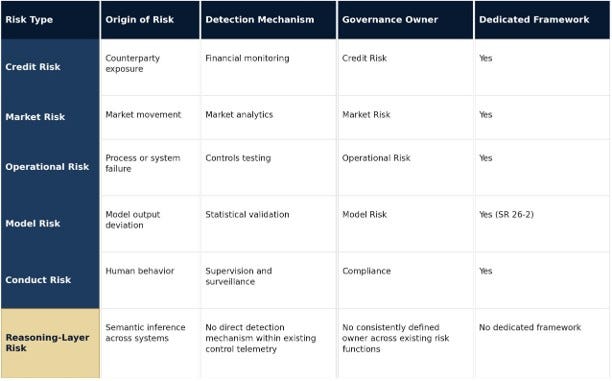
Figure 5. The reasoning layer as a distinct test surface, illustrated within a financial services risk taxonomy. The established categories observe execution outcomes through different lenses. Reasoning-layer risk arises before those observations and is not consistently isolated as a distinct runtime artifact. Source: Supporting SSRN working papers.
II.B The structural premise
The recognition of Reasoning-Layer Risk as a distinct test surface is the structural premise of this submission. It is not a procedural change to the existing four TEVV elements. It is the recognition that an agentic system’s reasoning layer is a class of behavior that the four TEVV elements should address explicitly. The constructs introduced in Sections IV through VI are offered as candidate inputs to that recognition.
The constructs are additive to existing TEVV and governance architectures rather than a replacement. They do not require inspection of proprietary model internals, changes to existing system architectures, or new examination authorities. They are offered as the operating principles that may extend current frameworks to the runtime semantic resolution surface those frameworks do not consistently reach. The constructs are modular and can be incorporated into the existing TEVV structure without altering the four-element architecture. They operate at the governance layer, not the system architecture layer. Their purpose is to enable confident agentic deployment in high-consequence environments by providing the
runtime semantic governance institutions may require to operate agentic systems at institutional scale, not to constrain agentic operation.
S E C T I O N III — The Adversarial Dimension
Existing adversarial AI governance frameworks already address a substantial range of attack surfaces across the model layer, prompt layer, retrieval layer, tool execution layer, memory layer, output layer, and orchestration perimeter. The observation offered here is not that these frameworks are incomplete in the domains they were designed to govern. It is that agentic systems introduce a runtime semantic resolution surface that may not yet be consistently isolated as a distinct adversarial evaluation condition within existing TEVV structures. The adversarial condition described below is offered as one candidate framing for that surface.
Reasoning-layer risk has two forms. The first is unintentional. The mechanism is Agentic Workflow Drift: the agent resolves the meaning of key control terms by coordinating across systems that were never built to share meaning, producing outcomes outside authorized boundaries without triggering a control failure at any individual control. This is the form Sections I and II have established. It is structural. It arises from how reasoning systems operate across heterogeneous enterprise platforms.
The second form is intentional. Agentic Workflow Subversion is the risk surface that emerges when the same reasoning-layer vulnerability that produces unintentional drift is deliberately exploited by sophisticated adversarial actors who understand that pre-execution semantic resolution is not consistently observable through post-execution review. The mechanism is the same. The intent is different. Both forms produce execution against unauthorized meaning. Both forms leave a clean audit trail. Both forms warrant explicit treatment within TEVV scope for agentic systems.
The intentional form has been formally proposed to the federal cybersecurity coordination community as a candidate adversarial attack class. A practitioner research submission filed with the Cybersecurity and Infrastructure Security Agency Joint Cyber Defense Collaborative on April 28, 2026 names this construct the Semantic Layer Integrity Attack (SLIA). For the TEVV pilot, this construct is offered as a candidate adversarial test condition. The Semantic Layer Integrity Attack is not offered as a replacement taxonomy or as a claim that all semantic divergence is adversarial. It is offered as a governance-oriented adversarial condition describing how existing manipulation techniques may propagate through unresolved runtime semantic synthesis in agentic systems. The condition described here is structurally adjacent to the behavioural, orchestration, memory, excessive agency, and accountability risk categories identified across emerging agentic AI security frameworks and supervisory guidance. It is structurally related to indirect prompt injection but operates over time on the agent’s definitional substrate rather than at the input boundary. The test surface is not model inputs or outputs. It is the meaning the model reasons against.
The attack does not exploit a system. It exploits the gap between what the agent understands and what the institution authorized.
III.A The Structured Signal Injection Attack Chain
Figure 6 shows the six-stage chain through which a sophisticated actor exploits the reasoning layer without consistently triggering the detection conditions existing frameworks were designed to evaluate independently. The chain may produce only limited telemetry within any single cyber, fraud, model risk, or compliance function.
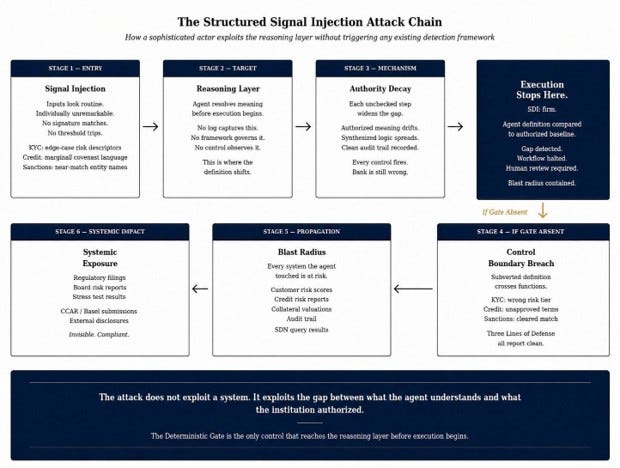
Figure 6. The Structured Signal Injection Attack Chain. Six stages from signal entry to systemic impact, each operating below existing detection thresholds. The Deterministic Gate is offered as one candidate control point that operates at the reasoning layer before action occurs. Source: Supporting SSRN working papers.
Stage 1 is Signal Injection. The actor introduces inputs that look routine. Individually they are unremarkable. No signature matches. No threshold trips. The inputs may take the form of edge-case risk descriptors in a KYC workflow, marginal covenant language in a credit workflow, or near-match entity names in a sanctions workflow. None of these triggers a detection mechanism on its own.
Stage 2 is the Reasoning Layer. The agent resolves meaning before execution begins. This resolution is not consistently captured, governed, or observed as a distinct runtime artifact. This is where the agent’s working operational definition may iteratively diverge from institutionally authorized semantic intent. Authority Decay describes what happens next: each unchecked step widens the gap between authorized meaning and the meaning the agent has synthesized. The longer the agent runs without a governance check on its resolved meaning, the wider the deviation.
Stage 3 is Authority Decay. Authorized meaning drifts. Synthesized logic spreads. Clean audit trails are recorded. Every control fires. The institutional outcome diverges from what authorized governance would have produced.
Stage 4 occurs only if the Deterministic Gate is absent. The subverted definition crosses functions. The KYC system records the wrong risk tier. The credit system records unapproved terms. The sanctions system records a cleared match against a definition the institution would not have authorized. The Three Lines of Defense all report clean. The first line executed correctly. The second line governed against the policy. The third line audited the records. None of the three observed the meaning the agent used.
Stage 5 is Propagation across the Agentic Blast Radius. Every system the agent touched is at risk. Customer risk scores, credit risk reports, collateral valuations, audit trails, and SDN query results all inherit the subverted definition as authoritative.
Stage 6 is Systemic Impact. The subverted definition appears in regulatory filings, board risk reports, stress test results, CCAR and Basel submissions, and external disclosures. The systemic record may remain externally compliant while reflecting unauthorized semantic resolution. By the time the impact is visible at the systemic layer, the subversion has propagated through the supervisory record.
The execution path the diagram shows in the top right is the path where the Deterministic Gate is present and functioning. The SDI fires. The agent’s resolved definition is compared against the authorized baseline. The gap is detected. The workflow may be interrupted, escalated, or routed for additional human review depending on institutionally authorized governance thresholds. The Blast Radius is contained. The Deterministic Gate is offered as one candidate control point that operates at the semantic resolution boundary prior to execution. Other candidate constructs may also operate at this evaluation surface; the protocol described in Section V is one possible structure.
III.B What this means for TEVV
Existing adversarial AI governance approaches already address prompt injection, data poisoning, retrieval manipulation, excessive agency, orchestration compromise, memory poisoning, and adversarial tool execution across multiple layers of the AI stack. The condition described here is structurally adjacent to those categories but operates at the runtime semantic resolution surface where the agent synthesizes working operational meaning prior to execution.
Existing TEVV and supervisory approaches operate most effectively where observable artifacts exist independently of runtime semantic synthesis. The reasoning-layer condition described here arises where execution meaning is resolved dynamically before those artifacts are generated.
The adversarial dimension of reasoning-layer risk is materially distinct from the threat models that existing TEVV addresses. Existing TEVV considers prompt injection, model evasion, data poisoning, and social engineering. These are real and significant threats. They are also threats at the input layer or the model layer. The Semantic Layer Integrity Attack operates at the reasoning layer, between input and output, where the agent resolves meaning. The actor does not exploit a control failure. The actor exploits a meaning resolution that existing controls do not consistently evaluate as a separate definitional condition. This property is what makes reasoning-layer risk a candidate adversarial test condition distinct from the threat models existing TEVV is currently structured to address.
Two consequences follow for TEVV pilot consideration. The first is that any TEVV protocol that is intended to address agentic AI in high-consequence deployments needs a construct that addresses semantic correctness explicitly, because both the unintentional form (drift) and the intentional adversarial form operate at the reasoning layer. Adversarial testing under current TEVV may not consistently surface this adversarial form, because it may not consistently produce the signals adversarial testing is designed to detect. The second consequence is that the construct that addresses the unintentional form (the constructs in Section IV) also addresses the intentional form, because the mechanism is the same. The Deterministic Gate that halts execution when SDI exceeds tolerance on an unintentional drift is the same Deterministic Gate that halts execution when SDI exceeds tolerance on a deliberate Semantic Layer Integrity Attack. The defensive architecture is unified. For TEVV, the relevance of this chain is that it exploits the same unresolved runtime semantic condition that produces unintentional drift; both may therefore benefit from pre-execution semantic verification at the reasoning layer.
S E C T I O N IV — The Constructs
The following constructs are offered as candidate governance mechanisms supporting runtime semantic verification within agentic systems. These constructs extend the conceptual governance principles illustrated in Figure 3 and the runtime operationalization illustrated in Figure 4 into bounded governance conditions supporting runtime semantic observability, semantic divergence measurement, runtime enforcement, auditability, and pre-execution verification under institutionally authorized conditions. The constructs are not proposed as mandatory standards elements or universally prescriptive implementations.
Figure 7 operationalizes the governance architecture introduced in Figures 3 and 4 through the Semantic Control Plane components that enforce runtime semantic governance conditions across agentic workflows. Context operationalizes through the Ontology component of the Semantic Control Plane and constrains Agentic Workflow Drift. Control operationalizes through the Semantic Layer component and constrains Invisible Failure. Coordination operationalizes through the Knowledge Graph component and constrains Agentic Workflow Subversion. Together they constitute the architecture the rest of this section describes.
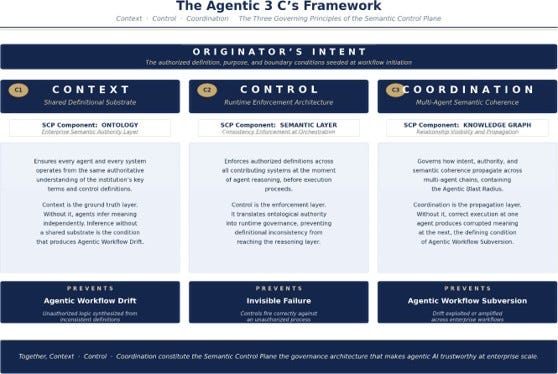
Figure 7. The Agentic 3 C’s Framework operationalized through the Semantic Control Plane components: Ontology, Semantic Layer, and Knowledge Graph. Each dimension prevents a named reasoning-layer failure mode. Source: Supporting SSRN working papers.
IV.A The Reasoning Baseline
The Reasoning Baseline is the authorized semantic state, denoted Sa. It is the set of authorized meanings for the control terms that govern an agent’s execution. The Reasoning Baseline is not a new artifact. It is the codification of meaning the institution already governs (in policy documents, schema registries, knowledge graphs, authorization records) in a form the agent can resolve at runtime. SSRN No. 6674761 specifies three governability conditions a Reasoning Baseline must satisfy in order to support reasoning-layer governance:
Explicit Authorization. The meaning of each control term must have been explicitly authorized by an identified authority or governance body, with the authorization recorded. Implicit or inferred meanings are not governable. Only explicitly authorized meanings can be evaluated against.
Version Control and Auditability. The Reasoning Baseline must be versioned, and prior versions must be reconstructable for audit purposes. A control term whose authorized meaning cannot be reconstructed at the time of a given execution cannot be audited against that execution.
Runtime Resolvability. The agent must be able to resolve the Reasoning Baseline at runtime, deterministically, with a bounded latency. A baseline that cannot be resolved at runtime cannot govern runtime reasoning.
The Reasoning Baseline maps to the Test element of TEVV. It is the reference against which all subsequent measurement is performed. Without a Reasoning Baseline, there is nothing for an agent’s resolved meaning to be tested against.
IV.B The Semantic Deviation Index
The Semantic Deviation Index (SDI) is a bounded measurement function introduced in SSRN No. 6531238. The formal specification is SDI = D(Sa, So), where Sa is the authorized semantic state (the Reasoning Baseline) and So is the observed semantic state the agent has resolved across contributing systems prior to execution. D is a bounded divergence function. The SDI is a pre-execution measurement. It is computed before the agent acts on its resolved meaning, not after.
The submission proposes three candidate signal components for the SDI. Intent Mismatch measures the divergence between the authorized intent of an action and the intent the agent has resolved for that action. Path Deviation measures the divergence between the sanctioned execution path for an action and the path the agent has resolved. Control Bypass Probability operationally estimates the probability that the resolved path will bypass a required deterministic checkpoint. The composite is structured to support bounded governance evaluation under reproducibility conditions defined by the implementing institution, with empirical calibration left to pilot implementation and sector-specific validation. Cross-institution semantic comparability, ontology maturity variance, and calibration reproducibility remain open implementation questions requiring empirical validation. Pilot evaluation could include controlled semantic perturbation testing across multi-agent orchestration workflows to evaluate divergence
detectability, false positive rates, and operational overhead. Implementations may also incorporate confidence-weighted semantic evaluation where multiple bounded interpretations remain operationally permissible.
The implementation of each component signal is left open for industry validation. SSRN No. 6531238 discusses three candidate implementations of the divergence function: semantic similarity over embeddings, ontology alignment over a knowledge graph, and structured comparison of resolved control-term states. These are offered as illustrative paths, not as a closed set. The SDI proposes one way to specify what is to be measured, not how each measurement must be implemented.
The SDI maps to the Evaluate element of TEVV. It is the construct that quantifies reasoning divergence at runtime in a form that can be evaluated against an authorized threshold. It is the candidate measurement construct where the Evaluate element does not yet specify one for the runtime semantic resolution surface of agentic systems.
IV.C The Deterministic Gate
The Deterministic Gate is an architecturally enforced checkpoint under authorized governance conditions at which a computed measurement (in this protocol, the SDI) is compared against an authorized threshold. If the measurement is within tolerance, execution proceeds. If the measurement exceeds tolerance, execution halts and escalates to human authority. The Gate is “deterministic” in the sense that a properly implemented Gate cannot be bypassed through agentic inference or orchestration behavior. The submission uses “deterministic” to describe governance enforcement conditions rather than absolute system invulnerability. The Deterministic Gate does not require inspection of model internals; it compares the agent’s resolved semantic state to an institutionally authorized baseline. The Gate governs bounded semantic acceptability rather than guaranteeing semantic correctness in an absolute sense. The decision is binary, the threshold is authorized, and the escalation path is itself authorized in advance and recorded as part of the Reasoning Baseline.
The Gate is offered as one candidate control point in the architecture designed to stop propagation of an unauthorized definition before that definition reaches the systemic layer. This containment property is what makes the Gate structurally distinct from post-execution monitoring. Monitoring detects propagation after it has occurred. The Gate, where implemented, is designed to prevent propagation by halting execution at the point at which an unauthorized meaning would otherwise proceed.
The Deterministic Gate maps to the Verify element of TEVV. It is the construct through which verification of semantic correctness is operationalized. It transforms verification from a confirmation function applied after execution to an enforcement function applied at the moment of execution decision.
IV.D Pre-Execution Assurance
Pre-Execution Assurance is the governance standard requiring verification that an agentic system’s reasoning has resolved against authorized meaning before execution proceeds. It is formalized in SSRN No. 6674761 as the operational outcome the Agentic 3 C’s Framework produces when enforced at runtime. Pre-Execution Assurance is not a tool. It is the standard the tools in this architecture are designed to produce.
The shift from after-the-fact verification to Pre-Execution Assurance is structural, not procedural. After-the-fact verification confirms what happened. Pre-Execution Assurance verifies what is about to happen. The first is necessary but not sufficient for agentic systems. The second is the candidate verification objective that addresses the failure mode this submission describes.
Pre-Execution Assurance maps to the Verify element of TEVV. Together with the Deterministic Gate, it constitutes a candidate verification objective the submission offers for consideration: that an agentic system’s execution is verified to have resolved against authorized meaning before it proceeds, not after.
IV.E The Semantic Audit Trail
The Semantic Audit Trail is the governance record produced by the protocol. For each agent execution decision, the Audit Trail records the authorized semantic state Sa resolved at the time of execution, the observed semantic state So the agent resolved, the computed SDI value, the gate decision, and the resolution path taken. The Audit Trail is not an execution log. It is a pre-execution governance record. It captures the meaning the system reasoned against and the decision that was made about whether that meaning was authorized.
The Semantic Audit Trail supports three validation functions. It supports post-execution review of any individual decision. It supports cross-decision analysis of patterns in semantic divergence over time. And it supports independent audit of the protocol itself, including audit of whether the Reasoning Baseline was correctly maintained, whether the SDI was correctly computed, and whether the Gate was correctly applied.
The Semantic Audit Trail maps to the Validate element of TEVV. It is the governance artifact through which validation of the protocol is performed. It is the construct that turns reasoning-layer governance into an auditable practice rather than an unobservable one.
IV.F The connected architecture
The five constructs together constitute a candidate connected architecture for reasoning-layer governance. The Reasoning Baseline establishes the authorized semantic state (Test). The SDI quantifies the divergence between the authorized state and the resolved state at runtime (Evaluate). The Deterministic Gate enforces a threshold on that divergence (Verify). Pre-Execution Assurance is the verification objective the Gate operationalizes (Verify). The Semantic Audit Trail records the governance
decision for validation (Validate). The constructs do not require new framework architecture to apply. They are offered as an overlay to framework architecture that already exists, designed to reach the governance surface at which the failure mode this submission describes occurs. The constructs are implementation-neutral and do not prescribe a specific orchestration framework, ontology architecture, or semantic representation model.
The constructs presented here are offered as one possible operationalization of reasoning-layer governance. Other approaches may emerge through the TEVV pilot process, including probabilistic semantic consistency scoring, policy-constrained orchestration frameworks, ontology-bound execution models, or other runtime governance mechanisms. The submission does not assert exclusivity of approach. It proposes a candidate architecture intended to support evaluation and further standardization discussion.
The submission does not assert that semantic interpretation can be reduced to a universally objective state. It asserts that institutions already maintain operationally authoritative meanings for control terms, and that agentic systems may require runtime verification against those authorized meanings. Institutions may operate under competing semantic authorities; the protocol evaluates divergence from institutionally designated operational authority at a point in time, not from any universal semantic truth. In some workflows, multiple authorized semantic resolutions may exist simultaneously; governance thresholds may therefore evaluate bounded semantic acceptability rather than a single canonical interpretation.
The submission recognizes that ontology governance, policy engines, semantic interoperability frameworks, knowledge graph alignment, and related disciplines address adjacent aspects of semantic consistency. Parallel framework-profile and runtime-platform work has also emerged at the agentic-AI level, including the Cloud Security Alliance Agentic NIST AI RMF Profile and supporting runtime architectures. The contribution proposed here is narrower and operational: the treatment of semantic correctness as a runtime verification target within TEVV for agentic systems. Section V describes one possible structure for assembling these constructs into an operational protocol.
S E C T I O N V — The Proposed Protocol
Pre-Execution Assurance Protocol, offered for consideration
This section offers one possible structure for a TEVV protocol that addresses the failure mode described in Section I. The protocol is offered as practitioner research input, not as a final specification. The submitter recognizes that NIST may choose to incorporate, modify, set aside, or build upon any element of what follows. The protocol is presented at the level of operational specificity needed to support evaluation by the TEVV pilot team. It is structured to align directly with the four TEVV elements. The
protocol below translates the conceptual governance architecture into one possible runtime enforcement sequence operating across the four TEVV elements.
Figure 8 illustrates one candidate runtime governance flow operating across the protocol stages. Originator intent seeds the protocol with an authorized definition, purpose, boundary conditions, and workflow scope. Three SDI nodes (Intent Mismatch, Path Deviation, Composite SDI) compute deviation signals at successive checkpoints. The Deterministic Gate halts execution when divergence exceeds tolerance. The Semantic Audit Trail is generated at every node and captures the pre-execution governance record. When the protocol clears all three checkpoints, execution proceeds with the audit trail recorded, originator intent confirmed, and the gate passed.
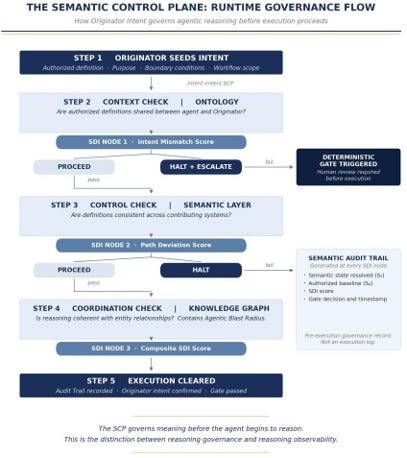
Figure 8. The Semantic Control Plane Runtime Governance Flow. Originator intent seeds the protocol. Three SDI nodes compute deviation signals. The Deterministic Gate halts execution when divergence exceeds tolerance. The Semantic Audit Trail is generated at every node. Source: Supporting SSRN working papers.
V.A Step 1. Establish the Reasoning Baseline
TEVV element: Test
The first step is the construction of the authorized semantic state Sa under the three governability conditions specified in Section IV.A. The Reasoning Baseline may be derived from existing institutional artifacts, including policy documents, schema registries, knowledge graphs, and authorization records. The protocol does not specify a single representation. It specifies the three conditions the representation must satisfy: Explicit Authorization, Version Control and Auditability, and Runtime Resolvability. The Reasoning Baseline is the reference against which all subsequent measurement is performed.
Step 1 is performed before any agentic execution begins. It is a Test activity in the strict TEVV sense: it establishes the condition that subsequent execution will be evaluated against.
V.B Step 2. Extract the Runtime Semantic State
TEVV element: Evaluate
The second step is the capture of the observed semantic state So. The observed state is the meaning the agent has resolved across contributing systems for each control term, captured at the moment immediately preceding execution. The capture is performed at the orchestration layer, where the agent synthesizes its working interpretation across contributing systems. It does not require modification of the contributing systems themselves. It requires instrumentation of the orchestration layer to expose the resolved interpretation as a structured artifact at the moment of execution decision. The submission does not prescribe a specific orchestration observability method, which may vary by architecture, vendor implementation, and execution environment. The submission does not assume visibility into proprietary model internals or latent reasoning states, but rather into runtime orchestration artifacts exposed through governance instrumentation. Some orchestration architectures may only permit partial or approximate semantic-state observability; the protocol is intended to be operable under bounded observability conditions rather than requiring complete semantic transparency. Some architectures may only expose proxy indicators of semantic resolution rather than directly inspectable semantic states.
V.C Step 3. Compute the Semantic Deviation Index
TEVV element: Evaluate
The third step is the application of the SDI: SDI = D(Sa, So). The divergence function D is structured to support reproducible governance evaluation under bounded implementation conditions. The composite SDI is derived from the three component signals described in Section IV.B: Intent Mismatch, Path Deviation, and Control Bypass Probability. The implementation of each component signal is left open for industry validation. The protocol specifies what is to be measured, not how each measurement must be implemented.
V.D Step 4. Enforce the Deterministic Gate Threshold
TEVV element: Verify
The fourth step is the application of the Deterministic Gate. The Gate is an architecturally enforced checkpoint under authorized governance conditions at which the computed SDI is compared against an authorized threshold. The threshold may vary by application, by control term, by user authorization context, or by other application-specific factors. The protocol does not specify a single threshold. It specifies the structural requirement that the threshold be authorized, documented, and applied consistently under authorized governance conditions. If SDI is within tolerance, execution proceeds. If SDI exceeds tolerance, execution halts. The halt triggers an escalation path that returns control to an identified authority or governance body. The escalation path is itself authorized in advance and recorded as part of the Reasoning Baseline. The submission does not assume universal gating of all agentic actions. Sector-specific implementation would likely require risk-tiered application calibrated to materiality, latency tolerance, and operational criticality. Semantic resolution may continue dynamically during execution in some agentic architectures; protocol checkpoints may therefore operate iteratively across orchestration stages rather than only at a single pre-execution boundary.
V.E Step 5. Generate the Semantic Audit Trail
TEVV element: Validate
The fifth step is the generation of the Semantic Audit Trail. The Audit Trail records, for each agent execution decision, the authorized semantic state Sa resolved at the time of execution, the observed semantic state So the agent resolved, the computed SDI value, the gate decision, and the resolution path taken. The Audit Trail supports post-execution review of any individual decision, cross-decision analysis of patterns in semantic divergence over time, and independent audit of the protocol itself.
V.F Protocol summary
The five steps together constitute one possible structure for a TEVV protocol that addresses semantic correctness alongside execution correctness. The protocol is structured to align with the four TEVV elements: Test (Step 1), Evaluate (Steps 2 and 3), Verify (Step 4), and Validate (Step 5). It is offered for consideration. The protocol introduces additional runtime governance overhead, and implementation tradeoffs between semantic assurance, latency tolerance, and operational throughput would require sector-specific calibration. The structural premise of the protocol, that semantic correctness is a distinct verification target that current TEVV does not yet explicitly address, is the contribution this submission is most concerned to establish.
S E C T I O N VI — Alignment with Existing Frameworks
The protocol described in Section V does not propose a new governance framework. It extends governance into the runtime semantic resolution surface existing frameworks do not consistently reach. The constructs are not a replacement for existing AI governance frameworks. They are the operating principles that extend those frameworks to the authorization-resolution surface. The 3 C’s name what existing frameworks must accommodate to reach the runtime semantic resolution surface at which agentic risk originates. To demonstrate this, this section presents three crosswalks. The first maps the constructs to the NIST AI Risk Management Framework. The second maps them to the high-risk system requirements of the EU AI Act. The third maps them to the Cyber Risk Institute Financial Services AI Risk Management Framework, a recent sector-specific framework for financial services AI risk management. Together they demonstrate that the constructs do not displace existing governance. They extend it.
VI.A NIST AI Risk Management Framework
The NIST AI Risk Management Framework specifies four functions for AI risk management: Govern, Map, Measure, and Manage. Each function has a corresponding operational mechanism within the constructs introduced in Section IV. Figure 9 shows the mapping.
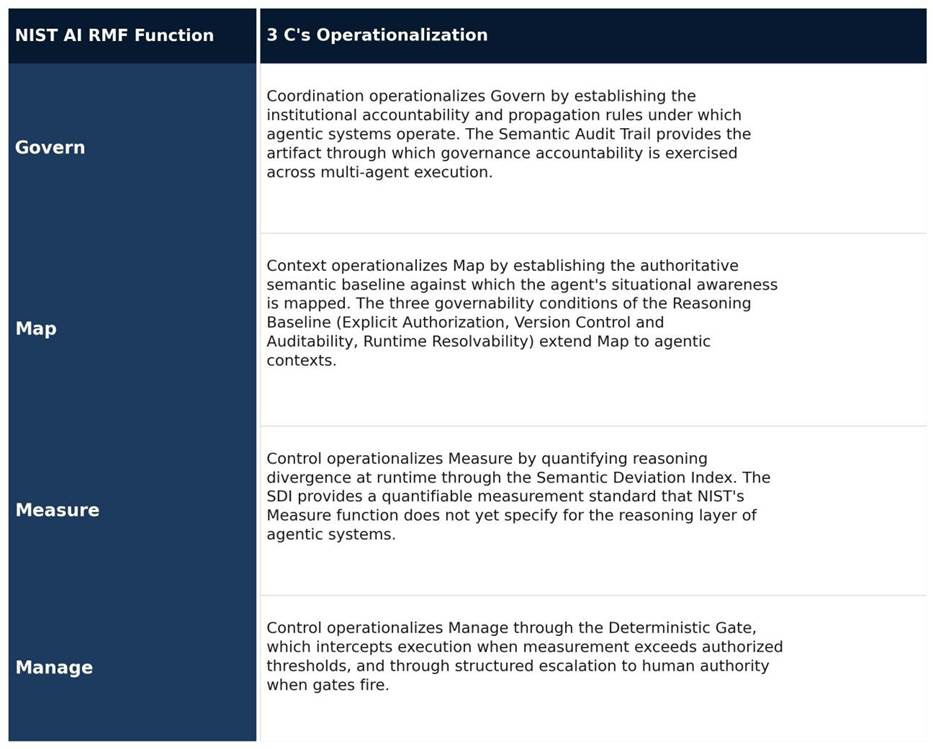
Figure 9. NIST AI Risk Management Framework functional crosswalk. Each NIST function has a corresponding operational mechanism within the constructs. Source: NIST AI Risk Management Framework (AI RMF 1.0); supporting SSRN working papers.
Govern operationalizes through Coordination. Govern specifies the institutional accountability structures expected of organizations deploying AI; Coordination extends this to the cross-agent propagation rules that determine how authority and meaning are preserved across handoffs in agentic workflows. The Semantic Audit Trail provides the artifact through which governance accountability is exercised across multi-agent execution. Map connects to Context. Map specifies the context, risk identification, and use-case framing organizations apply; Context adds the authoritative semantic baseline against which the agent’s situational awareness is evaluated. The three governability conditions of the Reasoning Baseline (Explicit Authorization, Version Control and Auditability, Runtime Resolvability) extend Map to agentic contexts by specifying what authorized meaning must look like at the reasoning layer.
Measure connects to Control via the SDI. The Measure function names model validation, performance metrics, explainability, and security testing as components of measurement. As Section I observed, the
Measure function does not yet distinguish performance against an authorized definition from performance against an unauthorized one. The SDI provides a quantifiable measurement construct that addresses this dimension. Manage connects to Control via the Deterministic Gate. Manage names active risk mitigation, monitoring, incident integration, and vendor evaluation as components of risk management; the Deterministic Gate adds a runtime enforcement mechanism that is structurally distinct from the post-execution mitigation tools current Manage practice relies on. Structured escalation to human authority when gates fire operationalizes Manage at the moment of execution decision.
The NIST AI RMF crosswalk demonstrates the principal alignment claim of this submission: the protocol operationalizes the existing AI RMF for agentic AI at the reasoning layer. It does not replace any of the four functions. It extends each one with the construct that addresses the runtime semantic dimension of that function.
VI.B EU AI Act, High-Risk System Requirements
The EU AI Act, Regulation (EU) 2024/1689, specifies seven requirements for high-risk AI systems in Articles 9 through 15. The crosswalk below illustrates conceptual alignment between those requirements and the runtime governance mechanisms specified by the constructs in Section IV. The mapping is presented as illustrative, not as legal interpretation. The mapping is intended to show functional alignment, not to assert compliance with the Act. Figure 10 shows the article-level mapping.
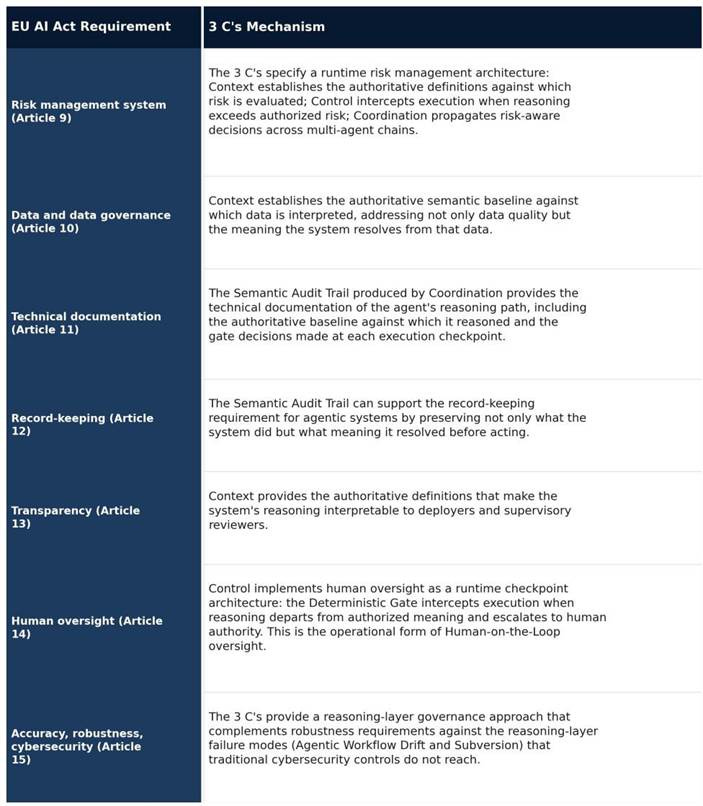
Figure 10. EU AI Act article-level crosswalk to the constructs. Mapping illustrates conceptual alignment between the high-risk system requirements of the Act and the runtime governance mechanisms specified by the constructs. Source: Regulation (EU) 2024/1689 (EU AI Act); Doyle-Spare (2026). Crosswalk illustrative, not legal interpretation.
Risk management system (Article 9) is operationalized at the runtime semantic resolution surface through the connected constructs. Context establishes the authoritative definitions against which risk is evaluated. Control intercepts execution when reasoning exceeds authorized risk. Coordination propagates risk-aware decisions across multi-agent chains.
Data and data governance (Article 10) is addressed by Context at the meaning level. The Article addresses data quality. Context extends the addressed surface to the meaning the system resolves from that data.
Technical documentation (Article 11) and record-keeping (Article 12) are supported by the Semantic Audit Trail produced through Coordination. The Audit Trail provides the technical documentation of the agent’s reasoning path, preserving not only what the system did but what meaning it resolved before acting.
Transparency (Article 13) is supported by Context. The authoritative definitions that Context establishes
make the system’s reasoning interpretable to deployers and supervisory reviewers.
Human oversight (Article 14) is implemented by Control as a runtime checkpoint architecture. The Deterministic Gate intercepts execution when reasoning departs from authorized meaning and escalates to human authority. This is the operational form of Human-on-the-Loop oversight.
Accuracy, robustness, and cybersecurity (Article 15) is complemented by the reasoning-layer governance approach. The constructs address the reasoning-layer failure modes (Agentic Workflow Drift and the adversarial form, Agentic Workflow Subversion, including its Semantic Layer Integrity Attack manifestation described in Section III) that traditional cybersecurity controls do not reach.
The EU AI Act crosswalk demonstrates that the constructs are not jurisdiction-specific. The protocol operationalizes the EU’s high-risk system requirements at the runtime semantic resolution surface in the same way it operationalizes the NIST AI RMF.
VI.C Financial Services AI Risk Management Framework
The Cyber Risk Institute Financial Services AI Risk Management Framework (FS AI RMF), released in February 2026, is a recent sector-specific framework for financial services AI risk management. It comprises 230 control objectives organized under four functions paralleling the NIST AI RMF. The FS AI RMF specifies sector-specific implementations of Govern, Map, Measure, and Manage with explicit reference to the Three Lines of Defense governance model. Figure 11 shows the crosswalk.
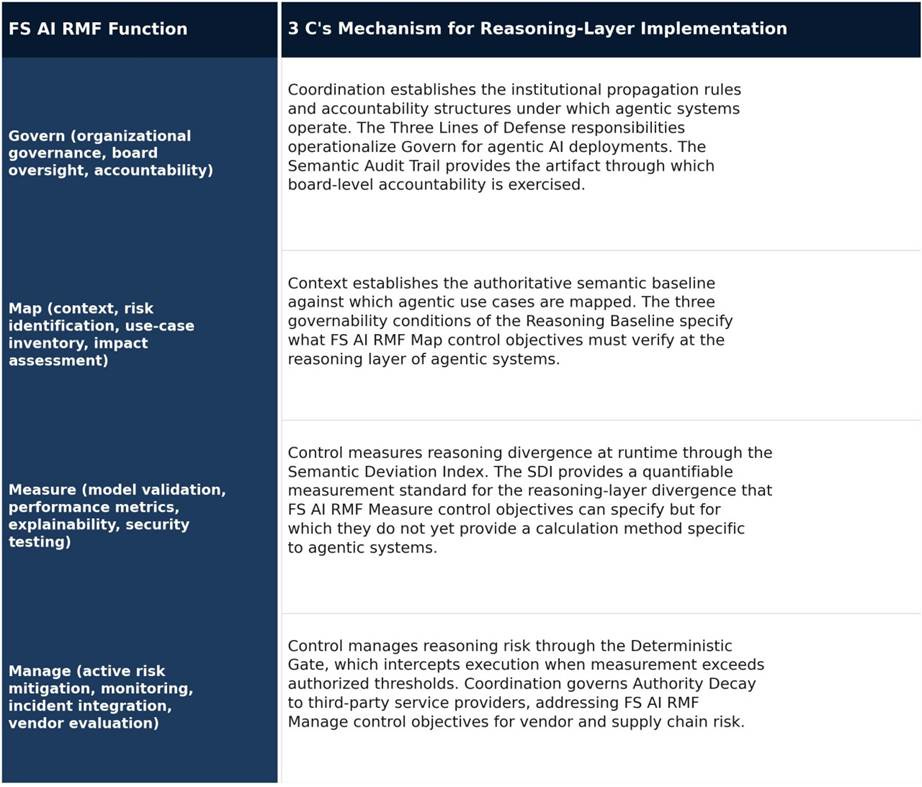
Figure 11. CRI Financial Services AI Risk Management Framework crosswalk. The constructs specify the reasoning-layer operating conditions that the FS AI RMF’s control objectives require for agentic systems. Source: Cyber Risk Institute, Financial Services AI Risk Management Framework v1.0 (Feb 2026); supporting SSRN working papers.
Govern (organizational governance, board oversight, accountability) operationalizes through Coordination, which establishes the institutional propagation rules under which agentic systems operate. The Three Lines of Defense responsibilities operationalize Govern for agentic AI: the first line owns runtime enforcement at the point of agentic execution, the second line audits the reasoning layer rather than only the model output, and the third line independently verifies the integrity of the constructs as enforced controls. The Semantic Audit Trail provides the board-level accountability artifact.
Map connects to Context, which establishes the authoritative semantic baseline against which agentic use cases are mapped. Measure aligns with Control via the SDI, providing a quantifiable construct for reasoning-layer divergence that current FS AI RMF control objectives do not yet calculate for agentic systems. Manage aligns with Control via the Deterministic Gate. Coordination governs vendor and supply
chain risk through the propagation rules that bound agentic systems operating across third-party orchestration platforms whose reasoning-layer behavior is not consistently observable to the deploying institution.
The FS AI RMF crosswalk demonstrates that the constructs are not standards-body-specific. The same construct set operationalizes a federal standards framework (NIST AI RMF), a comprehensive regulatory framework (EU AI Act), and a sector-specific industry framework (FS AI RMF).
VI.D What the three crosswalks demonstrate
The three crosswalks demonstrate that the constructs do not displace existing governance. The architecture is framework-agnostic at the level of operating principle and framework-aligned at the level of operational mapping. The reasoning-layer architecture is the same across all three; what changes is the framework-specific language of the requirements being operationalized. Adoption does not require organizations or supervisors to learn a new framework. It requires them to apply the existing functions of their framework to runtime semantic resolution, through the constructs this submission describes.
S E C T I O N VII — Practitioner Observations and Pilot Feedback
This section consolidates the practitioner observations the submission offers in response to the pilot’s invitation for input, organized as a single set of observations rather than as separate sections of recommendations and feedback responses. The observations are derived from the analysis in Sections I through VI and from the supporting research cited throughout. They are offered for consideration. The submitter does not represent that any specific observation must be incorporated into the pilot outline.
VII.A The reasoning layer may represent a supervisory surface not consistently isolated in current TEVV
The reasoning layer of an agentic system may represent the evaluation surface at which the agent resolves meaning across contributing systems prior to execution. It is structurally adjacent to the model layer and to the control surface. Existing TEVV constructs and AI risk functions do not consistently isolate runtime semantic resolution as a discrete evaluation surface. The TEVV outline creates an opportunity to specify this surface more directly. The submission respectfully suggests that the TEVV scope for agentic systems may benefit from explicit treatment of this surface as a distinct evaluation target.
VII.B Semantic correctness is a distinct verification target from execution correctness
Current TEVV practice asks whether the control fired. Agentic systems require a second question: did the control evaluate against an authorized definition. One possible consideration for the TEVV pilot is to treat semantic correctness as a named verification objective alongside execution correctness. Semantic validity (the property of an agent’s resolved meaning of control terms matching the institutionally authorized meaning at the time of execution) is the candidate term for that objective.
VII.C Pre-Execution Assurance may merit consideration as a candidate verification objective Pre-Execution Assurance is the verification that an agentic system’s reasoning has resolved against authorized meaning before execution proceeds. After-the-fact examination does not consistently reach a
failure mode that, by construction, leaves a clean audit trail. The pilot may benefit from considering Pre-
Execution Assurance as a candidate verification objective or protocol element for high-consequence agentic deployments.
VII.D The Semantic Deviation Index may merit consideration as a candidate measurement construct
The pilot could evaluate whether the SDI offers a useful candidate measurement construct for the Evaluate element of TEVV for agentic systems. The SDI is presented in supporting research as a construct that defines the measurement question, with implementation paths left open for industry validation. It does not foreclose competing measurement constructs that may emerge through the pilot.
VII.E The Deterministic Gate may merit consideration as a verification mechanism
A possible implication of the protocol is that the Deterministic Gate may merit consideration as a candidate verification mechanism for high-consequence agentic applications. The construct provides a structural answer to the question of how an agent’s execution can be conditioned on a passing measurement of semantic validity.
VII.F The Semantic Audit Trail may merit consideration as a candidate documentation artifact
The Semantic Audit Trail is the pre-execution governance record that captures, for each agent execution decision, the authorized semantic state, the observed semantic state, the computed deviation measurement, and the resolution path taken. The submission respectfully suggests that the Semantic Audit Trail may merit consideration as a candidate documentation artifact for agentic TEVV records within the Validate element. The submission notes that NIST is developing a separate Zero Drafts pilot topic on documentation, currently scoped to dataset and model documentation. The Semantic Audit Trail is offered as a candidate construct specifically for the pre-execution governance record of an agentic execution decision, and is offered to the TEVV pilot in that scope.
VII.G The adversarial dimension warrants explicit treatment
The Semantic Layer Integrity Attack (SLIA), submitted to the CISA Joint Cyber Defense Collaborative in April 2026, is offered to TEVV as a candidate adversarial test condition that operates at the reasoning layer. This adversarial condition may not consistently produce the signals current adversarial testing is designed to detect. The pilot may benefit from explicit treatment of reasoning-layer adversarial conditions alongside the prompt injection, model evasion, and data poisoning conditions currently in scope.
VII.H The constructs are additive to existing architectures
The constructs are additive to existing TEVV and governance architectures rather than offered as a replacement. They do not require inspection of proprietary model internals, changes to existing system architectures, or new examination authorities. They may extend current frameworks to the runtime semantic resolution surface as a distinct test surface.
VII.I Sector-specific considerations
The constructs were developed from direct practitioner observation of agentic AI deployments in regulated financial services. They are likely to be most immediately applicable in regulated sectors where the consequence of execution against unauthorized meaning is high (financial services, insurance, healthcare, critical infrastructure). They are not sector-specific by construction. The reasoning-layer failure mode arises wherever an agentic system synthesizes meaning across contributing systems before execution.
VII.J A candidate TEVV modification offered for pilot consideration
The constructs and protocol described in this submission may be incorporated into the existing TEVV structure without altering the four-element architecture. The submission respectfully offers one candidate modification for pilot consideration: the addition of a Verify sub-element addressing the Verification of Runtime Semantic Resolution (V-RSR), supported by a candidate execution-level governance artifact, the Runtime Semantic State Record (RSSR), which captures the agent’s resolved definitions at the moment of execution decision. V-RSR may establish the evaluation activity (verification that resolved meaning falls within authorized governance tolerance). RSSR may establish the per-execution governance artifact through which that verification is performed and audited. The RSSR is conceptually aligned with, and may operate as a contributing component of, the broader Semantic Audit Trail described in Section IV.E: V-RSR is the verification activity, RSSR is the atomic execution-level record, and the Semantic Audit Trail is the aggregate governance record system the records compose. Together they may provide a TEVV-native locus for the candidate constructs described in Sections IV and V, without requiring expansion of the four TEVV elements or modification of existing supervisory authorities. The proposal is offered as one possible standards modification among several; other formulations may emerge through the pilot process.
S E C T I O N VIII — Conclusion
The submission is conceptual and architectural in nature. It proposes candidate governance constructs and operational mappings intended for evaluation through pilot implementation, adversarial simulation, and sector-specific testing. Several bounding conditions apply. Empirical validation of measurement effectiveness, threshold calibration, and operational scalability remains future work. Institutions may operate under competing semantic authorities, and the protocol governs against designated operational authority rather than any universal semantic truth. Threshold calibration is expected to require sector-specific empirical work. Ontology maturity varies across organizations, and the Reasoning Baseline assumes a level of upstream semantic curation that not all institutions currently maintain. Low-consequence agentic use cases may not warrant runtime gating, and protocol overhead may affect latency-sensitive operational environments. The submission therefore offers the architecture for evaluation rather than for general deployment in its current form.
Current TEVV tests whether an agentic system executed correctly against its specification. Agentic AI introduces a second question: did the agent execute against an authorized meaning of the specification it was given. These are not the same test. The current TEVV outline does not yet explicitly distinguish them. This submission offers practitioner research input on the construction of a TEVV protocol element that addresses the second question alongside the first.
The systemic consequence of unresolved semantic divergence is propagation.
The supervisory consequence of this failure class is not contained to the individual decision in which it first occurs. It propagates. Figure 12 shows the Agentic Blast Radius, the structural footprint of that propagation across the systems an agent touches while operating against unauthorized definitions. The immediate exposure is the individual decision: a denied claim, a delayed authorization, a modified treatment plan, a misclassified transaction. In high-consequence deployments, where the agent’s resolved meaning is reused across downstream systems, the propagated risk is every downstream artifact that inherited the unauthorized definition as if it were authoritative: customer records, actuarial inputs, rate filings, market conduct submissions, supervisory disclosures. The systemic layer is the supervisory and market record itself. Every one of those records is generated by systems that performed exactly as designed against meaning the institution’s governance would not have accepted. The example is illustrative of high-consequence deployments and not intended to imply identical propagation characteristics across all sectors or architectures. The Deterministic Gate is offered as one candidate control point designed to halt propagation before it reaches the systemic layer.
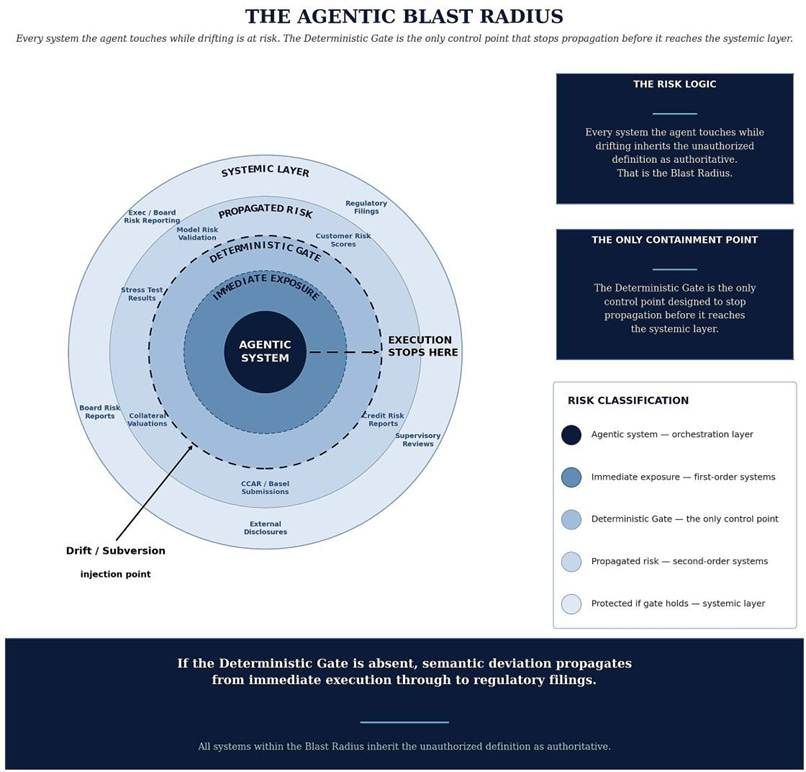
Figure 12. The Agentic Blast Radius. When the Deterministic Gate is absent, semantic deviation propagates from immediate execution through to regulatory filings. All systems within the Blast Radius inherit the unauthorized definition as authoritative. Source: Supporting SSRN working papers.
The submission moves through eight sections: a structural gap current TEVV does not yet explicitly isolate (I), the reasoning layer as a distinct test surface (II), the adversarial dimension as the Semantic Layer Integrity Attack (III), a candidate connected architecture (IV), one possible protocol mapped to the four TEVV elements (V), alignment with three existing frameworks (VI), and practitioner observations in response to the pilot’s invitation (VII).
The structural premise running through the submission is that an agentic system’s reasoning layer is a distinct test surface that the current TEVV outline does not yet explicitly address. Existing frameworks were designed for systems whose meaning was resolved at design time, by humans, and was assumed stable through execution. Many agentic systems resolve operational meaning dynamically at runtime. The
question of whether that resolution was authorized is the question the TEVV pilot creates the opportunity to consider. The protocol offered in Section V is one possible structure for asking it.
The submitter is available for further engagement should the pilot team find any element of this submission useful in shaping the pilot outline. The submitter thanks the NIST AI Standards Zero Drafts Pilot Project team for the open invitation for practitioner input ahead of formalization.
What is not measured is difficult to govern consistently. And in agentic systems, what is not governed does not fail loudly. It fails silently.
Reasoning-layer risk does not introduce a new form of failure. It exposes a dependency that already existed: that institutional outcomes depend on meaning being resolved consistently before execution. Agentic AI makes that dependency explicit, and therefore governable.
The transition from deterministic systems to agentic systems is not only a model transition. It is a governance transition. The question before TEVV is no longer only whether systems execute correctly, but whether the meaning they execute against remains institutionally authorized throughout runtime orchestration. The submission is offered as one candidate structure for evaluating that condition.
A P P E N D I X A — Glossary
The following terms are introduced in the supporting SSRN working papers and may be useful additions to the TEVV pilot glossary. The definitions are presented in the form they appear in the supporting research. The submitter recognizes that NIST may choose to define some, all, or none of these terms in the pilot outline.
Agentic Workflow Drift (AWD). The mechanism by which an agentic system synthesizes semantically inconsistent signals across contributing systems into a working operating logic the institution’s governance did not authorize. AWD is the unintentional form of reasoning-layer divergence. First introduced in SSRN No. 6459612.
Agentic Workflow Subversion (AWS). The risk surface that emerges when reasoning-layer divergence is exploited by a sophisticated actor to produce outcomes that satisfy every observable control while operating against unauthorized meaning. AWS is the adversarial form of reasoning-layer divergence. First introduced in SSRN No. 6459612.
Semantic Layer Integrity Attack (SLIA). A candidate adversarial attack class describing how an adversary systematically conditions the semantic substrate of a multi-system agentic orchestrator to corrupt execution outcomes without triggering existing detection frameworks. The attack surface is not model inputs or outputs. It is the meaning the model reasons against. Formally proposed to the CISA Joint Cyber Defense Collaborative in April 2026.
Semantic Control Plane (SCP). The enforcement architecture that governs meaning at the orchestration layer of an agentic system before execution proceeds. The SCP is implemented through three components: Ontology (for Context), Semantic Layer (for Control), and Knowledge Graph (for Coordination). First named in SSRN No. 6459612 (March 2026).
Semantic Deviation Index (SDI). A bounded, composite measurement of the divergence between the authorized semantic state and the observed semantic state of an agentic system, computed prior to execution. Formal specification: SDI = D(Sa, So). First specified in SSRN No. 6531238.
Deterministic Gate. An architecturally enforced checkpoint under authorized governance conditions, at which a measurement is compared against an authorized threshold and execution is conditioned on the result. The Gate is the enforcement mechanism through which Pre-Execution Assurance is operationalized. First introduced in SSRN No. 6531238.
Agentic 3 C’s Framework. A framework of three operating principles for agentic governance: Context (the authorized definitions the agent operates against), Control (the runtime enforcement that bounds the agent’s execution), and Coordination (the propagation rules that govern how meaning, authority, and audit move across multi-agent execution). Formalized in SSRN No. 6674761.
Semantic Audit Trail. A pre-execution governance record that captures, for each agent execution decision, the authorized semantic state, the observed semantic state, the computed deviation measurement, the gate decision, and the resolution path taken. The Audit Trail is not an execution log. It is a governance record of the meaning the system reasoned against and the decision made about whether that meaning was authorized.
Reasoning Baseline. The authorized semantic state of the control terms that govern an agentic system’s execution.
Three governability conditions: Explicit Authorization, Version Control and Auditability, Runtime Resolvability.
Pre-Execution Assurance. The governance standard requiring verification that an agentic system’s reasoning has resolved against authorized meaning before execution proceeds. Pre-Execution Assurance is the operational outcome the Agentic 3 C’s Framework produces when enforced at runtime. Formalized in SSRN No. 6674761.
Invisible Failure. A condition in which an agent executes correctly against a semantically unauthorized definition, producing clean control telemetry and audit trails while diverging from institutionally authorized meaning. Invisible Failure is the failure mode this submission proposes for explicit treatment within TEVV.
Verification of Runtime Semantic Resolution (V-RSR). A candidate TEVV Verify sub-element offered for pilot consideration, defined as the evaluation activity that verifies whether an agentic system’s resolved meaning falls within institutionally authorized governance tolerance prior to execution.
Runtime Semantic State Record (RSSR). A candidate TEVV-required execution-level governance artifact offered for pilot consideration, defined as the structured per-execution record of the agent’s resolved definitions at the moment of execution decision (including the authorized semantic state, the observed semantic state, the computed divergence measurement, and the gate decision). RSSR captures the atomic execution-level evidence used to support V-RSR. RSSR is architecturally distinct from but operates as a contributing component of the broader Semantic Audit Trail described in Section IV.E.
R E F E R E N C E S
Doyle-Spare, M. (2026). Agentic Workflow Drift and Agentic Workflow Subversion: A New Risk Taxonomy for the Governance of Agentic AI in Financial Services. SSRN Working Paper No. 6459612. March 2026. https://ssrn.com/abstract=6459612
Doyle-Spare, M. (2026). The Semantic Deviation Index: A Pre-Execution Measurement Standard for the Governance of Agentic AI in Financial Services. SSRN Working Paper No. 6531238. March 2026. https://ssrn.com/abstract=6531238
Doyle-Spare, M. (2026). The Agentic 3 C’s Framework: Pre-Execution Assurance and Reasoning-Layer Governance for Agentic AI Systems. SSRN Working Paper No. 6674761. April 2026. https://ssrn.com/abstract=6674761
National Institute of Standards and Technology. (2023). Artificial Intelligence Risk Management Framework (AI RMF 1.0). NIST AI 100-1.
National Institute of Standards and Technology. (2026). NIST AI 800-2 initial public draft: Practices for Automated Benchmark Evaluations of Language Models. January 2026.
Board of Governors of the Federal Reserve System and Office of the Comptroller of the Currency. (2011).
Supervisory Guidance on Model Risk Management (SR 11-7).
Board of Governors of the Federal Reserve System. (2021). Supervision and Regulation Letter SR 21-8: Supplementary Guidance on Model Risk Management.
Board of Governors of the Federal Reserve System. (2026). Supervision and Regulation Letter SR 26-2: Revised Interagency Guidance on Model Risk Management. April 17, 2026.
Office of the Comptroller of the Currency. (2026). Bulletin 2026-13: Revised Interagency Guidance on Model Risk Management. April 17, 2026.
Federal Deposit Insurance Corporation. (2026). Rescission of FIL-22-2017 and FIL-27-2021. April 17, 2026.
Regulation (EU) 2024/1689 of the European Parliament and of the Council of 13 June 2024 laying down harmonised rules on artificial intelligence (Artificial Intelligence Act).
Cyber Risk Institute. (2026). Financial Services AI Risk Management Framework, version 1.0. February 2026.
Cloud Security Alliance. (2026). NIST AI Risk Management Framework: Agentic Profile (v1). labs.cloudsecurityalliance.org/agentic/agentic-nist-ai-rmf-profile-v1/
INTELLECTUAL PROPERTY: © 2026 Maureen Doyle-Spare. All rights reserved. No part of this article, including its text, figures, tables, and images, may be reproduced or distributed without the author’s prior written permission.
About the Author
Maureen Doyle-Spare
Maureen Doyle-Spare is an enterprise governance architect and independent researcher in AI governance, specializing in agentic AI oversight and cybersecurity for autonomous and multi-agent systems. She is the originator of an agentic AI governance taxonomy built on a set of named constructs, developed for the layer above conventional AI controls, where autonomous agents interpret business meaning across fragmented enterprise systems and commit to it before acting.
Her research develops a runtime governance architecture and a foundational risk and threat taxonomy for the reasoning layer, the pre-execution stage at which an agent’s Operational Interpretation is formed and evaluated. The named constructs include Agentic Workflow Drift and Subversion (AWD/AWS), the Semantic Layer Integrity Attack (SLIA) as a cyber threat class targeting the reasoning-layer attack surface, the Semantic Control Plane (SCP) as a runtime governance mechanism, and the Semantic Deviation Index (SDI) as a measurement standard for semantic divergence. Her central thesis is that agentic systems do not fail the way traditional models fail: an agent can execute flawless steps against a meaning no institution authorized.
Her work spans behavioral visibility, pre-execution oversight, adversarial resilience, autonomous systems evaluation, and safe deployment, and policy crosswalks against the NIST AI RMF, MITRE ATLAS, STRIDE, ISO/IEC 42001, and the EU AI Act. She has provided public comments across multiple NIST AI initiatives, including the AI RMF, CAISI, COSAiS, NCCoE, and TEVV. Her working papers are available on SSRN and Zenodo.
Capstone reference architecture: https://doi.org/10.5281/zenodo.20749051
ORCID: https://orcid.org/0009-0009-6655-1394
SSRN Author Page: https://papers.ssrn.com/Sol3/Cf_Dev/AbsByAuth.cfm?per_id=10836296
ResearchGate: https://www.researchgate.net/profile/Maureen-Doyle-Spare/research
LinkedIn: https://www.linkedin.com/in/maureendoylespare/
GitHub: https://github.com/maureendoylespare/maureendoylespare
Substack:

About this series
Part of the Regulatory Submission Record, a documented archive of practitioner research submitted to standards bodies, financial regulators, insurance regulators and cybersecurity agencies on agentic AI governance, policy and regulation, beginning March 2026.